
Opening Scene
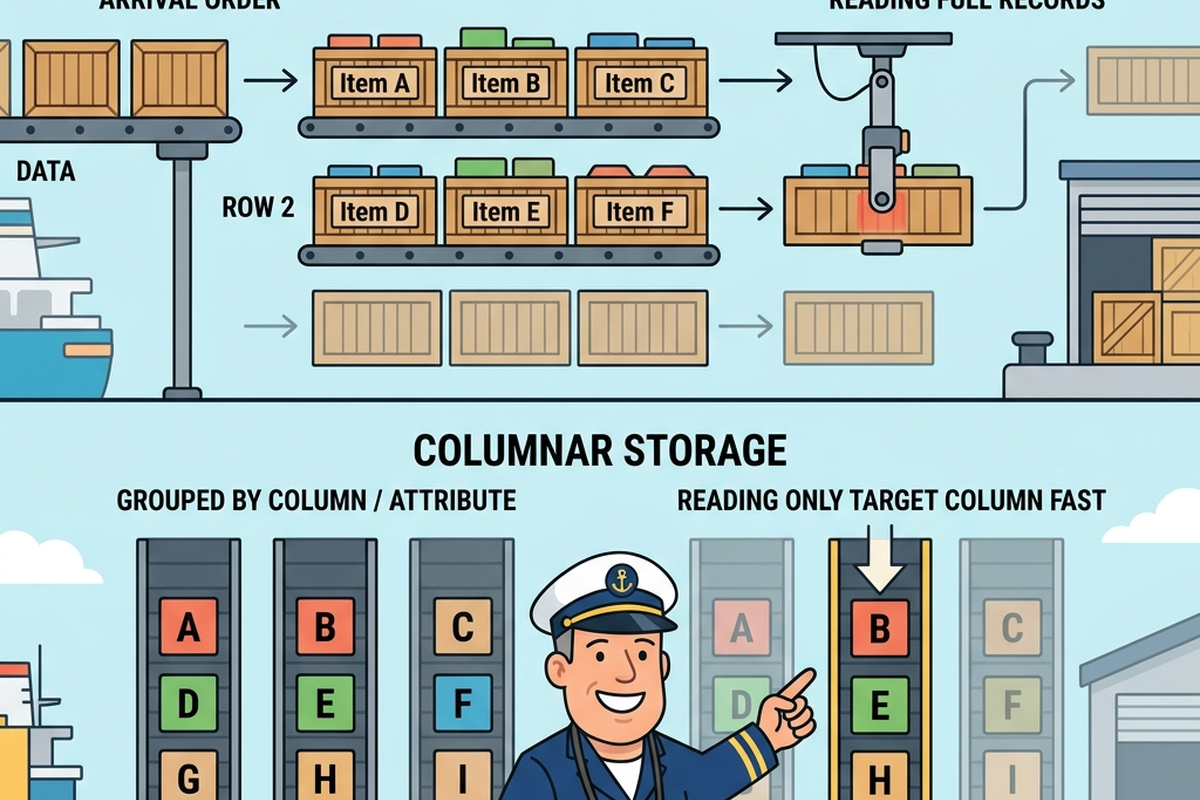
Imagine a container yard organized purely by arrival time — row after row, each container wherever it happened to land the day it came off a ship. Now imagine you need every container holding refrigerated produce, out of ten thousand containers on the lot. Organized by arrival order, you’d have to check every single row. Organized by contents instead — all the refrigerated containers grouped together, regardless of when they arrived — you’d walk straight to one section and be done.
That’s the difference between row-based and columnar data storage, and it’s one of the most consequential decisions in how a warehouse or lakehouse actually performs.
In Plain English
Row-based storage keeps each record’s full contents together, the way arrival-order stacking keeps everything about one container in one place. It’s efficient when you need entire records at once. Columnar storage groups each individual field together across all records — the way contents-based organization groups all refrigerated containers together regardless of arrival date. It’s dramatically faster for analytical queries that scan one or two specific fields across millions of records, which is most of what warehouse and lakehouse queries actually do.
The Old Way
Early database systems were almost universally row-based, because they were originally built for transactional workloads — processing one order, one customer record, one transaction at a time, where you genuinely want the whole record together. That made complete sense for its original purpose.
Analytical queries are a fundamentally different access pattern: “what’s the average order value across a million transactions” only needs one or two fields from each record, not the whole thing. Running that kind of query against row-based storage means reading far more data than the question actually requires — scanning full records just to pull out one field from each, the yard-wide search for refrigerated containers organized by arrival date instead of contents.
What’s Changing (and Why AI Is the Reason)
- Columnar storage became the analytical default, and stayed there. Modern warehouses and lakehouses overwhelmingly use columnar storage formats specifically because analytical query patterns benefit so dramatically — this is one of the more settled architectural decisions covered in this series, not an emerging trend.
- AI workloads have their own access patterns, and platforms are adapting. Training and embedding-generation workloads sometimes need different access patterns than traditional BI queries — modern platforms increasingly support hybrid or workload-aware storage strategies rather than forcing every use case through the same columnar assumptions.
- AI-assisted query optimization increasingly picks the right strategy automatically. Rather than requiring an engineer to manually understand and choose storage layout for every table, AI-assisted platform tooling is getting better at recommending or automatically applying the layout that suits actual observed query patterns.
The Metaphor, Fully Extended
| Harbor Element | Storage Concept |
|---|---|
| A yard organized by arrival order | Row-based storage |
| A yard organized by cargo contents | Columnar storage |
| Searching every row for refrigerated containers | Scanning full records to extract one field |
| Walking straight to the refrigerated section | Scanning just the needed column across all records |
| A yard planner recommending reorganization based on what gets searched for most | AI-assisted storage layout optimization |
For Beginners: What to Actually Do
- Get concrete, hands-on intuition for the difference by running the same analytical query against a row-based and a columnar version of similar data, if you have access to try it — the performance gap is far more convincing felt than described.
- Learn to recognize analytical query patterns (aggregations, filtering on a few columns across many rows) versus transactional ones (fetching or updating one whole record) — that distinction is the entire reason this choice matters.
- Don’t assume every table in a modern platform needs the same storage strategy. Ask what a given table is actually used for before assuming columnar is automatically correct.
- Trust, but verify, AI-assisted storage recommendations early on — check that the suggested layout actually matches how the data is queried in practice, not just how it’s structured.
For Practitioners and Leaders: The Deeper Layer
- If any part of your platform still runs analytical workloads against row-based storage inherited from a transactional system, quantify the actual performance cost — it’s often larger and more fixable than teams assume.
- Storage layout decisions compound: a poor choice made early tends to get load-bearing as more queries and dashboards get built against it, making it progressively more expensive to revisit later.
- As AI training and embedding workloads grow alongside traditional BI, make sure your platform’s storage strategy decisions explicitly account for both access patterns rather than optimizing purely for legacy BI query shapes.
- Treat AI-assisted layout optimization as a genuinely useful recommendation engine, but keep a human reviewing its suggestions against actual business-critical query paths before applying changes broadly.
Quick Recap
- Row-based storage keeps whole records together; columnar storage groups individual fields together across records — and columnar dramatically speeds up the kind of queries most analytical work actually runs.
- This is why modern warehouses and lakehouses default to columnar storage for analytical workloads.
- AI training workloads sometimes need different access patterns, pushing platforms toward hybrid, workload-aware storage strategies.
- AI-assisted tooling is increasingly recommending or automatically applying the right storage layout based on real query patterns.
Where This Fits in the Series
Article 6 covered when to label cargo. This article covered how cargo gets physically organized once labeled. Article 8 goes one level further, into how that organization gets divided into zones for even faster retrieval.
Key References
- Databricks Lakehouse Architecture — Official reference guide on combining data warehouse performance with lake flexibility.
- Apache Iceberg Table Format Specification — Open-source table format standard for huge analytic datasets.
- Delta Lake Open Source Project — Open-source storage layer that brings ACID transactions to Apache Spark and big data workloads.
Subscribe to the Newsletter
Get the latest DataParables articles delivered straight to your inbox.