
Opening Scene
A dockworker faces the same decision hundreds of times a day: label this crate now, while it’s fresh off the ship and easy to inspect, or leave it for whoever eventually comes looking for it. Label now, and you pay the cost upfront, every time, whether or not anyone ever needs that specific crate. Label later, and you save that cost — but only if you can actually find the right crate when someone finally does come looking, which depends entirely on how well the wharf is organized in the meantime.
Articles 2 and 3 introduced schema-on-write and schema-on-read separately. This article puts them side by side and asks the question practitioners actually have to answer: which one, when?
In Plain English
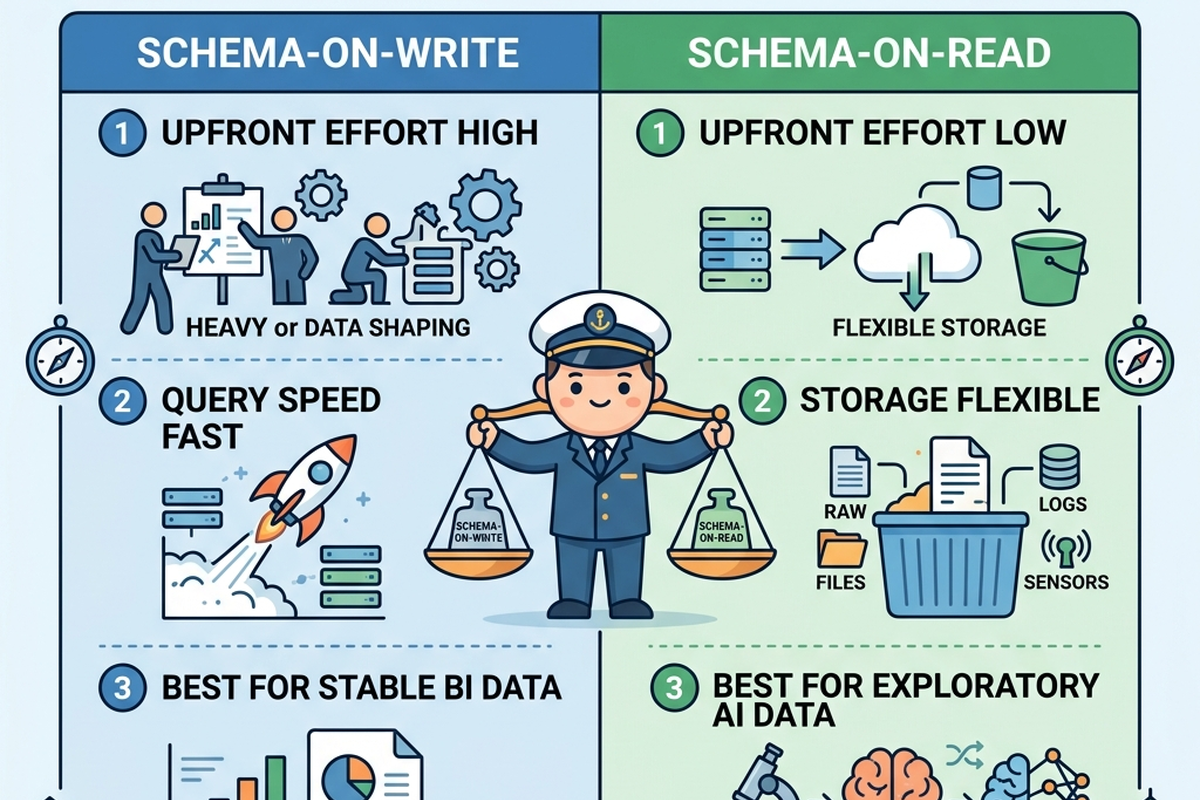
Schema-on-write validates and structures data before it’s stored — labeling now. Schema-on-read stores data as-is and applies structure only when it’s queried — labeling later. Neither is strictly better; they trade upfront cost for deferred flexibility in opposite directions, and the right choice depends heavily on how predictable your data’s shape is and how often it actually gets used.
The Old Way
Historically this wasn’t really a choice at all — it was a consequence of which system you’d already committed to. Choose a warehouse, and you got schema-on-write, full stop. Choose a lake, and you got schema-on-read, full stop. Organizations often ended up with whichever approach matched their first major platform decision, rather than choosing deliberately based on the actual shape and use pattern of a given dataset.
That’s a meaningfully worse situation than it sounds, because different data genuinely suits different approaches. Stable, well-understood, heavily-queried data — the kind that rarely changes shape and gets read constantly — benefits enormously from schema-on-write’s upfront validation. Exploratory, rarely-queried, or fast-changing data often loses more from forced upfront structure than it gains, and suits schema-on-read far better. A single organization-wide default served neither case well.
What’s Changing (and Why AI Is the Reason)
- Lakehouse architecture makes this a per-dataset decision, not a platform-wide one. Because a lakehouse (Article 4) can offer both modes over the same underlying storage, teams can genuinely choose schema-on-write or schema-on-read based on a specific dataset’s actual characteristics, rather than inheriting whatever their platform happened to default to.
- AI is narrowing the practical gap between the two. Schema-on-read query engines are getting meaningfully better at inferring reliable structure on the fly, and AI-assisted schema design (Article 2) is making schema-on-write’s upfront cost cheaper to pay — softening, though not eliminating, the trade-off.
- AI workloads themselves often want schema-on-read. Exploratory AI training and experimentation frequently benefits from working with raw, unstructured data before anyone has committed to a final shape — making schema-on-read newly relevant even for teams that have historically defaulted to warehouse-style rigor.
The Metaphor, Fully Extended
| Harbor Element | Schema Concept |
|---|---|
| Filling out the manifest before stacking the crate | Schema-on-write |
| Leaving the crate unlabeled until someone comes looking | Schema-on-read |
| A dockworker deciding case-by-case, crate-by-crate | Choosing schema-on-write or schema-on-read per dataset |
| One depot-wide policy applied to every shipment regardless of type | A platform-wide default applied uniformly, regardless of fit |
| A wharf where any crate can get a manifest filled out on demand, fast | Query engines that infer reliable structure quickly at read time |
For Beginners: What to Actually Do
- For any new dataset, ask two concrete questions before choosing an approach: how stable is its shape, and how often will it actually be queried? Those two answers point strongly toward one approach or the other.
- Resist the urge to apply whatever your team defaults to out of habit. Practice justifying the choice explicitly, even on small datasets, to build the judgment for when it matters more.
- Get real hands-on experience with schema-on-read query performance versus schema-on-write. The practical difference is far more concrete once you’ve felt it firsthand than any explanation can convey.
- Understand that a lakehouse offering “both” doesn’t mean the choice stops mattering — it means you now have to actually make it deliberately, dataset by dataset.
For Practitioners and Leaders: The Deeper Layer
- Audit whether your organization’s schema-on-write versus schema-on-read choices are actually deliberate, dataset-by-dataset decisions, or simply inherited defaults from whichever platform came first. The latter is a common, quietly expensive pattern.
- The cost of schema-on-write isn’t just the initial design effort — it’s every future change to that schema. Weigh both when deciding, not just the upfront design cost Article 2 described.
- The cost of schema-on-read isn’t just query-time inference overhead — it’s the discoverability risk from Article 3 if metadata discipline is weak. Weigh both, not just the deferred flexibility.
- As lakehouse platforms make this a genuine per-dataset choice, build institutional guidance for your teams on how to make it well — without that, “either is technically possible” quietly becomes “nobody decides deliberately,” reproducing the old problem in a new architecture.
Quick Recap
- Schema-on-write labels data before storage; schema-on-read labels it at query time — neither is universally better, and the right choice depends on a dataset’s stability and how often it’s actually queried.
- Historically, this wasn’t a real choice — it was a consequence of committing to a warehouse or a lake as your only platform.
- Lakehouse architecture makes this a genuine per-dataset decision, and AI is narrowing the practical performance gap between the two approaches.
- Organizations should build deliberate guidance for making this choice well, rather than letting it default to whatever a team happens to be used to.
Where This Fits in the Series
Article 5 introduced the three cargo shapes. This article revisited the write-versus-read schema question from Articles 2 and 3 as a deliberate, per-dataset decision. Article 7 moves from how data is labeled to how it’s physically arranged for fast retrieval.
Key References
- Databricks Lakehouse Architecture — Official reference guide on combining data warehouse performance with lake flexibility.
- Apache Iceberg Table Format Specification — Open-source table format standard for huge analytic datasets.
- Delta Lake Open Source Project — Open-source storage layer that brings ACID transactions to Apache Spark and big data workloads.
Subscribe to the Newsletter
Get the latest DataParables articles delivered straight to your inbox.