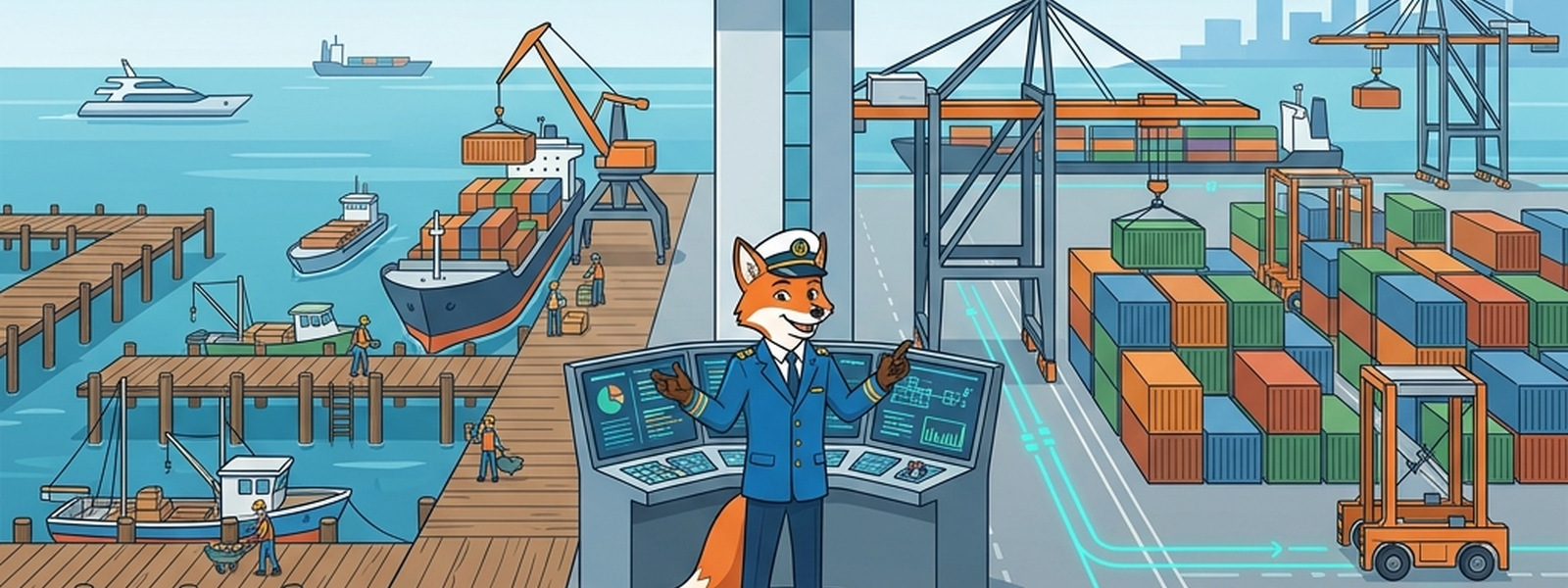
Opening Scene
Walk the length of a genuinely modern port and the line between “depot” and “wharf” starts to blur. Cargo comes in raw at the wharf, but the same cranes, the same yard management system, and increasingly the same ledger track it whether it’s sitting unsorted or fully manifested. A shipment can move from raw and unsorted to structured and catalogued without ever leaving the port or being handed off to some entirely separate facility across town.
That’s a lakehouse: not a warehouse and a lake bolted together with a pipe between them, but one port running both operations as a genuinely unified system.
In Plain English
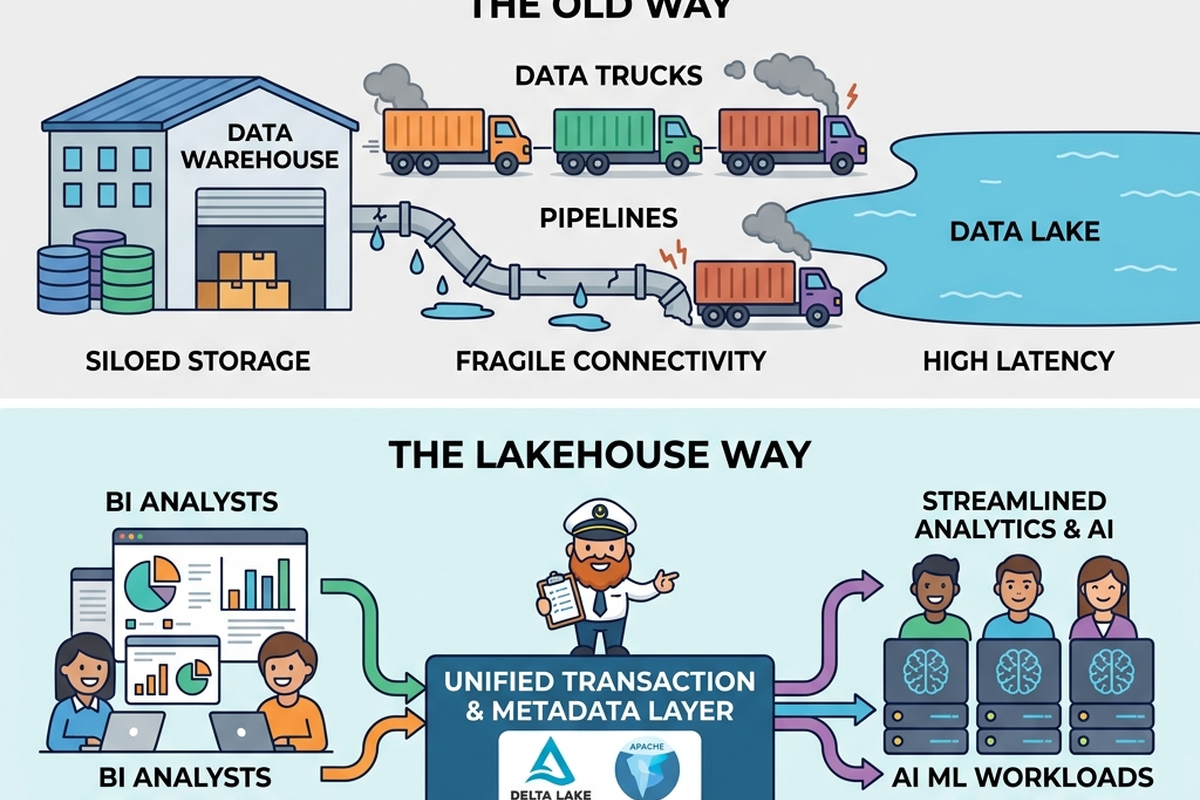
A lakehouse combines the low-cost, flexible raw storage of a data lake with the structure, reliability, and performance guarantees traditionally only available in a data warehouse. It does this by adding a structured metadata and transaction layer on top of lake storage — letting the same underlying data be queried with warehouse-like reliability when structure is needed, and lake-like flexibility when it isn’t, without physically duplicating the data between two separate systems.
The Old Way
Before lakehouse architecture matured, organizations that needed both warehouse-style reliability and lake-style flexibility typically ran two entirely separate systems, connected by pipelines that copied and transformed data from the lake into the warehouse. This worked, but at a real cost: data duplication, pipeline complexity, and a persistent lag between “the lake has it” and “the warehouse has it too” — the exact seams Article 1 gestured at with “two docks, two separate operations awkwardly connected by a bridge.”
That lag mattered more than it might sound. Analysts querying the warehouse were often working with data that was hours or days behind what had already landed in the lake, and every new use case that needed both structured reliability and raw flexibility meant building yet another bridge between the two systems, each with its own failure modes to monitor and maintain.
What’s Changing (and Why AI Is the Reason)
- The transaction layer is what actually makes “one port” real, not just a marketing claim. Table formats that bring ACID transaction guarantees to lake storage — covered in depth in Article 10 — are the specific technology that lets a lakehouse offer warehouse-grade reliability without a separate warehouse system underneath it.
- AI workloads are a major reason “one port” matters now. Traditional BI wants structured, warehouse-style tables. AI training and retrieval workloads often want raw, lake-style access to the same underlying data. A lakehouse lets both draw from a single source of truth instead of two systems that can drift out of sync.
- AI is helping manage the added complexity of a unified system. A lakehouse’s metadata and transaction layer is genuinely more sophisticated than either a plain warehouse or a plain lake alone — AI-assisted tooling is increasingly handling optimization tasks (Article 11’s elastic compute, Article 12’s cataloging) that would otherwise require deep specialist expertise to manage well.
The Metaphor, Fully Extended
| Harbor Element | Lakehouse Concept |
|---|---|
| A modern port running the depot and wharf as one operation | A lakehouse |
| Two separate facilities connected by a truck route | Separate warehouse and lake systems bridged by pipelines |
| Cargo lagging behind while trucked between facilities | Data staleness between a lake and a warehouse copy |
| One shared ledger tracking cargo across the whole port | A transaction layer providing consistency across the lakehouse |
| A single yard management system, however cargo arrived | Unified metadata and query access over raw and structured data |
For Beginners: What to Actually Do
- Before assuming you need a lakehouse, get genuinely comfortable with warehouses and lakes separately (Articles 2 and 3) — the value of “both together” is much clearer once you understand what each side actually offers alone.
- When you encounter a lakehouse platform, look specifically for its transaction/table-format layer (previewed here, detailed in Article 10) — that’s the actual innovation, not just “a lake with a warehouse-sounding name.”
- Ask what problem a lakehouse is solving in any specific setup you encounter: eliminating duplicate copies, reducing pipeline lag, or something else. The honest answer is usually more specific than “it’s the modern approach.”
- Notice that a lakehouse doesn’t eliminate the warehouse-versus-lake distinction from Articles 2 and 3 — it lets both modes coexist over the same data, which is a different thing than making the distinction disappear.
For Practitioners and Leaders: The Deeper Layer
- The real ROI case for a lakehouse is usually eliminating duplicate storage and the staleness/complexity of bridging pipelines, not simply “unifying tools” for its own sake — quantify that saving explicitly before treating a lakehouse migration as self-evidently worth it.
- A lakehouse’s added sophistication is real, and so is the operational maturity needed to run one well. Evaluate your team’s readiness honestly, not just the platform’s feature list.
- As AI workloads increasingly need both structured and raw access to the same data, a lakehouse architecture directly reduces the risk of your AI initiatives quietly drifting from what your BI and reporting layer considers the source of truth.
- Migrating an existing warehouse-plus-lake setup into a lakehouse is a significant undertaking (covered fully in Article 18) — this article’s “one port” framing is the destination, not a description of how easy the journey there is.
Quick Recap
- A lakehouse combines lake-style low-cost, flexible raw storage with warehouse-style structure and reliability, over one underlying copy of the data.
- The old alternative — separate warehouse and lake systems bridged by pipelines — created data duplication, complexity, and staleness.
- A transaction/table-format layer over lake storage is the specific technology that makes lakehouse reliability real, detailed later in this series.
- AI workloads are a major driver of lakehouse adoption, since they often need both structured and raw access to the same underlying data.
Where This Fits in the Series
Articles 2 and 3 covered the depot and the wharf separately. This article showed them running as one port. The next several articles zoom into specific mechanics of how a lakehouse actually works, starting with the cargo itself.
Key References
- Databricks Lakehouse Architecture — Official reference guide on combining data warehouse performance with lake flexibility.
- Apache Iceberg Table Format Specification — Open-source table format standard for huge analytic datasets.
- Delta Lake Open Source Project — Open-source storage layer that brings ACID transactions to Apache Spark and big data workloads.
Subscribe to the Newsletter
Get the latest DataParables articles delivered straight to your inbox.