Opening Scene
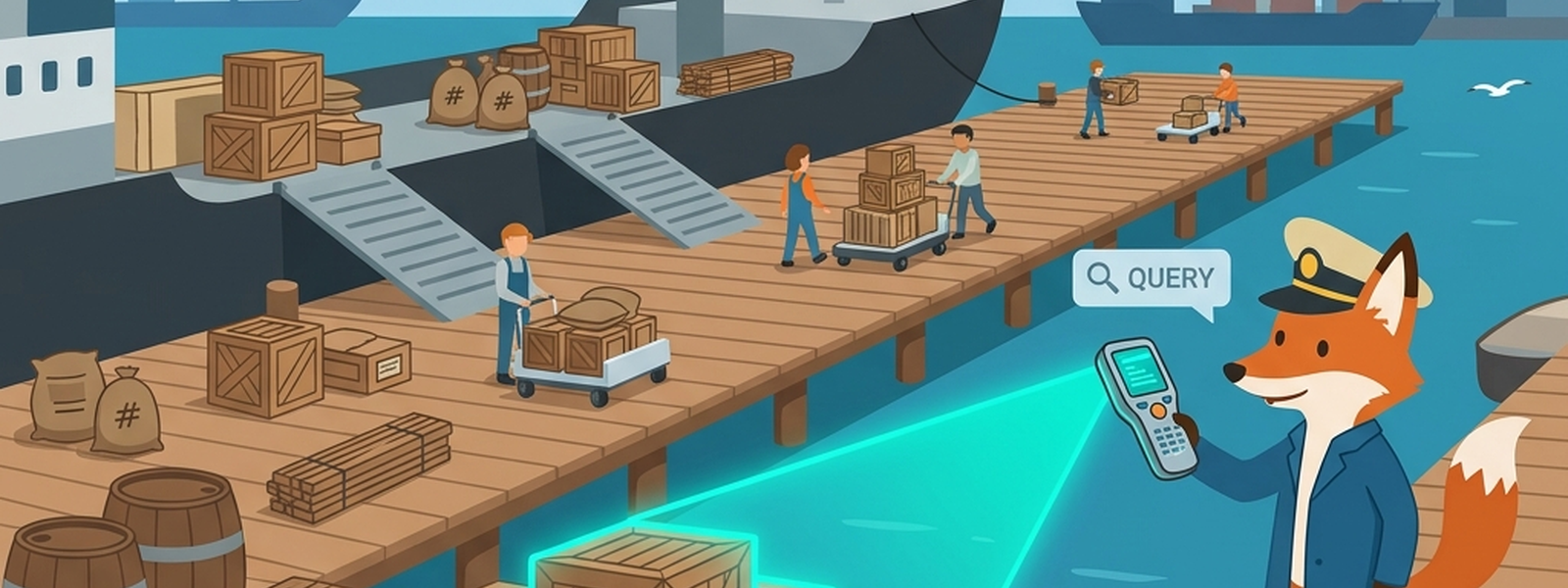
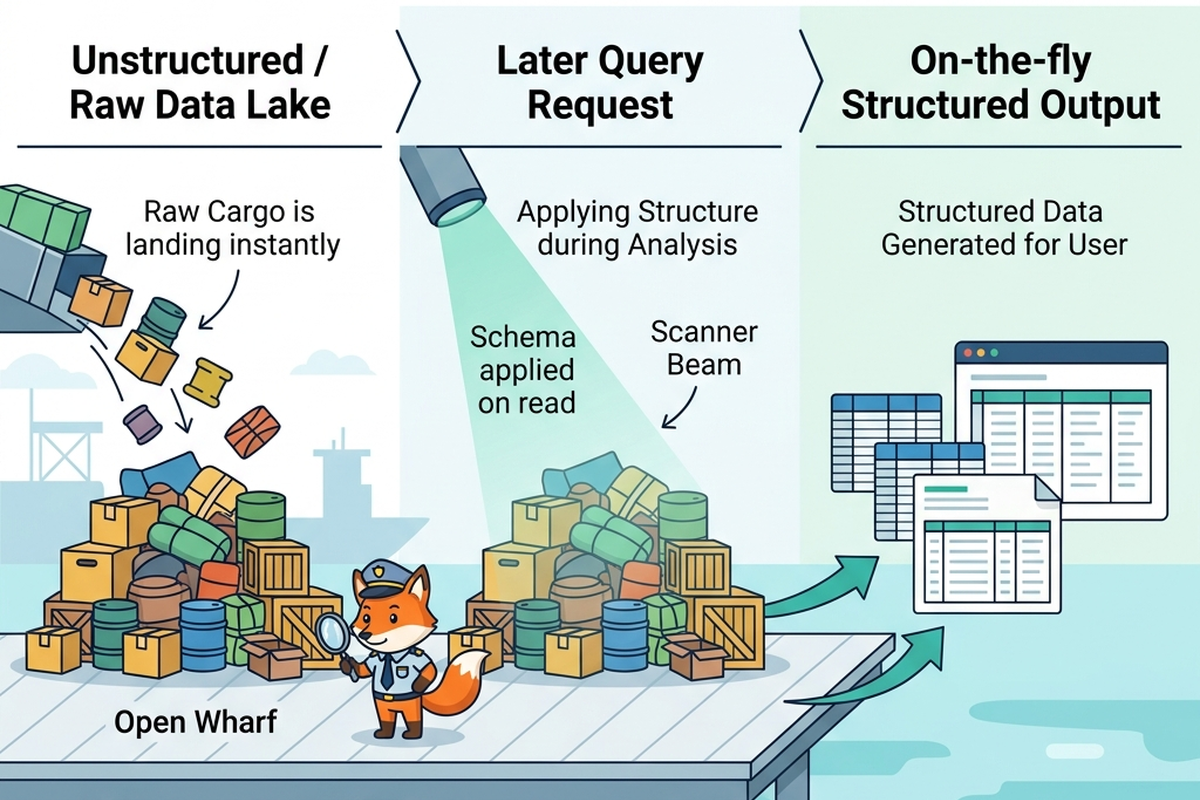
At the open wharf, nothing waits for paperwork. A ship pulls up, cargo comes off, and it lands on the dock — sorted or not, labeled or not, whatever form it arrived in. Nobody stops the unloading to fill out a manifest first. That’s the entire point: get everything off the ship fast and cheap, and figure out what to do with it later, if and when someone actually needs a specific crate.
This is a data lake, and it’s a genuinely different philosophy from the depot next door, not a sloppier version of it.
In Plain English
A data lake stores data in its raw, original form — structured, semi-structured, or completely unstructured — without requiring a predefined schema before it’s loaded. Structure gets applied later, at the moment someone actually queries or processes the data, an approach called schema-on-read. This is the mirror image of the warehouse’s schema-on-write discipline from the previous article.
The Old Way
Before data lakes became practical, “raw, unsorted data” mostly wasn’t stored at all — if it didn’t fit a warehouse’s schema, it usually got discarded, because storage was too expensive to keep data around “just in case.” Data lakes became viable once storage costs dropped enough that keeping everything, unsorted, was no longer a wasteful luxury.
That shift unlocked real value: data that would have been thrown away — logs, documents, sensor readings, anything that didn’t map cleanly to rows and columns — could now be kept and mined later for questions nobody had thought to ask yet. But it came with a well-known failure mode. Without real discipline about naming, organizing, and documenting what actually landed on the wharf, a lake could quietly become a swamp: technically stored, practically unfindable, cargo nobody remembered dropping off or could confidently identify months later.
What’s Changing (and Why AI Is the Reason)
- AI is doing the sorting the wharf never used to get. Rather than depending entirely on humans to label and organize what’s dropped off, AI-assisted cataloging tools can now inspect raw files, infer likely structure and content, and generate usable metadata automatically — directly addressing the swamp problem this approach has always struggled with.
- Schema-on-read is getting genuinely smarter, not just more permissive. Modern query engines increasingly infer a reasonable structure from raw data at query time with real sophistication, narrowing the gap between “what a lake can offer immediately” and “what a warehouse offers after months of upfront design.”
- Raw, unstructured cargo has a new reason to matter. Documents, logs, and other unstructured content sitting in a lake are exactly the kind of raw material AI systems — particularly the RAG pipelines this series’ companion topic on pipelines covered — need directly, giving previously low-value “just in case” cargo a very concrete new purpose.
The Metaphor, Fully Extended
| Harbor Element | Data Lake Concept |
|---|---|
| The open wharf | A data lake |
| Cargo unloaded without a manifest | Data stored without a predefined schema |
| Filling out the manifest only once someone needs the crate | Schema-on-read |
| Cheap, fast unloading with no sorting required | Low-cost storage for raw data at scale |
| A wharf full of forgotten, unlabeled crates | A data swamp |
| A dockworker who can identify unlabeled cargo by inspection | AI-assisted cataloging of raw data |
| A crate of loose parts an engineer later needs urgently | Unstructured content later needed for an AI system |
For Beginners: What to Actually Do
- Don’t treat “data lake” as shorthand for “messy data.” A well-run lake has real organization — it’s just applied later than a warehouse’s, not absent.
- When exploring a lake for the first time, check what cataloging or metadata tooling is available before trying to manually make sense of raw files yourself.
- Get hands-on with the idea of schema-on-read: query the same raw file two different ways and notice how the structure you impose at query time changes what you get back.
- Ask, for any lake you work with, “what happens to data nobody’s queried in a year?” The answer tells you a lot about whether it’s a lake or a swamp in practice.
For Practitioners and Leaders: The Deeper Layer
- The lake-versus-swamp distinction is almost entirely about metadata discipline, not storage technology — invest there deliberately rather than assuming the platform alone will prevent it.
- AI-assisted cataloging meaningfully lowers the cost of good organization, but someone still needs to own the decision of what “well organized” means for your specific lake — AI can execute a standard, not invent one from nothing.
- As raw, unstructured content becomes valuable AI training and retrieval material, revisit any “delete after N days” retention policies set back when that content had no obvious downstream use.
- Track query patterns against your lake over time. Content nobody ever queries is a signal worth investigating — either it’s genuinely unneeded, or it’s undiscoverable, and those call for very different fixes.
Quick Recap
- A data lake stores raw data in any form without requiring a predefined schema — schema-on-read, applied at query time rather than load time.
- This flexibility unlocked value from data that would previously have been discarded, at the real risk of becoming an unusable “data swamp” without discipline.
- AI-assisted cataloging is directly addressing the swamp problem by inferring structure and metadata automatically from raw content.
- Unstructured content sitting in a lake has renewed value as raw material for AI systems, particularly RAG pipelines.
Where This Fits in the Series
Article 2 covered the container depot’s upfront discipline. This article covered the open wharf’s deferred one. Article 4 walks the whole port at once, showing how a lakehouse runs both operations as a single integrated system.
Key References
- Databricks Lakehouse Architecture — Official reference guide on combining data warehouse performance with lake flexibility.
- Apache Iceberg Table Format Specification — Open-source table format standard for huge analytic datasets.
- Delta Lake Open Source Project — Open-source storage layer that brings ACID transactions to Apache Spark and big data workloads.
Subscribe to the Newsletter
Get the latest DataParables articles delivered straight to your inbox.