Opening Scene
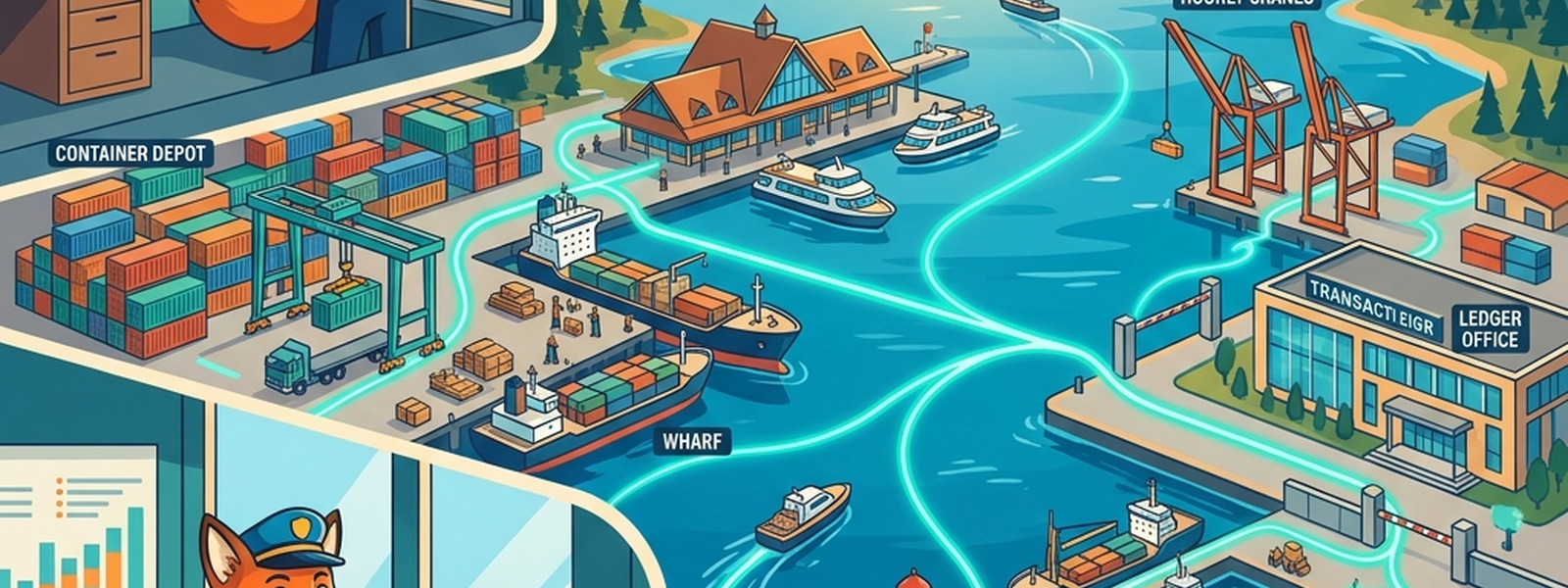
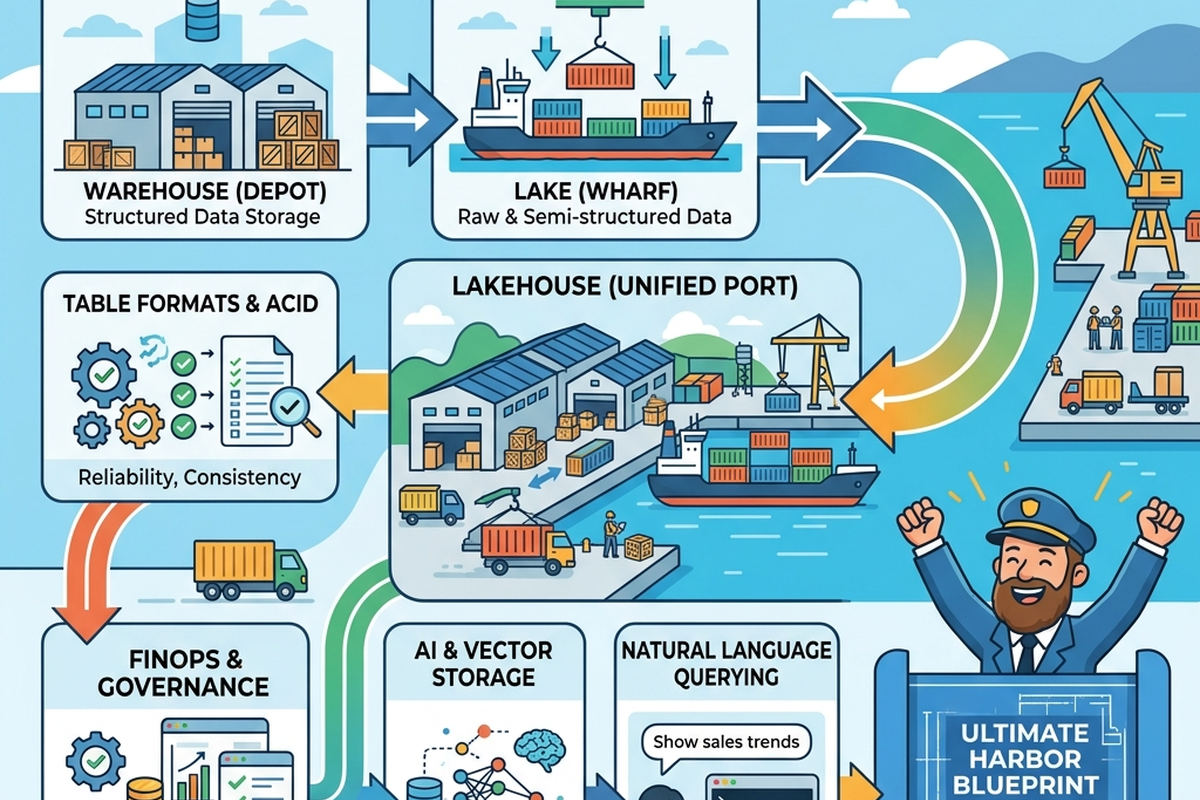
Stand at the harbormaster’s tower and look out over the whole port at once. The container depot runs its precise, manifested operation on one side. The open wharf takes in raw cargo on the other. Between them, an integrated terminal moves data-cargo fluidly across both modes, tracked by a single reliable ledger, zoned and sorted for fast retrieval, catalogued so anyone can find what they need, gated so only the right people reach it, and increasingly staffed by a harbormaster who can answer a plain question directly, or hand a query straight to an AI agent that already knows exactly where to look. Ships carrying an entirely new kind of cargo — vectors, embeddings — now dock alongside the traditional ones, in a section built specifically for them.
That’s the harbor this series has built, one dock at a time, since Article 1.
In Plain English
This final article doesn’t introduce a new concept — it’s a deliberate walk back through everything the series has covered, reassembled as one connected system. The point is simple: every piece of good lakehouse architecture, from schema design to migration strategy, exists to answer one question well — can the right person, or the right AI system, get the right data, in the right form, fast enough to actually use it.
The Old Way
The “old way,” across this entire series, was consistent: a hard choice between structure and flexibility, warehouse or lake, paid for either in rigidity or risk, with the two systems, when both existed, bridged by fragile pipelines rather than genuinely unified. None of that history has become irrelevant — every “new way” this series covered was built on top of those original trade-offs, not as a dismissal of them. The container depot’s manifest discipline from Article 2 still matters inside a lakehouse. The open wharf’s flexibility from Article 3 still matters too. The throughline across all twenty articles has been integration and augmentation, not replacement of what came before.
What’s Changing (and Why AI Is the Reason): The Series, Recapped
- Structure and flexibility stopped being an either-or choice. From the warehouse-versus-lake split in Articles 2 and 3 to the unified lakehouse in Article 4, and the deliberate per-dataset schema choice in Article 6, this series traced how “both, chosen deliberately” became a genuinely practical answer, not just an aspiration.
- The physical and organizational machinery matured together. Storage layout (Article 7), zoning (Article 8), file formats (Article 9), and the transactional ledger (Article 10) gave lake storage the reliability a warehouse always had; cataloging (Article 12) and access control (Article 13) gave it the discoverability and governance a growing platform genuinely needs.
- The harbor gained new kinds of cargo and new kinds of visitors. Vector embeddings (Article 16) and streaming cargo (Article 17) are genuinely new additions AI made necessary. Natural-language querying (Article 15) and AI agents querying directly are genuinely new visitors, changing who interacts with a lakehouse and how, not just what’s stored inside it.
The Metaphor, Fully Extended: The Whole Harbor
| Harbor Element | Series Article & Core Lesson |
|---|---|
| Two docks, seen from the water | Article 1 — Warehouse, lake, and lakehouse, the whole overview |
| The container depot’s manifest | Article 2 — Schema-on-write |
| The open wharf | Article 3 — Schema-on-read |
| One integrated port | Article 4 — Lakehouse architecture |
| Crates, barrels, and loose cargo | Article 5 — Structured, semi-structured, unstructured data |
| Label now or label later | Article 6 — Choosing schema-on-write vs. read deliberately |
| Sorting by contents, not arrival | Article 7 — Columnar vs. row storage |
| Zoning the yard | Article 8 — Partitioning and clustering |
| Which crate are we using | Article 9 — Open file formats |
| A ledger for the open wharf | Article 10 — Table formats and ACID guarantees |
| Cranes rented by the hour | Article 11 — Compute-storage separation |
| The port’s master directory | Article 12 — Data cataloging |
| Who’s allowed on the dock | Article 13 — Access control and governance |
| Paying by the container or the ton | Article 14 — Storage and compute cost models |
| Asking the harbormaster | Article 15 — Natural-language querying |
| A new kind of cargo | Article 16 — Vector embeddings |
| Ships that don’t wait to dock | Article 17 — Streaming ingestion |
| Relocating the whole port | Article 18 — Migration strategy |
| Which dock your cargo needs | Article 19 — A practical decision framework |
| The whole harbor, working as one | Article 20 — Every piece, reassembled as one connected whole |
For Beginners: What to Actually Do
- If you’re new to this space, treat Articles 2 through 4 as the essential foundation — the warehouse/lake/lakehouse distinction underlies almost everything else this series covered.
- Revisit any article covering a concept you use regularly at work, and practice re-explaining its metaphor in your own words. That’s a genuine test of whether it’s actually landed, not just been read.
- Get comfortable with the idea that this is a fast-moving area, particularly around vector storage (Article 16) and AI-assisted tooling generally — treat what you’ve learned as a strong foundation, not a finished, static picture.
- Don’t let “AI can query this for me now” (Article 15) become a reason to skip understanding the architecture underneath. Every article in this series showed AI accelerating a process that still depends on someone able to judge whether the underlying structure, and the resulting answer, are actually sound.
For Practitioners and Leaders: The Deeper Layer
- Audit your own platform against this series’ throughline: where does your organization still treat warehouse-versus-lake as an inherited default (Article 6) rather than a deliberate, workload-by-workload decision (Article 19)?
- The recurring theme of new AI-driven visitors to the harbor — agents querying directly, natural-language users, training pipelines demanding elastic compute — deserves a coordinated response across governance, cost, and architecture, not isolated fixes wherever each first shows up.
- Consider where your organization still treats the reliability disciplines covered in Articles 8 through 13 as optional extras rather than baseline infrastructure. AI-assisted tooling makes all of them cheaper to implement well; there’s less excuse than there used to be to defer them.
- The most durable skill for a data professional going forward isn’t memorizing any single platform’s current feature set — it’s the judgment to match architecture to actual need (Article 19), and to know what an AI-generated schema, query, or recommendation doesn’t yet know about your specific data and your specific business. That judgment is what every article in this series, in different language, has ultimately been about.
Quick Recap
- This series treated warehouses, lakes, and lakehouses as a working harbor — different docks suited to different cargo, increasingly integrated into one connected port.
- Across twenty articles, AI consistently accelerated schema design, cataloging, querying, and migration, but never replaced the human judgment needed to match architecture to actual need.
- A clear throughline: lakehouses increasingly serve AI systems and AI agents directly, not just human analysts, raising the stakes on structure, governance, and freshness rather than lowering them.
- The disciplines covered — schema design, storage layout, file and table formats, elastic compute, cataloging, governance, cost management, natural-language access, vector storage, streaming, and migration — combine into one connected practice, not eleven separate ones.
- The most durable skill going forward is judgment: knowing which dock your cargo actually needs, and what an AI-generated recommendation doesn’t yet know about your business.
Where This Fits in the Series
This article closes the loop opened in Article 1, reassembling every dock covered since as one working harbor. There’s no next article to point toward within this topic — but every concept covered here remains a living discipline, not a finished one, as lakehouse technology and AI-assisted tooling continue to evolve.
Key References
- Databricks Lakehouse Architecture — Official reference guide on combining data warehouse performance with lake flexibility.
- Apache Iceberg Table Format Specification — Open-source table format standard for huge analytic datasets.
- Delta Lake Open Source Project — Open-source storage layer that brings ACID transactions to Apache Spark and big data workloads.
Subscribe to the Newsletter
Get the latest DataParables articles delivered straight to your inbox.