
Opening Scene
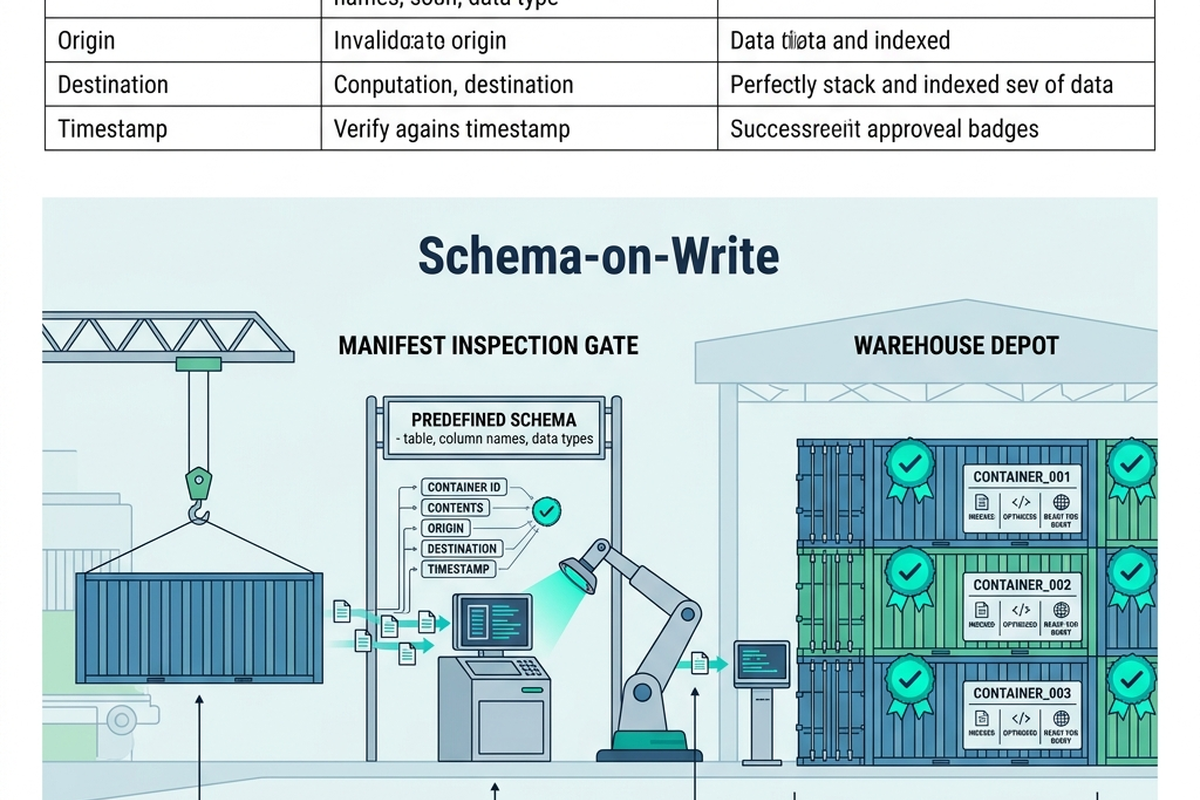
Nothing enters the container depot without paperwork done first. Before a crane ever lifts a box off a ship, its manifest is filled out: contents, weight, dimensions, destination zone. That paperwork isn’t bureaucracy for its own sake — it’s what lets a depot worker locate any container in seconds, and what lets the whole yard stay organized as thousands of boxes move through it. Skip the manifest, and you don’t have a depot anymore. You have a pile.
That upfront discipline is the entire personality of a data warehouse.
In Plain English
A data warehouse requires data to conform to a predefined structure — a schema — before it’s ever loaded in. Tables, columns, data types, and relationships are all defined ahead of time, the same way a container’s manifest is filled out before it’s stacked in the yard. This is often called schema-on-write: the structure is enforced at the moment data is written, not later when someone tries to read it.
The Old Way
Traditionally, building a warehouse meant a heavy upfront design phase: data modelers and analysts working out exactly what tables and columns would be needed, often months before the first real row of data arrived. Getting this modeling right mattered enormously, because changing a warehouse’s schema later — adding a column, splitting a table — was often slow and risky, touching every downstream report and query built against the old shape.
This rigor bought real benefits: warehouse data was reliably clean, consistently typed, and fast to query, because all the messy validation work happened once, upfront, rather than being repeated by every person who later queried it. The cost was inflexibility — a warehouse struggled with any data that didn’t fit neatly into rows and columns decided in advance, and struggled just as much when the business’s questions changed faster than its schema could be redesigned.
What’s Changing (and Why AI Is the Reason)
- Schema design itself is getting AI assistance. Rather than a purely manual modeling exercise, AI tools can now look at sample data and propose a reasonable starting schema — column names, types, likely relationships — turning a blank-page design problem into a draft a data modeler reviews and refines, similar to how Article 3 of the pipelines series described AI proposing transformation rules.
- Schema evolution is less catastrophic than it used to be. Modern warehouse platforms increasingly support adding or adjusting columns without the painful full rebuilds of the past, softening the historical trade-off between upfront rigor and long-term flexibility.
- AI systems querying a warehouse directly benefit enormously from good schema design. A well-labeled manifest doesn’t just help a human dockworker — it’s exactly the kind of structure an AI agent needs to translate a natural-language question into a correct query, a theme this series returns to later.
The Metaphor, Fully Extended
| Harbor Element | Data Warehouse Concept |
|---|---|
| A container’s manifest, filled out before stacking | A predefined schema |
| Filling out the manifest before the crane lifts the box | Schema-on-write: structure enforced at load time |
| A depot planner designing zones months in advance | Upfront data modeling |
| Redoing every manifest because the zoning changed | A costly schema migration |
| An assistant drafting a manifest from a quick inspection | AI-assisted schema design from sample data |
| A well-labeled manifest any dockworker can read at a glance | A clean schema an AI agent can query correctly |
For Beginners: What to Actually Do
- Before writing a single query, spend time actually reading a warehouse’s schema — table names, column names, relationships. Understanding the manifest is a prerequisite to understanding the cargo.
- Practice sketching a schema for a small, familiar dataset by hand before leaning on AI-assisted schema tools — you’ll get much more out of reviewing a suggestion once you’ve tried the problem yourself.
- Get comfortable with the idea that schema changes have downstream consequences. A column rename that seems trivial to you might quietly break someone else’s report.
- Learn to distinguish schema-on-write (warehouse) from schema-on-read (lake, covered next article) — it’s one of the most fundamental distinctions in this entire topic.
For Practitioners and Leaders: The Deeper Layer
- Upfront schema design remains valuable specifically because it front-loads validation cost into a single design phase rather than repeating it across every downstream query — that trade-off is still real even as AI makes the design phase itself faster.
- AI-proposed schemas are a genuinely useful starting draft, but they reflect patterns in the sample data they saw, not necessarily your organization’s actual business rules or edge cases. Review them the way you’d review a junior analyst’s first draft.
- Track how often schema changes actually happen in your warehouse and how painful each one is. If schema evolution is still routinely painful despite modern tooling, that’s worth investigating directly rather than accepting as an unavoidable cost of using a warehouse.
- As AI agents increasingly query warehouses directly, schema quality stops being purely an internal data-team concern — a poorly labeled schema now degrades an AI agent’s accuracy in ways a human analyst might have compensated for through tribal knowledge.
Quick Recap
- A data warehouse requires a predefined schema before data is loaded — schema-on-write.
- This upfront rigor produces clean, fast, reliably-typed data, at the cost of flexibility and slower adaptation to change.
- AI is easing both sides of that trade-off: assisting with initial schema design and making schema evolution less painful.
- Good schema design increasingly matters for AI agents querying a warehouse directly, not just for human analysts.
Where This Fits in the Series
Article 1 introduced the whole harbor. This article walked onto the container depot itself. Article 3 heads to the open wharf, where nothing gets a manifest until — or unless — someone actually needs to read it.
Key References
- Databricks Lakehouse Architecture — Official reference guide on combining data warehouse performance with lake flexibility.
- Apache Iceberg Table Format Specification — Open-source table format standard for huge analytic datasets.
- Delta Lake Open Source Project — Open-source storage layer that brings ACID transactions to Apache Spark and big data workloads.
Subscribe to the Newsletter
Get the latest DataParables articles delivered straight to your inbox.