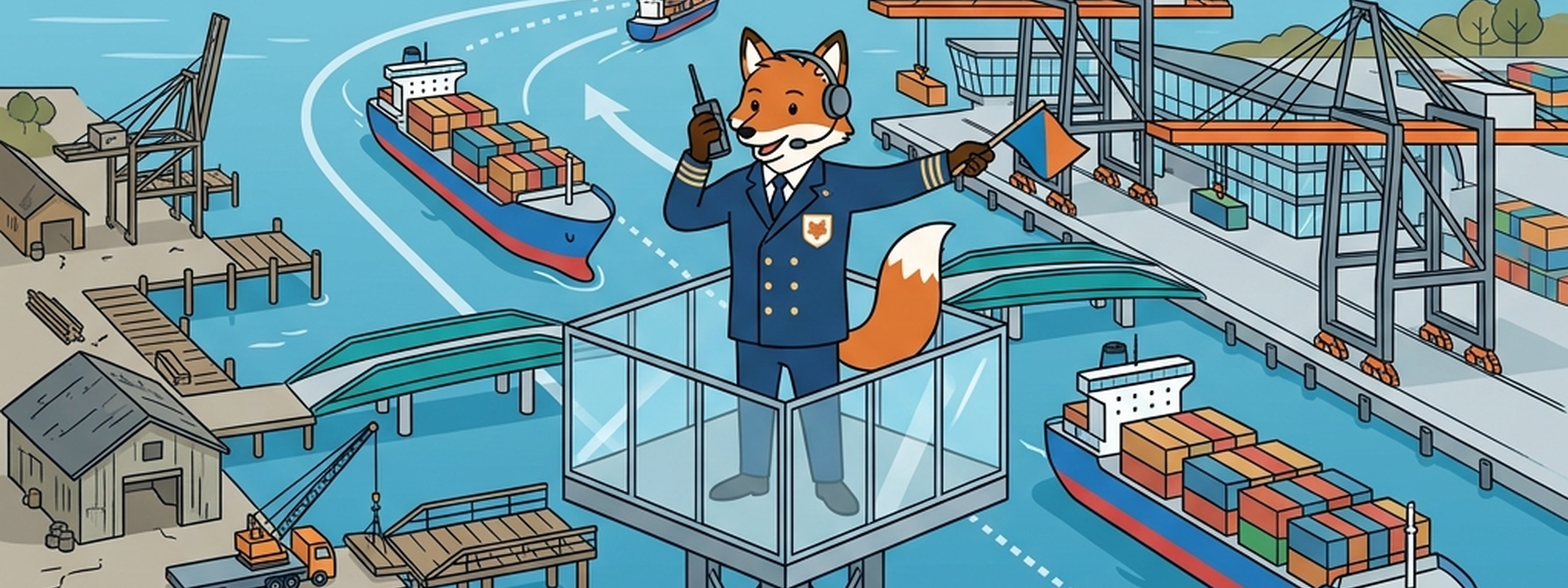
Opening Scene
Relocating an entire working port — every container, every crane, every ledger entry — to a new location, without ever fully closing the old one down while ships are still arriving, is one of the genuinely hardest operations in shipping. Cargo has to keep moving throughout. Nothing can simply vanish mid-transfer. And the new port has to actually work better than the old one, or the whole disruptive exercise wasn’t worth it.
Migrating a live warehouse or data lake into a lakehouse architecture is that same operation, and it deserves the same respect for its difficulty.
In Plain English
Lakehouse migration means moving existing data, and the workloads that depend on it, from a legacy warehouse or lake into lakehouse architecture — typically involving converting data into open file formats (Article 9), wrapping it in a table format (Article 10), rebuilding catalog entries (Article 12), and re-pointing every downstream query, dashboard, and pipeline to the new system, all while the business keeps running on the data throughout.
The Old Way
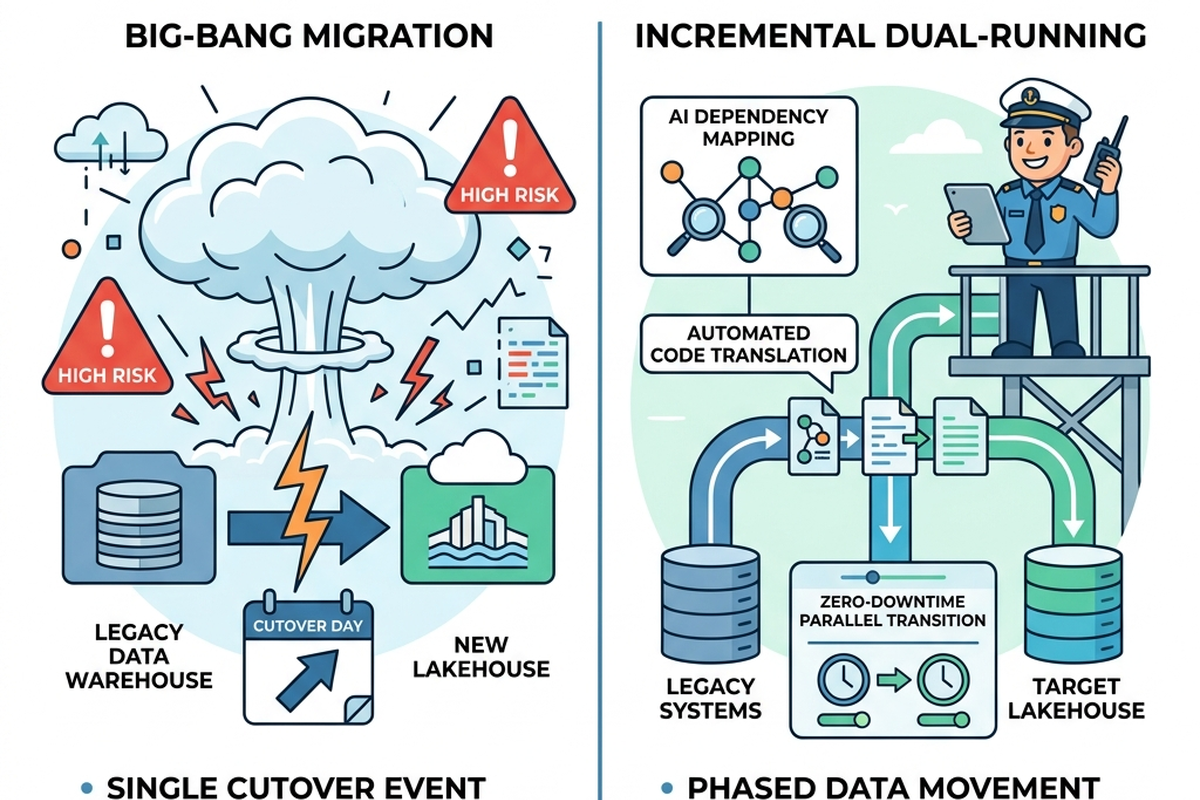
Historically, migrations of this scale were often approached as a single, high-risk cutover: build the new system fully in parallel, then switch everything over at once on a target date. This “big bang” approach concentrated enormous risk into one narrow window — if something was subtly wrong with the new system, the blast radius touched everything simultaneously, discovered only after the switch, when the old system might already be decommissioned or badly out of date.
Even when migrations avoided a literal single cutover, they were still frequently under-scoped in practice — teams underestimated the sheer number of downstream dependencies (reports, dashboards, pipelines, ad hoc queries no one had fully inventoried) actually pointing at the legacy system, discovering broken dependencies for months after the “migration” was declared complete.
What’s Changing (and Why AI Is the Reason)
- AI-assisted dependency mapping is making migration scope genuinely knowable upfront. Rather than discovering downstream dependencies reactively as they break, AI-assisted tooling can analyze query logs and pipeline code to build a much more complete map of what actually depends on a legacy system before migration begins — directly addressing the historical under-scoping problem.
- Incremental, dual-running migration strategies are increasingly practical, not just theoretically preferable. Running old and new systems in parallel and gradually shifting workloads over, rather than one big-bang cutover, has always been the safer approach in principle; better tooling for keeping both systems consistent during the transition is making it more practical in reality.
- AI-assisted code translation is easing one of the most tedious parts of migration. Converting queries, transformation logic, and pipeline code written against a legacy system into equivalent logic for the new platform is exactly the kind of large-scale, pattern-based translation task AI assistance handles well, similar to the natural-language pipeline generation covered in this series’ companion topic.
The Metaphor, Fully Extended
| Harbor Element | Migration Concept |
|---|---|
| Relocating an entire working port without closing it | Migrating a live data platform without business disruption |
| A single high-risk cutover date | A “big bang” migration approach |
| Running old and new ports simultaneously during transition | Incremental, dual-running migration |
| Discovering forgotten shipping routes still pointing to the old port, months later | Undiscovered downstream dependencies breaking after migration |
| A surveyor mapping every actual shipping route before relocation begins | AI-assisted dependency mapping ahead of migration |
| Translation crews converting old paperwork formats to the new system’s standards | AI-assisted code and query translation |
For Beginners: What to Actually Do
- If you’re involved in any migration project, prioritize understanding dependency mapping early — knowing what actually depends on the system being replaced is more valuable groundwork than almost anything else at the start.
- Get familiar with the concept of dual-running (old and new systems operating in parallel) as the generally safer default over a single cutover, even before you’ve been through a migration yourself.
- Treat AI-assisted code translation output as a strong first draft requiring review, the same way this series has treated AI-generated schemas, catalogs, and pipelines throughout — useful acceleration, not a finished, trustworthy result on its own.
- Ask, on any migration you’re part of, “what happens if we discover a dependency we missed, after cutover?” — the quality of the answer tells you a lot about how well-planned the migration actually is.
For Practitioners and Leaders: The Deeper Layer
- Invest specifically in dependency mapping before committing to a migration timeline — this is consistently where migrations go over budget and over schedule, and it’s also the area AI assistance can most concretely help with today.
- Default to incremental, dual-running migration over big-bang cutovers wherever feasible, even though it takes longer and costs more to run two systems in parallel temporarily — the reduced blast radius of problems is usually worth that cost.
- Budget explicitly for the “long tail” of migration: the last, least-visible dependencies that take disproportionate effort to find and fix relative to the volume of data or usage they represent.
- Treat AI-assisted code translation as a genuine accelerator for migration timelines, but keep validation testing rigorous — translated logic that looks plausible but subtly changes behavior is a real risk, not a hypothetical one, especially in complex transformation logic.
Quick Recap
- Lakehouse migration means moving data and dependent workloads from a legacy system into lakehouse architecture without disrupting the business relying on it.
- Historical “big bang” cutovers concentrated risk into one narrow window, and migrations were frequently under-scoped due to undiscovered downstream dependencies.
- AI-assisted dependency mapping and code translation are directly addressing both historical weaknesses, though translated logic still needs rigorous validation.
- Incremental, dual-running migration remains the generally safer strategy, and better tooling is making it more practical to execute well.
Where This Fits in the Series
Article 17 covered cargo that doesn’t wait to dock. This article covered relocating an entire port. Article 19 steps back to a decision that comes before any of this: which dock a given kind of cargo actually needs in the first place.
Key References
- Databricks Lakehouse Architecture — Official reference guide on combining data warehouse performance with lake flexibility.
- Apache Iceberg Table Format Specification — Open-source table format standard for huge analytic datasets.
- Delta Lake Open Source Project — Open-source storage layer that brings ACID transactions to Apache Spark and big data workloads.
Subscribe to the Newsletter
Get the latest DataParables articles delivered straight to your inbox.