Opening Scene
Every kind of cargo this series has discussed — crates, barrels, loose cargo from Article 5 — fits somewhere on a traditional manifest: contents, weight, dimensions. Now imagine a shipment arrives that doesn’t describe itself that way at all. Instead, it comes with a long list of coordinates describing where it belongs relative to every other kind of cargo in the yard — closer to some, farther from others, based on some underlying similarity nobody wrote down explicitly. The old manifest format has no field for that.
That’s a vector embedding, and it’s a genuinely new kind of cargo, not a variation on the old kinds.
In Plain English
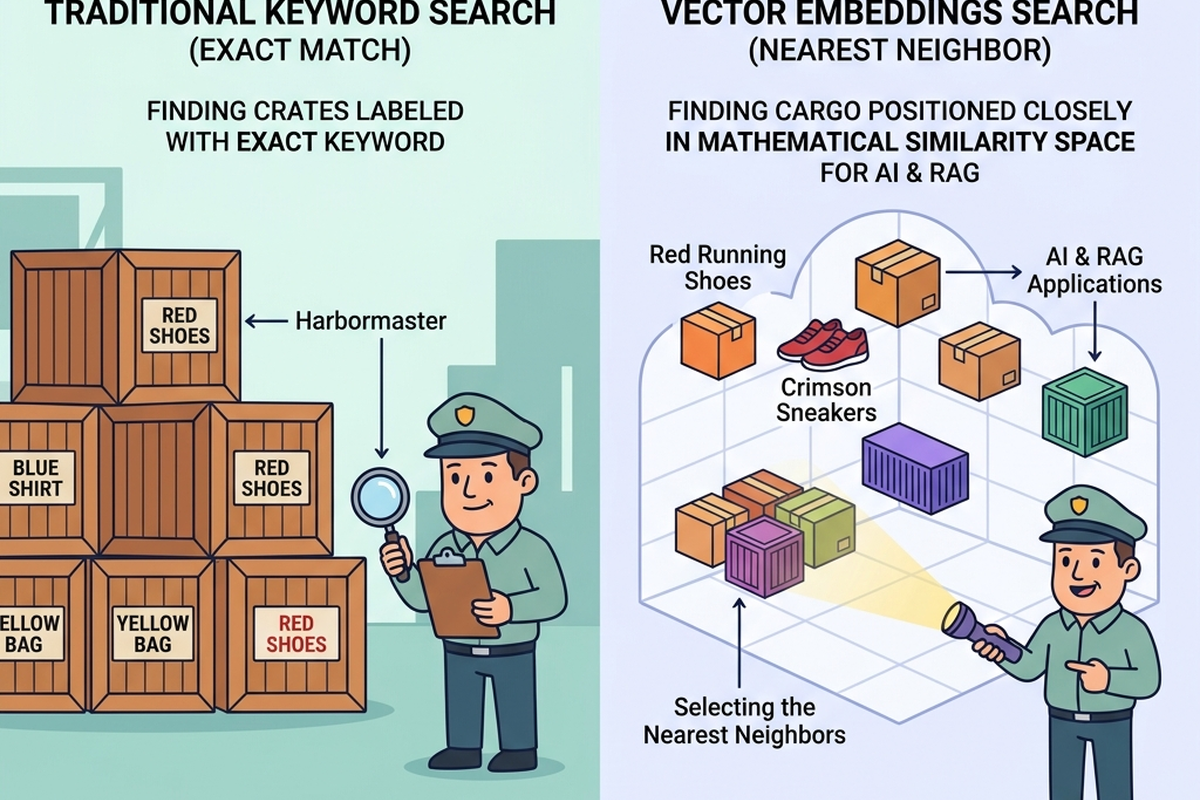
A vector embedding is a numerical representation of a piece of content — text, an image, audio — that captures its meaning as a list of numbers, positioned in a mathematical space where similar content ends up close together and dissimilar content ends up far apart. A vector database (or vector storage layer, increasingly built directly into a lakehouse) is optimized specifically for storing embeddings and quickly finding the nearest ones to a given query — a fundamentally different kind of lookup than the exact-match or range queries traditional warehouse and lake storage were built for.
The Old Way
Before embeddings and vector search became mainstream, “similarity” wasn’t something a data platform could meaningfully answer at all. You could ask exact-match questions (“find every record where category equals X”) or range questions (“find every value between Y and Z”), but “find the documents most similar in meaning to this one” had no good native answer in a traditional warehouse or lake — it required entirely separate, specialized systems, disconnected from the rest of an organization’s data infrastructure.
This meant AI applications that needed similarity search — the RAG pipelines described in the pipelines-and-ETL topic’s article on this exact subject — often had to bolt on a completely separate vector database alongside the existing warehouse and lake, another system to integrate, secure, and keep in sync, echoing the exact “two separate systems bridged by pipelines” problem Article 4 described for warehouses and lakes generally.
What’s Changing (and Why AI Is the Reason)
- Vector storage is increasingly being absorbed into the lakehouse itself, not bolted on beside it. Following the same “one port, not two systems” logic from Article 4, modern lakehouse platforms are increasingly adding native vector storage and similarity search capability directly, rather than requiring a separate specialized system.
- This is entirely an AI-driven development. Vector embeddings exist because of AI — specifically because modern AI models can generate them from raw content — making this cargo type unlike any other covered in this series: it didn’t exist as a practical concept before AI made it possible to generate and use at scale.
- Storage and indexing techniques for vectors are still actively maturing. Unlike the well-settled file and table formats from Articles 9 and 10, efficient large-scale vector storage and indexing is a genuinely newer, faster-moving area — expect more change here over the next few years than in the more mature parts of lakehouse architecture this series has covered.
The Metaphor, Fully Extended
| Harbor Element | Vector Embedding Concept |
|---|---|
| A shipment described by coordinates relative to other cargo, not weight or dimensions | A vector embedding representing meaning as numbers |
| A section of the yard organized by similarity, not by type or arrival date | A vector database or vector index |
| Finding the crate most similar to a sample, not matching it exactly | Nearest-neighbor similarity search |
| A separate specialized facility for this new cargo type, disconnected from the main port | A standalone vector database bolted on outside the lakehouse |
| The main port adding a dedicated new section to handle this cargo directly | Native vector storage built into a modern lakehouse |
For Beginners: What to Actually Do
- Build real intuition for what an embedding actually represents — try generating embeddings for a few sentences yourself and looking at how similar or different sentences end up positioned relative to each other.
- Understand that similarity search is a genuinely different operation from the exact-match and range queries covered earlier in this series — don’t try to force your existing SQL intuition onto it without adjustment.
- If your organization uses RAG pipelines (as covered in the data-pipelines-etl topic), understand where the resulting embeddings actually get stored — a separate vector database, or a native lakehouse capability — and why that choice was made.
- Stay aware that this is an actively evolving area. Don’t assume whatever approach you learn first is the permanent, settled answer the way file formats (Article 9) largely are.
For Practitioners and Leaders: The Deeper Layer
- Evaluate whether a standalone vector database or native lakehouse vector support better fits your organization’s needs, explicitly weighing integration simplicity against the maturity and specialization of dedicated vector database products.
- Vector storage and indexing performance characteristics differ meaningfully by implementation and are evolving quickly — avoid long-term architectural commitments here without revisiting the decision more frequently than you would for more settled parts of your stack.
- The “two systems bridged by pipelines” staleness and complexity problem from Article 4 applies directly if you’re running a separate vector database alongside your lakehouse — evaluate that operational cost honestly, not just the initial integration cost.
- As embeddings become a routine part of your data estate, extend your governance and access control thinking (Article 13) to cover them explicitly — an embedding can indirectly expose the sensitive content it was generated from, even without storing that content directly.
Quick Recap
- Vector embeddings represent content’s meaning as numbers, enabling similarity search — a fundamentally different query type than the exact-match and range queries traditional data platforms were built for.
- Before embeddings, similarity search required entirely separate specialized systems, disconnected from core data infrastructure.
- Modern lakehouses are increasingly absorbing native vector storage, following the same “one port” logic that motivates lakehouse architecture generally.
- This is a genuinely AI-native, still-maturing area of the data platform landscape, warranting more frequent reassessment than more settled parts of the stack.
Where This Fits in the Series
Article 15 covered asking questions in plain language. This article covered the new kind of cargo that makes some of those questions answerable by meaning, not just exact match. Article 17 turns to cargo that doesn’t wait to be unloaded at all — streaming data.
Key References
- Databricks Lakehouse Architecture — Official reference guide on combining data warehouse performance with lake flexibility.
- Apache Iceberg Table Format Specification — Open-source table format standard for huge analytic datasets.
- Delta Lake Open Source Project — Open-source storage layer that brings ACID transactions to Apache Spark and big data workloads.
Subscribe to the Newsletter
Get the latest DataParables articles delivered straight to your inbox.