
Opening Scene
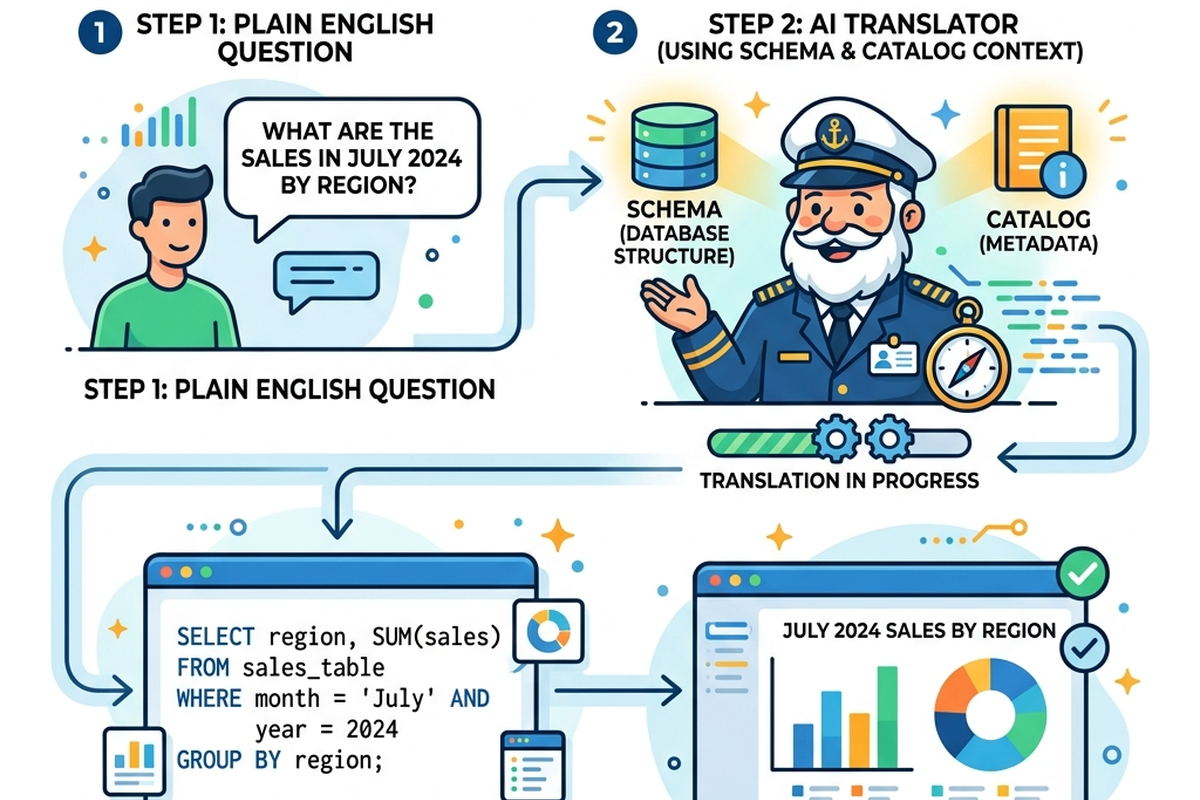
Most people who come to a port with a question don’t want to learn how to read a manifest, walk the yard, and cross-reference a zoning map themselves. They want to ask the harbormaster a plain question — “do we have any refrigerated capacity free this week?” — and get a straight answer back, without needing to understand how the yard is actually organized underneath. The harbormaster does the manifest-reading and cross-referencing on their behalf.
AI-assisted natural-language querying is that same shift, applied directly to a lakehouse.
In Plain English
Natural-language querying lets someone ask a question about data in plain English — “what were our top five products by revenue last quarter” — and have an AI system translate that into a correct, executable query against the underlying warehouse or lakehouse, without the person needing to write query code themselves. It doesn’t replace the underlying structured query language; it sits on top of it, acting as a translator between plain human questions and precise machine instructions.
The Old Way
Traditionally, getting an answer from a warehouse or lakehouse required knowing how to write structured queries — a real, non-trivial skill that took time to learn and kept a large share of an organization’s potential questions bottlenecked through a comparatively small number of people who could actually write them. Anyone else with a question had to submit a request and wait, sometimes days, for someone on a data team to translate their plain-English question into a query, run it, and hand back the result.
This bottleneck had real costs beyond mere inconvenience: questions that would have taken thirty seconds to answer if askable directly often didn’t get asked at all, either because the requester didn’t want to burden an already-busy data team or because the answer, by the time it arrived, was no longer as useful as it would have been immediately.
What’s Changing (and Why AI Is the Reason)
- Natural-language querying is removing the query-writing bottleneck directly. This is the most literal and visible way AI is changing how people interact with a lakehouse — turning a skill-gated capability into something available to anyone who can ask a clear question, dramatically widening who can get answers from data self-service.
- Query quality depends heavily on everything covered earlier in this series. A natural-language query is only as good as the schema (Article 2), catalog (Article 12), and access controls (Article 13) it’s working against — this capability is the payoff for the architectural discipline the rest of this series has built up, not a substitute for it.
- Trust and verification are becoming a genuinely new skill people need. As more people get instant answers without understanding the underlying query, the ability to sanity-check whether an AI-generated answer actually makes sense becomes a valuable skill in its own right — echoing the “trust but verify” theme this series has returned to before, now applied to end users rather than just data professionals.
The Metaphor, Fully Extended
| Harbor Element | Natural-Language Query Concept |
|---|---|
| Asking the harbormaster a plain question | Asking an AI system a question in natural language |
| The harbormaster translating the question into a manifest lookup | AI translating natural language into a structured query |
| Waiting days for a data team to hand-translate a request | The traditional query-writing skill bottleneck |
| A harbormaster who only knows what’s actually in the master directory | Query accuracy depending on catalog and schema quality |
| A tenant double-checking the harbormaster’s answer against what they know | End users learning to sanity-check AI-generated answers |
For Beginners: What to Actually Do
- Start using natural-language querying tools where available, but don’t stop there — look at the actual generated query underneath when you can, and use it as a learning tool for understanding structured querying itself.
- Practice phrasing questions clearly and specifically. Vague natural-language questions produce vague or wrong translations just as often as vague requests to a human analyst would.
- Build the habit of sanity-checking a surprising or important answer against what you already know, rather than accepting any AI-generated number at face value, especially for decisions that matter.
- Understand that this capability doesn’t eliminate the value of learning to query directly — it lowers the floor for getting started, but deeper fluency still compounds in value over time.
For Practitioners and Leaders: The Deeper Layer
- The reliability of natural-language querying at your organization is a direct function of investments covered earlier in this series — schema quality, catalog completeness, access governance. Treat this capability as a reason to prioritize those investments, not a replacement for them.
- Widening access to instant answers changes organizational dynamics that are worth thinking through deliberately: who previously benefited from being the gatekeeper to data answers, and how does that role need to evolve rather than simply disappear?
- Build explicit guidance and training for end users on verifying AI-generated query answers, particularly for any answer that will inform a real decision — this is a genuinely new organizational skill gap, not an automatic byproduct of rolling out the capability.
- Monitor natural-language query accuracy over time as a real, first-class metric, not an assumption. A tool that’s confidently wrong some fraction of the time and goes unmonitored can quietly erode trust in data across the whole organization.
Quick Recap
- Natural-language querying lets people ask plain-English questions and get answers translated into and executed as structured queries automatically.
- Traditionally, structured querying was a real skill bottleneck that gated most of an organization’s questions through a small number of people who could write queries.
- This capability’s accuracy depends directly on schema, catalog, and governance quality covered earlier in this series — it’s a payoff for that discipline, not a substitute for it.
- End users need a new skill: sanity-checking AI-generated answers rather than accepting them automatically.
Where This Fits in the Series
Article 14 covered cost. This article covered a new, more direct way people interact with a lakehouse. Article 16 covers an entirely new kind of cargo this shift is making newly important: vector embeddings.
Key References
- Databricks Lakehouse Architecture — Official reference guide on combining data warehouse performance with lake flexibility.
- Apache Iceberg Table Format Specification — Open-source table format standard for huge analytic datasets.
- Delta Lake Open Source Project — Open-source storage layer that brings ACID transactions to Apache Spark and big data workloads.
Subscribe to the Newsletter
Get the latest DataParables articles delivered straight to your inbox.