Opening Scene
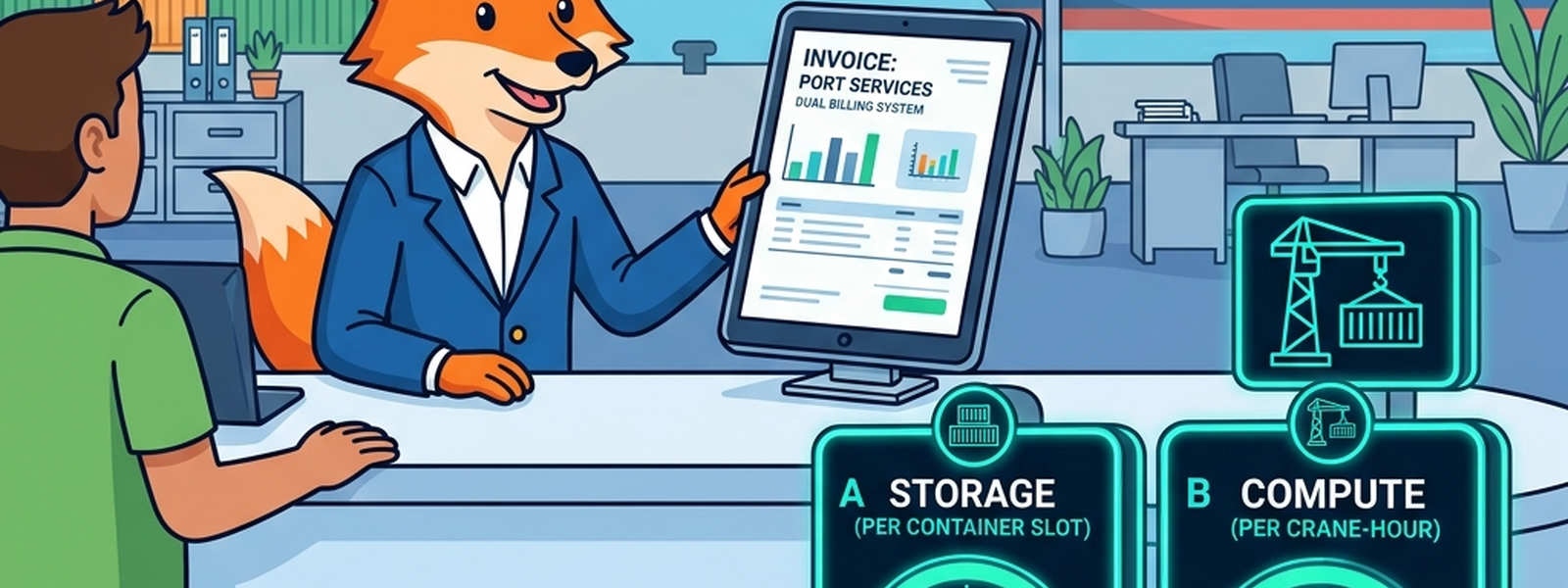
Every port has to decide how it actually charges tenants: by container slot occupied, by ton of cargo moved, by crane-hour used, or some blend of all three. The choice isn’t neutral. A port that bills purely by slot occupied rewards tenants for moving cargo through quickly. One that bills by crane-hour rewards tenants for batching work efficiently. Whichever model a port chooses quietly shapes how every tenant actually behaves, whether they realize it or not.
Lakehouse platforms have the exact same dynamic, split roughly along the storage-versus-compute line from Article 11.
In Plain English
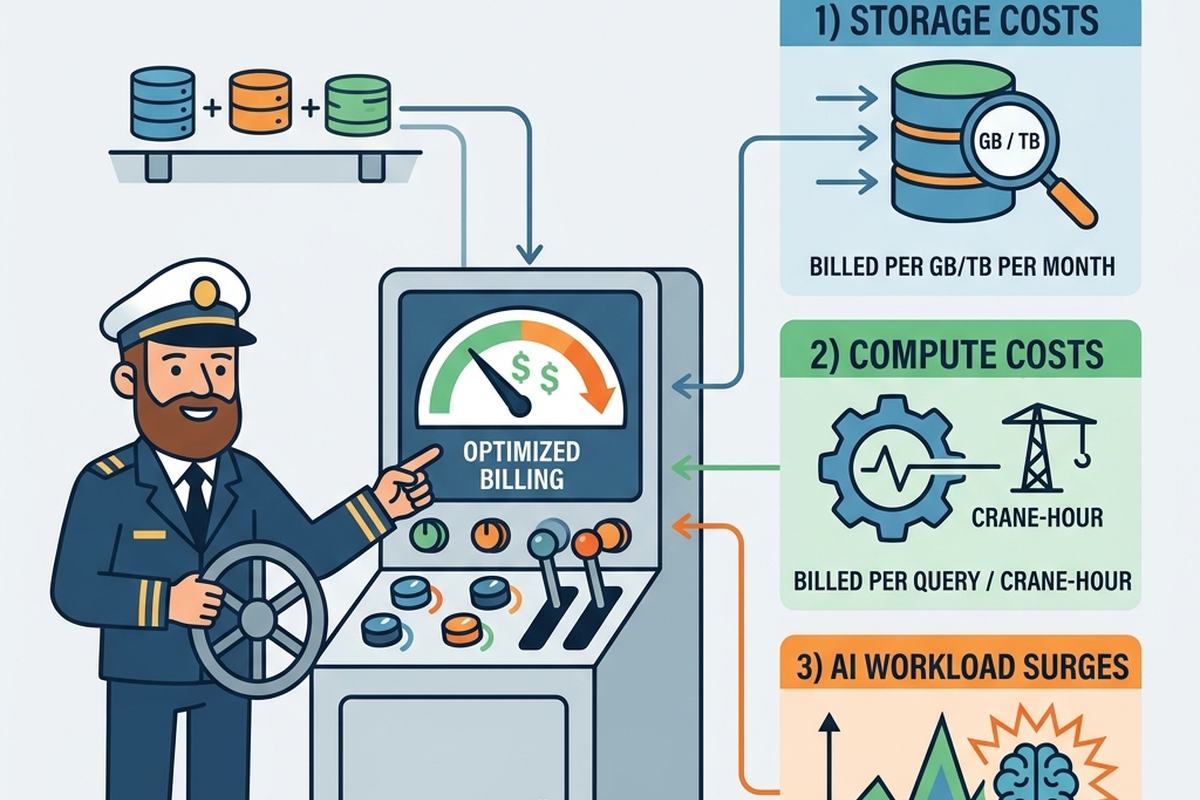
Lakehouse costs typically break into two categories that scale differently: storage costs, generally billed per unit of data kept over time, and compute costs, generally billed per unit of processing actually used — a query run, a job executed. Because these scale independently (Article 11’s compute-storage separation), understanding which of your costs come from which side, and why, is essential to controlling spend rather than just watching a total bill grow.
The Old Way
In bundled, fixed-capacity systems, cost was comparatively simple to reason about, if not necessarily cheap: you paid for the provisioned system, roughly flat, regardless of exact usage. That simplicity came at the cost of the over- and under-provisioning waste described in Article 11 — cost was predictable, but not necessarily efficient.
As platforms moved toward elastic, separated compute and storage, cost became more efficient in principle but genuinely harder to reason about — a single poorly-written, frequently-run query could now generate a surprisingly large compute bill in a way that a fixed-capacity system’s flat cost never would have exposed as directly. The elasticity that eliminated waste also removed a kind of built-in cost ceiling many teams had implicitly relied on.
What’s Changing (and Why AI Is the Reason)
- AI is helping identify wasteful queries and access patterns before they become expensive habits. Rather than discovering an expensive, inefficient query pattern only when a monthly bill spikes, AI-assisted cost monitoring can flag inefficient queries — poor partitioning use from Article 8, unnecessary full-table scans — much closer to when they first start happening.
- AI workloads have introduced a genuinely new, often large cost category. Training and inference costs, particularly for large-scale AI workloads, can dwarf traditional BI query costs — this series’ recurring theme of AI reshaping storage and compute demand shows up here as a direct, often underestimated line item in platform budgets.
- AI-assisted forecasting is improving cost predictability despite elasticity. Even though elastic systems don’t offer a fixed-cost ceiling by default, AI-assisted usage forecasting can predict likely spend with increasing accuracy, giving back some of the predictability that fixed-capacity systems used to offer for free.
The Metaphor, Fully Extended
| Harbor Element | Cost Concept |
|---|---|
| Billing by container slot occupied over time | Storage costs |
| Billing by crane-hour actually used | Compute costs |
| A flat, predictable port fee regardless of activity | Fixed-capacity system cost, simple but wasteful |
| A single inefficient crane job generating a surprise bill | An inefficient query generating unexpected compute cost |
| A dockmaster flagging wasteful crane usage patterns as they start | AI-assisted cost monitoring catching inefficiency early |
| A forecast estimating next month’s likely crane-hour demand | AI-assisted usage and cost forecasting |
For Beginners: What to Actually Do
- Learn to distinguish storage cost from compute cost on any bill or cost dashboard you encounter — that split is the foundation for almost every other cost-related decision.
- Practice writing queries with the partitioning and clustering concepts from Article 8 explicitly in mind — cost-efficient querying and performance-efficient querying are, in a lakehouse, usually the same skill.
- Before running a large or unfamiliar query, get in the habit of estimating its likely scope (how much data will this actually touch) rather than just running it and seeing what happens.
- If you’re new to a team, ask specifically how AI training or inference costs are tracked separately from traditional query costs — the answer tells you a lot about the platform’s cost maturity.
For Practitioners and Leaders: The Deeper Layer
- Break out AI workload costs (training, inference) as an explicit budget category rather than letting them blend into general compute spend — the growth rate and drivers are usually different enough to warrant separate tracking and forecasting.
- Elastic compute removes waste but also removes the implicit cost ceiling of fixed-capacity systems — pair elasticity with active cost monitoring and alerting, not just trust that efficiency will naturally follow from the pricing model.
- Treat query efficiency training for your analysts and engineers as a direct cost-control investment, not just a performance nicety — the connection between Article 8’s partitioning discipline and actual dollars is often more direct than teams realize.
- AI-assisted forecasting is a genuine improvement over manual budget guessing, but validate it against actuals regularly, particularly as AI workload volume itself is often the least predictable part of the forecast.
Quick Recap
- Lakehouse costs split into storage (per data kept) and compute (per processing used), scaling independently due to the compute-storage separation covered in Article 11.
- Fixed-capacity systems offered simple, predictable cost at the price of real waste; elastic systems are more efficient but harder to predict without active monitoring.
- AI-assisted cost monitoring can catch inefficient queries early, and AI workloads themselves are often a large, distinct cost category worth tracking separately.
- AI-assisted forecasting is improving cost predictability despite the inherent unpredictability of elastic, usage-based billing.
Where This Fits in the Series
Article 13 covered access control. This article covered what it all costs to run. Article 15 turns to a very different kind of access — asking questions of the data directly, in plain language.
Key References
- Databricks Lakehouse Architecture — Official reference guide on combining data warehouse performance with lake flexibility.
- Apache Iceberg Table Format Specification — Open-source table format standard for huge analytic datasets.
- Delta Lake Open Source Project — Open-source storage layer that brings ACID transactions to Apache Spark and big data workloads.
Subscribe to the Newsletter
Get the latest DataParables articles delivered straight to your inbox.