
Opening Scene
Knowing exactly where a container is doesn’t mean everyone should be able to open it. A working port has gates, badges, and zone-specific access rules — the general cargo yard is open to most staff, the customs-hold zone requires clearance, and certain containers are logged every single time anyone touches them. The master directory from the last article tells you where things are. This layer decides who’s actually allowed to go there.
That’s access control and governance, and it matters just as much as discoverability, in the opposite direction.
In Plain English
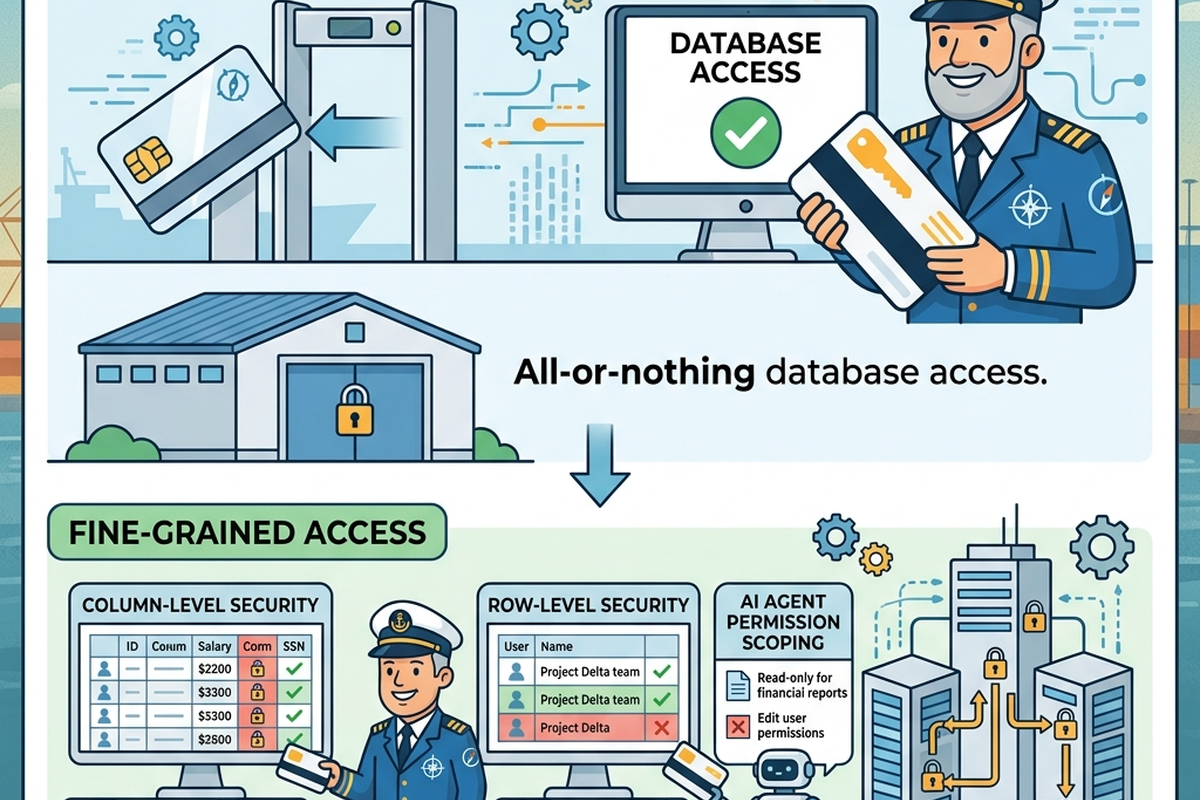
Access control determines who can view, query, or modify specific data — often at a fine-grained level, down to specific tables, columns, or even individual rows, not just an all-or-nothing decision about an entire platform. Governance is the broader set of policies and practices ensuring data is used appropriately: who’s accountable for a dataset, what compliance rules apply to it, and how access decisions themselves get made and audited.
The Old Way
Historically, access control in data platforms was often coarse-grained — a person either had access to a whole database or they didn’t, with little ability to grant, say, access to customer purchase history while restricting access to customer payment details within the same table. This forced an uncomfortable trade-off: grant broad access and accept real exposure risk, or restrict tightly and slow down legitimate work for anyone who needed even a small slice of a sensitive dataset.
As data platforms grew and regulatory requirements around data privacy became more stringent, this coarse approach became a genuine liability, not just an inconvenience — both the risk of overexposure and the cost of overly restrictive access were increasingly unacceptable at the same time.
What’s Changing (and Why AI Is the Reason)
- Fine-grained, attribute-based access control is becoming standard. Modern lakehouse platforms increasingly support column-level, row-level, and even dynamic, context-aware access rules, letting organizations grant exactly the access a role needs rather than choosing between “too much” and “too little.”
- AI is creating urgent new governance questions, not just automating old ones. An AI agent that can query a lakehouse on a user’s behalf needs its own access boundaries — should it inherit the requesting user’s exact permissions, or something more restrictive? This is a genuinely new governance question this series hasn’t had to address until this point.
- AI-assisted tooling is helping classify sensitive data automatically. Rather than relying entirely on manual tagging of what’s sensitive, AI-assisted classification can scan data and flag likely personally identifiable or otherwise sensitive information, helping governance teams apply appropriate access rules more comprehensively and consistently than manual tagging alone typically achieved.
The Metaphor, Fully Extended
| Harbor Element | Access Control Concept |
|---|---|
| A port-wide badge granting access to every zone | Coarse-grained, all-or-nothing access |
| A badge scoped to specific zones, or even specific shelves within a zone | Fine-grained, column- or row-level access control |
| A supervisor whose badge automatically restricts what an assistant they’ve sent can access | Governance questions around AI agents acting on a user’s behalf |
| A security team pre-inspecting new cargo for hazardous or restricted contents | AI-assisted automatic sensitive-data classification |
| A logged entry every time a restricted zone is accessed | Access auditing |
For Beginners: What to Actually Do
- Get familiar with the difference between coarse and fine-grained access control conceptually, even before you have hands-on platform experience — it shapes almost every governance conversation you’ll encounter later.
- When requesting data access for a task, request the narrowest access that actually accomplishes the task, rather than defaulting to the broadest available — good habits here compound across a career, not just a single project.
- If you build or use AI agents that query data on your behalf, ask explicitly what access boundaries that agent operates under. Don’t assume it’s automatically restricted the same way you are.
- Learn to recognize when a dataset likely contains sensitive information even before it’s formally classified — that instinct is a genuinely valuable skill independent of whatever tooling exists.
For Practitioners and Leaders: The Deeper Layer
- The AI-agent access question deserves explicit policy, not an implicit default. Decide deliberately whether agents inherit user permissions exactly, a restricted subset, or a separately governed set of permissions — and document that decision.
- Fine-grained access control is a real capability improvement, but it adds real administrative complexity — invest in role design and access request processes that scale, or the flexibility becomes its own operational burden.
- AI-assisted sensitive data classification meaningfully improves coverage versus manual tagging, but should be validated periodically, particularly for regulatory compliance purposes where a false negative has real consequences.
- Governance and discoverability (Article 12) are in genuine tension — a highly discoverable catalog description that inadvertently reveals sensitive information through its metadata is a real, easy-to-overlook risk worth explicitly reviewing for.
Quick Recap
- Access control determines who can access specific data, ideally at a fine-grained level; governance is the broader set of policies and accountability around how data gets used.
- Coarse, all-or-nothing access control historically forced an uncomfortable trade-off between overexposure and overly restrictive access.
- Modern platforms increasingly support fine-grained access control, and AI agents acting on a user’s behalf raise genuinely new governance questions.
- AI-assisted sensitive data classification is improving coverage and consistency, but still needs periodic human validation.
Where This Fits in the Series
Article 12 covered finding data. This article covered who’s allowed to actually access it. Article 14 turns to a related practical question: what all of this actually costs to run.
Key References
- Databricks Lakehouse Architecture — Official reference guide on combining data warehouse performance with lake flexibility.
- Apache Iceberg Table Format Specification — Open-source table format standard for huge analytic datasets.
- Delta Lake Open Source Project — Open-source storage layer that brings ACID transactions to Apache Spark and big data workloads.
Subscribe to the Newsletter
Get the latest DataParables articles delivered straight to your inbox.