
Opening Scene
A new dockworker’s first stop isn’t the yard — it’s the port office, where a master directory lists every zone, what’s typically stored there, who’s responsible for it, and how to request access. Without that directory, even a perfectly organized yard is only navigable to the handful of people who’ve memorized it by working there for years. With it, anyone new can find what they need in minutes, and the whole port stays usable as it grows far beyond what any one person could keep in their head.
That directory is a data catalog, and it’s what actually makes a large lakehouse discoverable rather than merely organized.
In Plain English
A data catalog is a searchable inventory of what data exists across a platform: what tables and datasets are available, what they contain, who owns them, how they’re related, and how to access them. It’s the discoverability layer sitting above all the physical organization covered in Articles 7 through 11 — zoning and labeling make data findable in principle; a catalog is what makes it actually findable in practice, especially at scale.
The Old Way
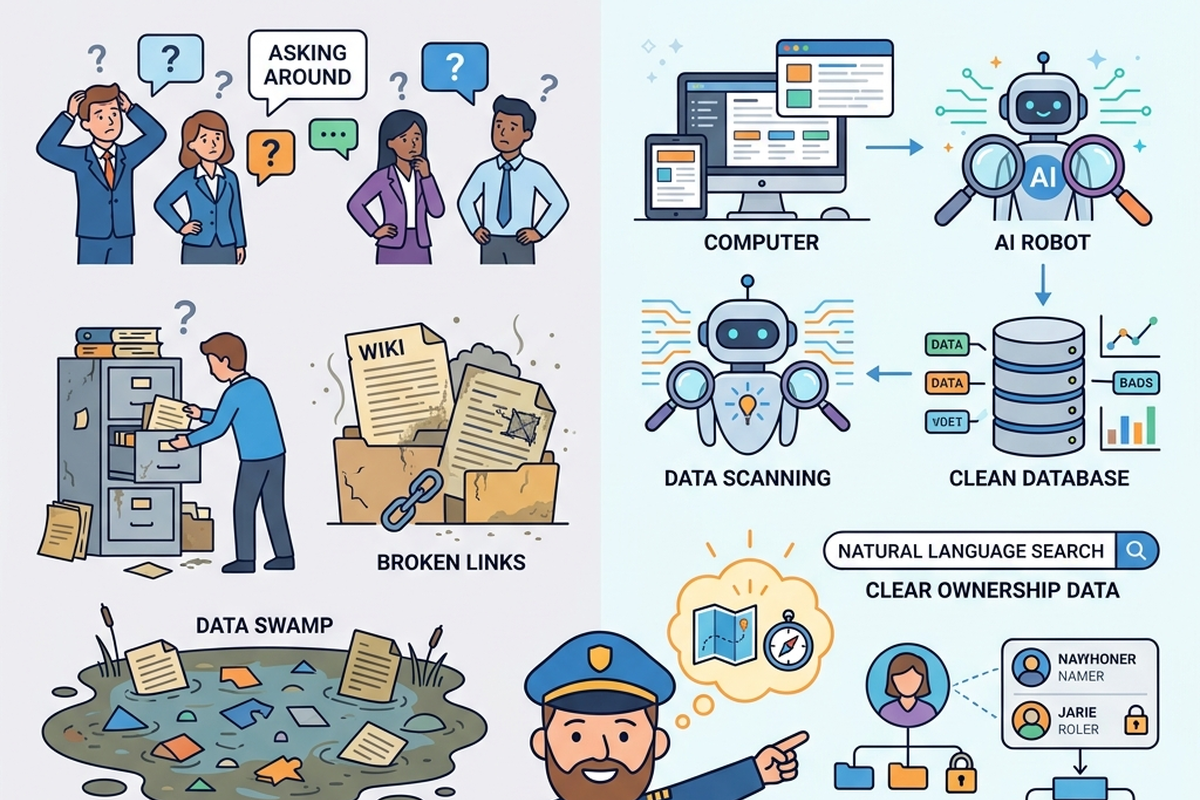
Before mature cataloging tools, discoverability at most organizations depended heavily on tribal knowledge — asking a colleague who’d been there long enough to remember which table had the data you needed, or hunting through inconsistent, often-outdated documentation scattered across wikis and spreadsheets. This worked, barely, when a platform had dozens of tables and a small, stable team. It broke down completely at any real scale, with new hires spending weeks just learning where things were, and duplicate datasets quietly proliferating because nobody could find the one that already existed.
This is the discoverability half of the data swamp problem introduced in Article 3 — data can be technically well-organized and still functionally lost if there’s no directory pointing anyone toward it.
What’s Changing (and Why AI Is the Reason)
- Cataloging is shifting from manual documentation to automated inference. Rather than depending on someone manually writing and maintaining descriptions for every table, AI-assisted catalog tools can inspect data directly and generate reasonable descriptions, tags, and relationship mappings automatically — echoing the AI-assisted cataloging theme first raised in Article 3, now as a mature, dedicated capability.
- Natural-language search over the catalog is becoming standard. Instead of needing to know exact table or column names, users increasingly can search a catalog conversationally — “where’s our customer churn data” — with AI translating that into the actual relevant assets, a direct preview of the fuller natural-language querying theme in Article 15.
- Catalogs are becoming the foundation AI agents rely on to use a lakehouse correctly. An AI agent generating a query on your behalf needs to know what tables exist and what they mean just as much as a human analyst does — a well-maintained catalog is increasingly a prerequisite for trustworthy AI-generated queries, not just a human convenience.
The Metaphor, Fully Extended
| Harbor Element | Data Catalog Concept |
|---|---|
| The port’s master directory | A data catalog |
| A new worker asking a veteran colleague where things are | Relying on tribal knowledge instead of documentation |
| An outdated paper directory nobody’s updated in years | Stale, manually-maintained catalog documentation |
| A directory assistant who can inspect a zone and write its description automatically | AI-assisted automatic metadata generation |
| Asking the port office “where’s the refrigerated cargo” instead of a zone code | Natural-language search over the catalog |
For Beginners: What to Actually Do
- Before querying any unfamiliar dataset, check whether a catalog entry exists for it first — reading the catalog is almost always faster than reverse-engineering a table from its raw contents.
- If you work somewhere without a strong cataloging culture, start small: document the datasets you personally own well, even informally. That habit compounds across a team faster than waiting for a top-down initiative.
- Get comfortable evaluating AI-generated catalog descriptions critically rather than trusting them automatically — they’re a strong starting draft, not guaranteed to be fully accurate.
- Practice natural-language catalog search if your platform supports it, but verify what it returns against the actual table structure, especially early on while you’re calibrating how much to trust it.
For Practitioners and Leaders: The Deeper Layer
- Cataloging is frequently under-invested relative to its impact — it doesn’t produce a visible dashboard, but poor discoverability quietly taxes every single person who has to search for data across your platform, every day.
- AI-assisted catalog generation dramatically lowers the cost of getting to “something documented” but doesn’t replace the need for human review, particularly for business-critical or sensitive datasets where an incorrect automatically-generated description could mislead someone.
- Treat catalog quality as a direct dependency for AI agent reliability going forward — an AI agent querying your lakehouse is only as good as its understanding of what exists, and that understanding routes through your catalog.
- Track duplicate dataset creation as a catalog health metric. A rising rate of near-duplicate tables being created is a strong signal that people can’t find what already exists.
Quick Recap
- A data catalog is the searchable directory that makes data across a lakehouse actually discoverable, not just physically organized.
- Before mature cataloging tools, discoverability depended on tribal knowledge and inconsistent documentation, which broke down at scale.
- AI-assisted cataloging is automating metadata generation and enabling natural-language search over the catalog.
- Catalog quality is increasingly a prerequisite for reliable AI agent queries, not just a human convenience.
Where This Fits in the Series
Article 11 covered the equipment used to process queries. This article covered how anyone finds the right cargo to query in the first place. Article 13 covers who’s actually allowed to access it once found.
Key References
- Databricks Lakehouse Architecture — Official reference guide on combining data warehouse performance with lake flexibility.
- Apache Iceberg Table Format Specification — Open-source table format standard for huge analytic datasets.
- Delta Lake Open Source Project — Open-source storage layer that brings ACID transactions to Apache Spark and big data workloads.
Subscribe to the Newsletter
Get the latest DataParables articles delivered straight to your inbox.