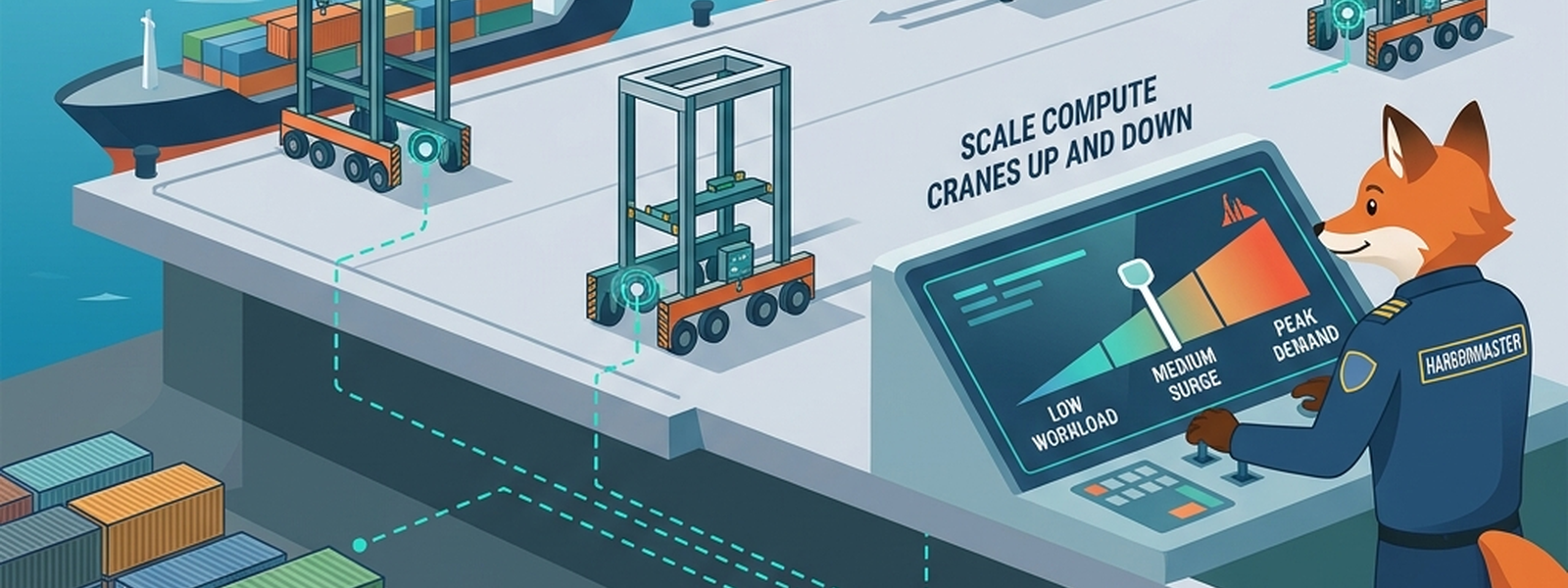
Opening Scene
A port that owns a fixed fleet of cranes faces an unavoidable trade-off: buy enough cranes for your busiest possible day, and most of them sit idle the rest of the year. Buy only enough for an average day, and a cargo surge grinds the whole port to a halt. Now imagine instead that cranes are rented by the hour, from a shared pool, completely separate from the yard where cargo actually sits. Busy day, rent more cranes. Quiet week, rent almost none. The yard’s storage and the port’s lifting capacity stop being tied to the same fixed number.
That separation — storage from compute — is one of the most consequential architectural shifts in modern data platforms.
In Plain English
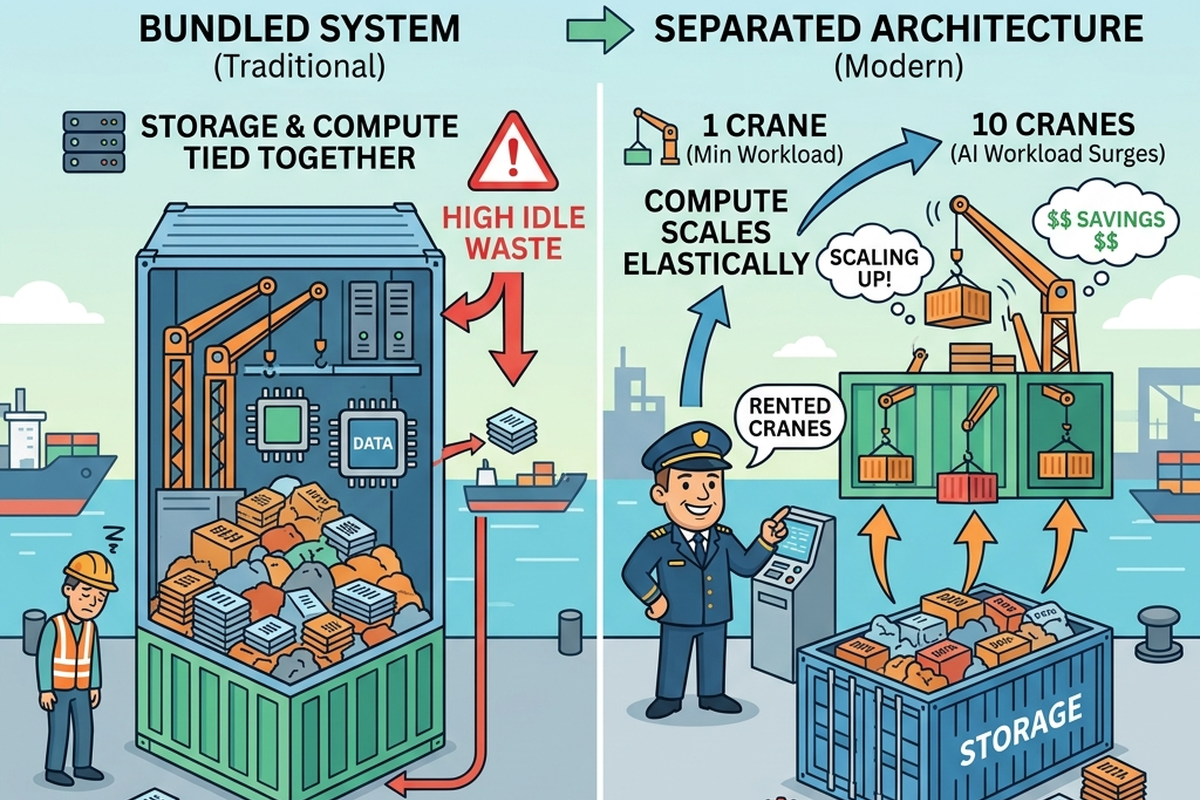
Compute-storage separation means the systems that store your data and the systems that process queries against it are independent, scaled separately, rather than bundled into one fixed-size system. In practice, this means you can scale query processing power up during heavy demand and down during quiet periods, paying roughly for what you actually use, without needing to over-provision storage-and-compute together as one inflexible unit.
The Old Way
Traditional warehouse systems typically bundled storage and compute together in a single, fixed-capacity system. Sizing that system meant guessing at peak demand in advance and paying for that peak capacity around the clock, even during the long stretches when actual usage was far below it — the fixed crane fleet, bought for the busiest conceivable day and mostly idle the rest of the time.
Scaling up meant a genuinely disruptive undertaking: provisioning an entirely larger bundled system and migrating onto it, not simply turning a dial. This made organizations conservative about warehouse sizing, often under-provisioning to control cost and accepting slow queries during genuine peak demand as the price of not overpaying the rest of the time.
What’s Changing (and Why AI Is the Reason)
- Elastic, separated compute is now the default expectation for a modern lakehouse. Cloud-native lakehouse platforms are largely built around this separation from the ground up, letting compute scale to match actual demand rather than a fixed provisioned ceiling — this is one of the clearer, more settled advantages of modern architecture over legacy bundled systems.
- AI workloads have genuinely spiky compute demand. Training a model or running a large batch inference job can demand an enormous, temporary burst of compute that would be wildly wasteful to keep provisioned permanently — compute-storage separation is close to a prerequisite for handling AI workloads cost-effectively alongside steady-state BI queries.
- AI-assisted autoscaling is making the “rent by the hour” model smarter, not just available. Rather than requiring an engineer to manually decide when to scale compute up or down, AI-assisted platform tooling increasingly predicts demand and adjusts capacity automatically, narrowing the gap between theoretical elasticity and actually realized cost savings.
The Metaphor, Fully Extended
| Harbor Element | Compute-Storage Separation Concept |
|---|---|
| A fixed fleet of owned cranes | Bundled, fixed-capacity compute and storage |
| Cranes rented by the hour from a shared pool | Elastic, independently-scaled compute |
| A quiet week with most cranes sitting idle | Over-provisioned capacity paid for but unused |
| A cargo surge with too few cranes to keep up | Under-provisioned capacity causing slow queries at peak demand |
| A dispatcher automatically calling in more cranes ahead of a predicted surge | AI-assisted predictive autoscaling |
For Beginners: What to Actually Do
- Get comfortable with the basic idea that “how much data you store” and “how much query power you’re using right now” are genuinely separate questions in a modern lakehouse — a habit of mind, not just a technical fact.
- When exploring a cloud lakehouse platform, look specifically for how compute scaling is configured — manual, scheduled, or automatic — and understand what each choice trades off.
- Notice the cost implications directly: running a query is often billed separately from storing data at rest, and understanding that split changes how you think about both.
- Don’t assume “elastic” means “free to scale carelessly.” Elastic compute still costs money proportional to usage — it removes waste from over-provisioning, not the need to be thoughtful about consumption.
For Practitioners and Leaders: The Deeper Layer
- If your organization still runs on a bundled, fixed-capacity system, quantify both sides of the waste explicitly: idle capacity paid for during quiet periods, and slow queries during genuine peaks — both are real, measurable costs worth comparing against a migration’s cost.
- Compute-storage separation is close to a prerequisite for running AI training or large batch inference workloads alongside steady BI workloads without one starving the other — treat it as foundational infrastructure for AI ambitions, not a nice-to-have optimization.
- AI-assisted autoscaling reduces manual tuning burden, but should be monitored, not left fully unattended — a poorly-calibrated autoscaler can create unexpected cost spikes just as easily as it can save money.
- Article 14 covers the cost model implications of this separation in more depth — treat this article’s architectural shift and that article’s financial planning as two halves of one decision.
Quick Recap
- Compute-storage separation lets query processing power scale independently from data storage, rather than bundling both into one fixed-capacity system.
- Traditional bundled systems forced a costly trade-off between over-provisioning for peak demand and under-provisioning and accepting slow queries.
- Modern lakehouse platforms are largely built around this separation, and it’s close to a prerequisite for handling spiky AI workloads cost-effectively.
- AI-assisted autoscaling is making elastic compute smarter, but still needs monitoring, not blind trust.
Where This Fits in the Series
Article 10 covered the reliability ledger. This article covered the equipment that actually processes queries against it, and why renting rather than owning matters. Article 12 turns to how anyone actually finds anything in a port this large in the first place.
Key References
- Databricks Lakehouse Architecture — Official reference guide on combining data warehouse performance with lake flexibility.
- Apache Iceberg Table Format Specification — Open-source table format standard for huge analytic datasets.
- Delta Lake Open Source Project — Open-source storage layer that brings ACID transactions to Apache Spark and big data workloads.
Subscribe to the Newsletter
Get the latest DataParables articles delivered straight to your inbox.