Opening Scene
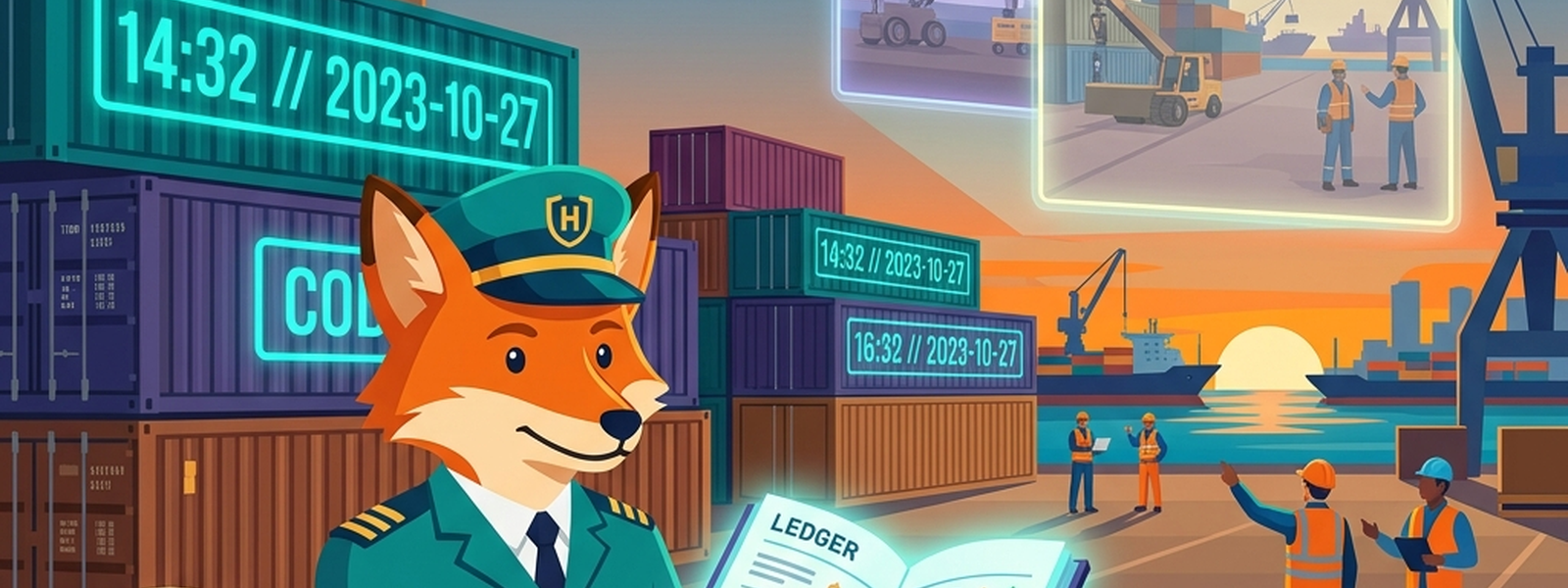
Ask a well-run container depot how many refrigerated containers are currently on site, and you get a number you can trust — because every addition and removal is logged in a single, consistent ledger, updated the instant it happens. Ask the open wharf the same question, historically, and the honest answer was “probably, as of the last time someone walked the whole thing and counted.” Two trucks could be loading the same crate at once, and nobody would necessarily know until it was too late.
That gap — a real, trustworthy ledger versus a best-effort estimate — is exactly what table formats like Delta Lake, Apache Iceberg, and Apache Hudi bring to lake storage.
In Plain English
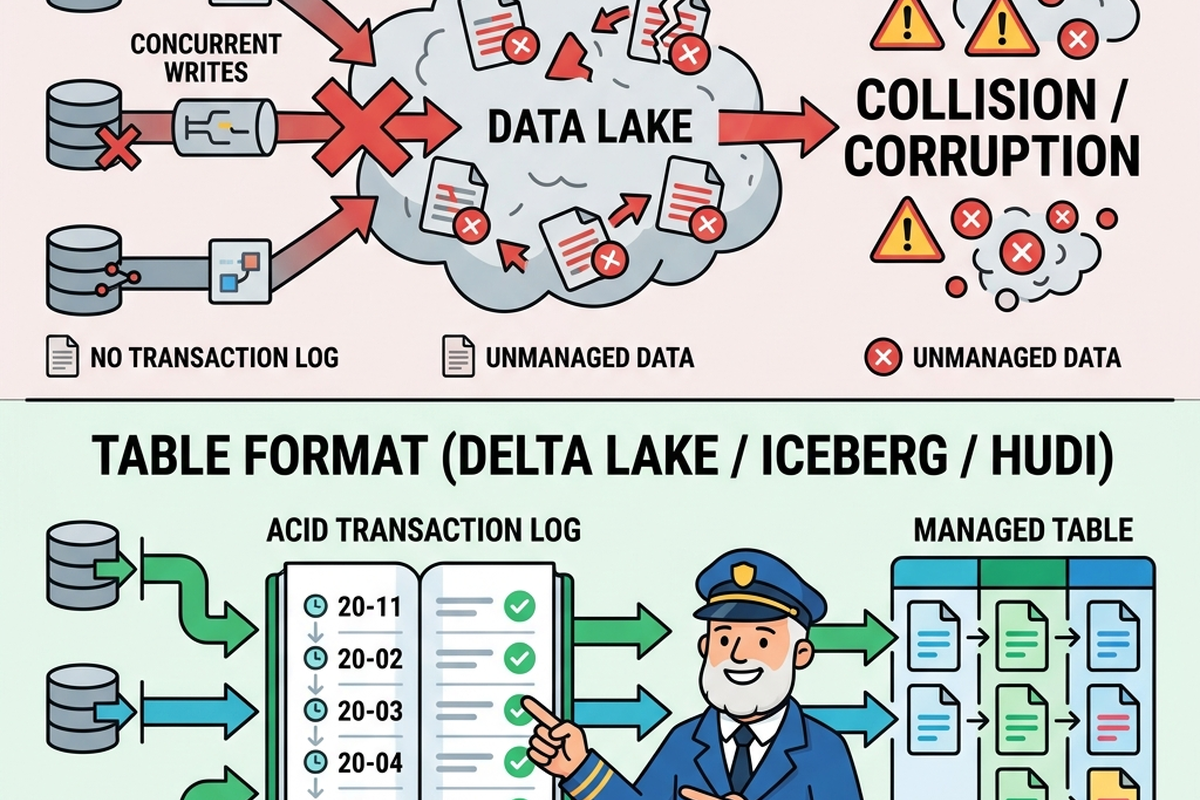
Table formats add a transactional metadata layer on top of raw files in a lake, providing ACID guarantees — atomicity, consistency, isolation, durability — that were traditionally only available in a database or warehouse. In practice, this means multiple people or processes can read and write the same lakehouse table simultaneously without corrupting it or seeing inconsistent results, and every change is tracked reliably enough to answer “what did this table look like an hour ago” with confidence.
The Old Way
Before table formats existed, a data lake was, structurally, just a collection of files in a folder. There was no built-in mechanism to guarantee that a query reading a table wouldn’t see a half-written update, or that two processes writing to the same table at the same time wouldn’t corrupt each other’s work. Consistency depended entirely on careful process discipline outside the storage layer itself — the wharf’s honest “probably” answer, backed by nothing more reliable than everyone being careful.
This was a genuine barrier to trusting a lake with business-critical workloads the way a warehouse had always been trusted. A team could build excellent pipelines and still get burned by a reader seeing an inconsistent, half-updated table simply because two operations happened to overlap.
What’s Changing (and Why AI Is the Reason)
- Table formats are the specific technology that makes the lakehouse promise real. Article 4 described a lakehouse offering warehouse-grade reliability over lake storage — table formats are literally how that promise gets kept, providing the transaction ledger a plain lake never had.
- Time travel is a genuinely new capability this ledger unlocks. Because table formats track every change over time, many support querying a table as it existed at a specific past moment — useful for auditing, debugging, and, increasingly, for reproducing the exact dataset an AI model was trained on.
- AI-assisted tooling increasingly manages the operational overhead table formats introduce. Table formats require ongoing maintenance — compacting small files, managing metadata growth — and AI-assisted platform tooling is increasingly automating this upkeep, similar to the automatic file organization mentioned in Article 8.
The Metaphor, Fully Extended
| Harbor Element | Table Format Concept |
|---|---|
| A single, trustworthy ledger tracking every container | A table format’s transaction log |
| Two trucks loading the same crate simultaneously without conflict | Concurrent writes corrupting an unmanaged lake table |
| A ledger that can answer “what was on site at 3pm yesterday” | Time travel querying a table’s state at a past point |
| A depot manager confirming today’s count matches the ledger exactly | ACID consistency guarantees |
| An automated crew quietly reorganizing scattered small crates overnight | Automated table maintenance like file compaction |
For Beginners: What to Actually Do
- Get concrete with what “ACID guarantees” actually prevent — specifically, look up an example of what can go wrong with concurrent writes to a plain, ungoverned lake to appreciate what a table format solves.
- Try using a time-travel query against a table format if you have access to one — querying a table’s past state is one of the more genuinely useful, tangible capabilities this technology unlocks.
- Learn to recognize the names Delta Lake, Apache Iceberg, and Apache Hudi as the major table formats in this space — you don’t need deep expertise in all three yet, but recognizing them is a useful baseline.
- Understand that a table format is a metadata layer on top of the file formats from Article 9, not a replacement for them — the two work together, not instead of each other.
For Practitioners and Leaders: The Deeper Layer
- If any business-critical workload still runs against an ungoverned lake without a table format, treat that as a real reliability gap worth closing, not a stylistic preference.
- Time travel querying has genuine compliance and AI-reproducibility value — evaluate whether your organization is actually using this capability where it would help, or whether it’s sitting unused despite being technically available.
- Table format maintenance overhead (metadata growth, small-file compaction) is real operational work — factor it into platform planning rather than treating table formats as maintenance-free just because AI-assisted tooling is improving.
- Choosing among Delta Lake, Iceberg, and Hudi is a genuine architectural decision with ecosystem and tooling-compatibility consequences — treat it with the same seriousness as the schema and format decisions covered earlier in this series.
Quick Recap
- Table formats like Delta Lake, Iceberg, and Hudi add a transactional metadata layer to lake storage, providing ACID guarantees that plain lake files never had.
- Before table formats, a lake had no built-in protection against concurrent writes corrupting a table or readers seeing inconsistent data.
- Table formats are the specific technology that makes lakehouse reliability real, and they enable useful capabilities like time-travel querying.
- They introduce real operational overhead, increasingly managed with AI-assisted automated maintenance.
Where This Fits in the Series
Article 9 covered the containers themselves. This article covered the ledger that makes tracking them trustworthy. Article 11 looks at the cranes and equipment used to actually move and query cargo once it’s reliably tracked.
Key References
- Databricks Lakehouse Architecture — Official reference guide on combining data warehouse performance with lake flexibility.
- Apache Iceberg Table Format Specification — Open-source table format standard for huge analytic datasets.
- Delta Lake Open Source Project — Open-source storage layer that brings ACID transactions to Apache Spark and big data workloads.
Subscribe to the Newsletter
Get the latest DataParables articles delivered straight to your inbox.