Opening Scene
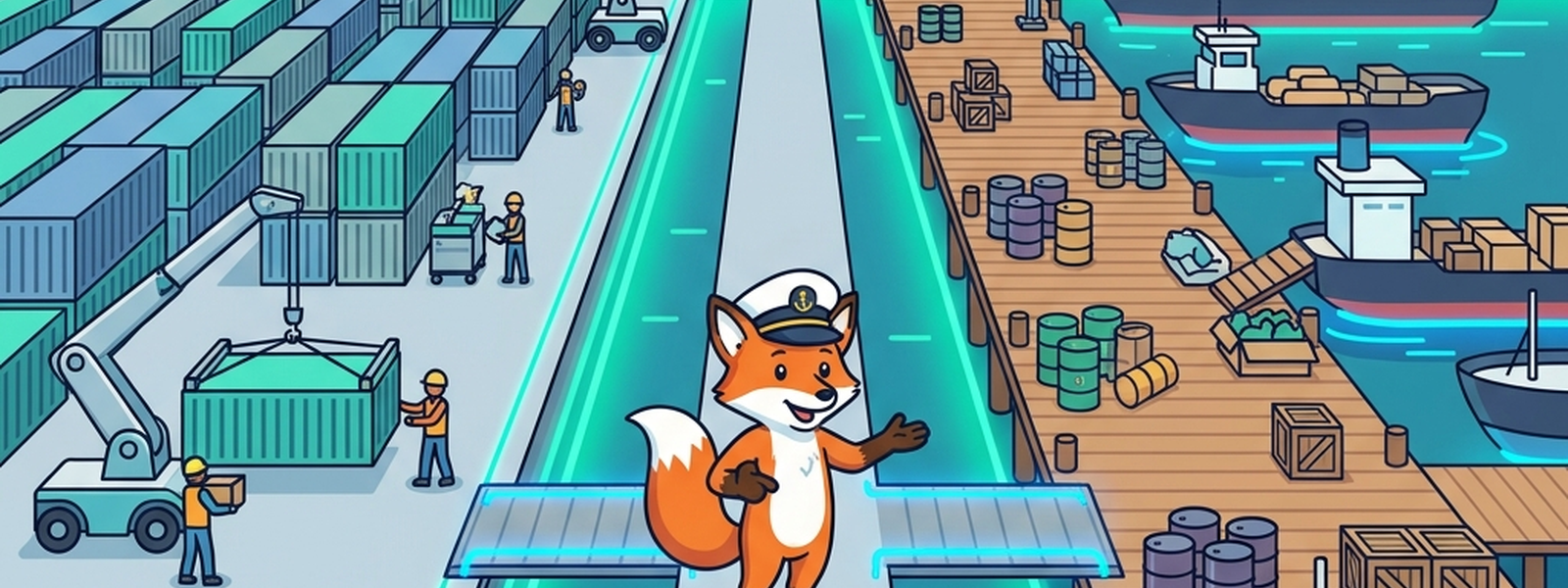
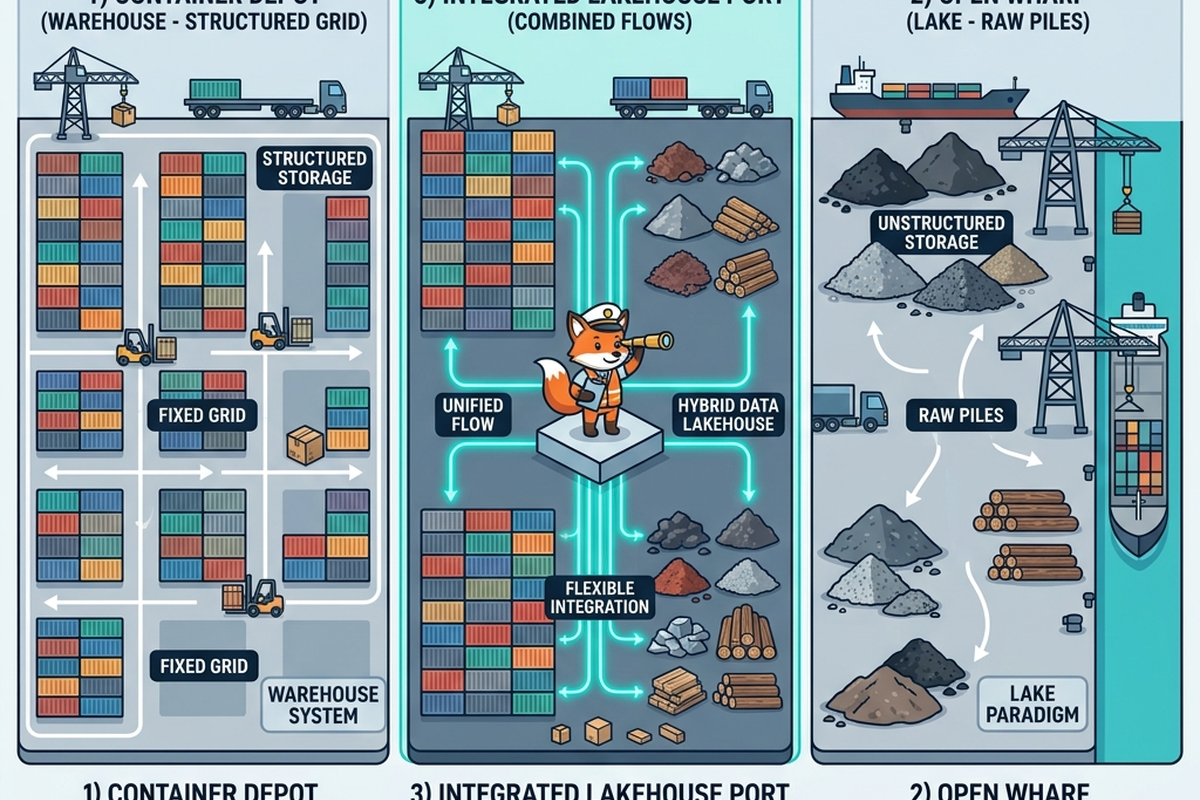
Sail into any major port and you’ll find two completely different operations happening side by side. On one side: a container depot, every box precisely slotted, labeled, and logged the moment it arrives, so any crane operator can find any container in seconds. On the other side: a wide-open wharf where ships simply unload whatever they’re carrying — pallets, barrels, loose cargo — onto the dock, fast and cheap, with sorting left for whenever someone actually needs to go find something.
Both are real, useful ways to run a harbor. Most modern ports run both at once. That’s this entire series in one image.
In Plain English
A data warehouse stores structured data in a carefully organized, predefined format — like the container depot, everything has its place before it arrives. A data lake stores data in whatever raw form it shows up in — structured, semi-structured, or completely unstructured — sorting deferred until someone actually needs to use it. A lakehouse is the modern attempt to run both operations as one integrated port, getting the organization of a warehouse and the flexibility of a lake without forcing every piece of cargo to choose a side before it even arrives.
The Old Way
Traditionally, choosing between a warehouse and a lake meant genuinely choosing — building one, then bolting on the other later if it turned out you needed both, which most organizations eventually did. Warehouses came first, historically: the container depot, built when storage was expensive and every crate had to earn its precisely labeled spot. Structured, curated, and fast to query, but expensive to load into and unwilling to accept anything that didn’t already fit its predefined format.
Data lakes emerged later, as storage got cheap enough that “just keep everything, sort it out later” became genuinely practical — the open wharf, accepting any cargo without asking questions first. Flexible and cheap, but that flexibility came at a cost: without discipline, a lake could become what the industry still half-jokingly calls a “data swamp” — cargo piled up with no manifest, technically stored, practically unusable.
What’s Changing (and Why AI Is the Reason)
- The lakehouse made “both” a real architecture, not just a compromise. Rather than choosing a warehouse or a lake and living with that choice’s limits, modern lakehouse technology brings warehouse-like structure and reliability directly to lake-style storage — one integrated port, not two separate operations awkwardly connected by a bridge. Later articles in this series go deep on how that actually works.
- AI needs both kinds of cargo at once. Traditional BI queries want warehouse-style structured tables. AI and machine learning workloads often want lake-style raw data, and increasingly, entirely new cargo types — embeddings, unstructured documents — that don’t cleanly belong to either camp. A port that can only handle one kind of cargo is increasingly a liability, not a simplification.
- AI is helping keep the wharf from becoming a swamp. One of the classic risks of a data lake — unsorted cargo nobody can find — is being addressed directly by AI-assisted cataloging and organization, automatically inferring what’s on the wharf and making it findable, rather than depending entirely on human discipline that historically didn’t scale.
The Metaphor, Fully Extended
| Harbor Element | Data Storage Concept |
|---|---|
| The container depot | A data warehouse |
| The open wharf | A data lake |
| A modern integrated port running both | A lakehouse |
| Every container labeled and slotted before storage | Structured data with a predefined schema |
| Cargo unloaded as-is, sorted later if ever | Raw, unstructured or semi-structured data |
| A wharf full of unlabeled, forgotten cargo | A “data swamp” — a lake with no usable organization |
| A dockworker cataloging cargo as it’s unloaded | AI-assisted metadata inference and cataloging |
For Beginners: What to Actually Do
- Before learning any specific tool, get comfortable with the core distinction: a warehouse expects structure up front; a lake accepts anything and sorts later. Nearly everything else in this series builds on that one idea.
- Don’t assume “lake” means “messy” and “warehouse” means “good” — a well-run lake and a well-run warehouse both take real discipline; a lake just defers where that discipline gets applied.
- When you hear “lakehouse,” picture one port running both operations well, not a third, entirely different thing — it inherits ideas from both sides.
- Get curious about what actually happens to unstructured data (documents, logs, images) at your own organization. That’s usually the fastest way to understand why lakes exist at all.
For Practitioners and Leaders: The Deeper Layer
- The historical warehouse-then-lake-then-lakehouse sequence reflects genuine technical constraints at each stage, not fashion — understanding why each approach emerged makes it much easier to evaluate whether a lakehouse platform’s specific claims are substantive or marketing.
- A data swamp is rarely a technology failure — it’s usually an organizational one, where “store now, organize later” quietly became “store now, organize never” because nobody owned the second half of that plan. AI-assisted cataloging helps, but doesn’t remove the need for actual ownership.
- As AI workloads pull more data toward lake-style raw storage, make sure your organization’s warehouse-side rigor (validated schemas, tested transformations, from earlier in this series’ pipelines coverage) doesn’t quietly erode just because it’s now technically optional at the storage layer.
- Treat “warehouse vs. lake vs. lakehouse” as a real architectural decision worth documenting explicitly, not a default inherited from whatever tool your team happened to adopt first.
Quick Recap
- A data warehouse stores structured data with a predefined format; a data lake stores raw data in any form, sorted later; a lakehouse aims to combine both in one system.
- Historically, choosing meant living with real trade-offs — warehouses were structured but rigid and expensive to load; lakes were flexible but risked becoming unusable swamps.
- Lakehouse technology is making “both” a genuine architecture rather than a compromise between two separate systems.
- AI workloads are a major reason both kinds of storage matter at once — different AI use cases genuinely need different forms of the same underlying data.
- AI-assisted cataloging is helping solve the data swamp problem, but real organizational ownership still matters.
Where This Fits in the Series
This is the opening article — the whole harbor, both docks, from the water. Article 2 walks onto the container depot itself: what actually makes a data warehouse a warehouse, and why structure has to come first.
Key References
- Databricks Lakehouse Architecture — Official reference guide on combining data warehouse performance with lake flexibility.
- Apache Iceberg Table Format Specification — Open-source table format standard for huge analytic datasets.
- Delta Lake Open Source Project — Open-source storage layer that brings ACID transactions to Apache Spark and big data workloads.
Subscribe to the Newsletter
Get the latest DataParables articles delivered straight to your inbox.