
Opening Scene
A fever feels, to the patient, like an unambiguous problem — uncomfortable, alarming, something to make go away as fast as possible. To a doctor reading it correctly, it’s actually useful information: the body actively signaling that something needs attention, and often pointing toward roughly where to look. Treating a fever purely as an annoyance to suppress, rather than a signal worth understanding, means missing what it was actually trying to tell you.
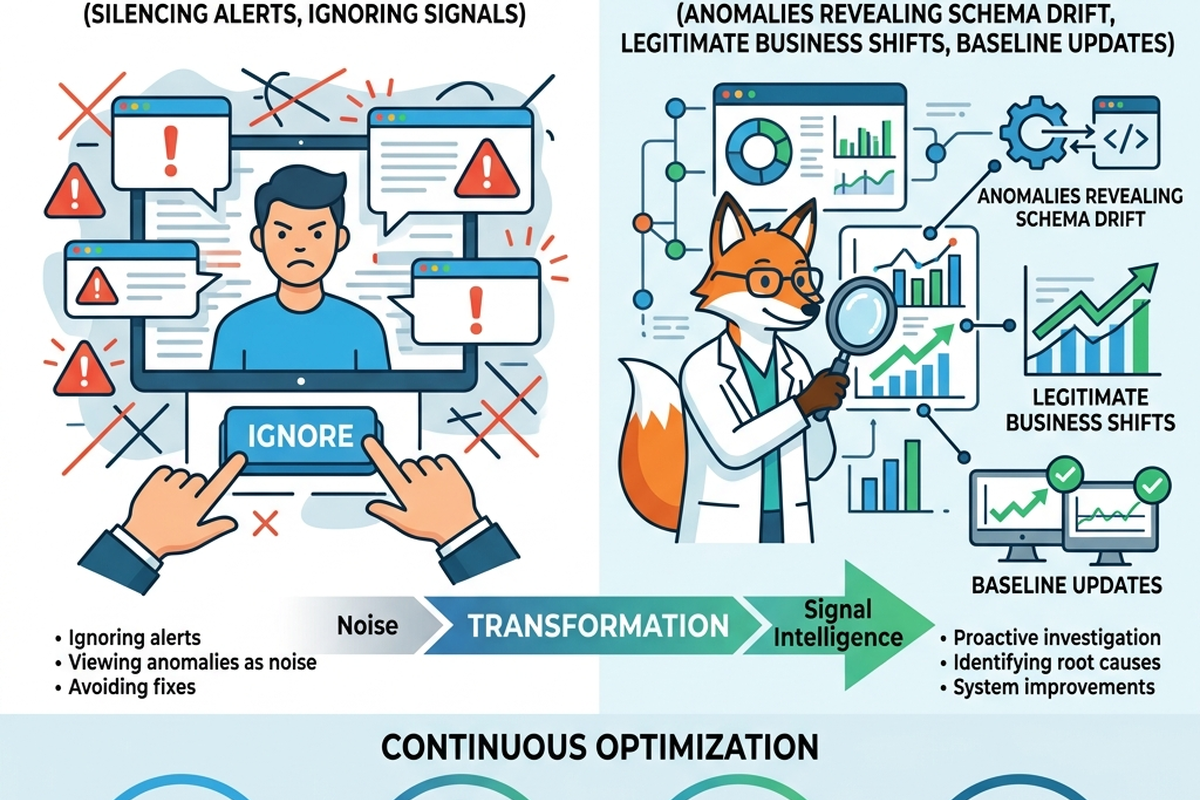
A data quality anomaly deserves that same reframe: not just an inconvenient alert to dismiss or silence, but a genuine signal worth understanding.
In Plain English
Reframing anomalies as signal means treating a detected data quality deviation as valuable information about what’s actually happening in a system, rather than purely as noise to be suppressed or an inconvenience to clear as quickly as possible. An anomaly that turns out to be a false alarm still often reveals something real — a baseline that needs updating, a legitimate business change nobody had accounted for yet.
The Old Way
Teams under alert fatigue (Article 6) commonly develop an adversarial relationship with anomaly detection: alerts are treated as obstacles to clear, dismissed as quickly as possible, with little curiosity about what they might actually be revealing. A false alarm gets closed and forgotten rather than investigated for what it says about the underlying baseline or system.
This adversarial posture has a real cost: teams miss the opportunity to learn from anomalies that don’t turn out to be genuine problems but do reveal something useful — a legitimate seasonal pattern the baseline hadn’t accounted for, a business process change nobody had communicated to the data team, a new, previously-unseen but entirely valid data pattern worth understanding.
What’s Changing (and Why AI Is the Reason)
- AI-assisted anomaly detection increasingly explains why something was flagged, not just that it was. Rather than a bare alert with no context, modern anomaly detection can surface what specifically deviated and how, giving a team a genuine starting point for understanding the signal rather than just a notification to dismiss.
- False alarms are becoming valuable training signal for improving baselines, not just wasted attention. When a team marks an alert as a false alarm, AI-assisted systems can incorporate that feedback to refine the underlying baseline (Article 5) directly, turning every false alarm into an improvement rather than pure overhead.
- AI is helping distinguish “interesting and worth investigating” from “genuinely broken.” Not every anomaly is a quality problem — some are legitimate, valuable signals about real changes in the business. AI-assisted classification can help separate these categories, preserving curiosity about genuinely interesting anomalies while still efficiently clearing the ones that are simply noise.
The Metaphor, Fully Extended
| Hospital Element | Anomaly-as-Signal Concept |
|---|---|
| A fever treated purely as an annoyance to suppress | An anomaly treated purely as noise to dismiss |
| A fever understood as the body signaling something worth investigating | An anomaly understood as a genuine signal worth understanding |
| A doctor using the fever’s pattern to narrow down where to look | Using an anomaly’s specific characteristics as an investigative starting point |
| Updating a patient’s known baseline after learning what turned out to be normal for them | Refining a data baseline after learning what a false alarm actually revealed |
| Distinguishing a fever worth real concern from mild, expected variation | AI-assisted classification separating genuinely interesting anomalies from simple noise |
For Beginners: What to Actually Do
- Practice treating your next false alarm as an investigation opportunity rather than pure overhead — ask what it actually reveals about the underlying data or baseline, even after confirming it’s not a genuine problem.
- Get comfortable with the idea that clearing an alert quickly isn’t the same as understanding it — the fastest resolution isn’t always the most valuable one.
- Notice patterns across multiple false alarms over time — a baseline that keeps generating the same kind of false alarm is telling you something specific and worth acting on.
- Approach anomaly detection with genuine curiosity rather than dread, even while recognizing that alert fatigue is a real and understandable response to poorly-tuned systems.
For Practitioners and Leaders: The Deeper Layer
- Build a lightweight feedback loop so that false-alarm classifications actually feed back into baseline refinement, rather than being discarded the moment an alert is closed.
- Track what fraction of your team’s anomaly investigations produce a genuine learning (a baseline update, a newly understood business pattern) versus pure dismissal — a low learning rate suggests either excellent baseline tuning or, more often, a team that’s stopped genuinely investigating.
- Invest in AI-assisted anomaly explanation specifically to reduce the investigative burden that historically made teams reluctant to engage curiously with alerts in the first place.
- Recognize that reframing anomalies as signal is partly a cultural shift, not purely a tooling one — teams under sustained alert fatigue need both better tools and explicit permission to treat investigation as valuable time, not overhead to minimize.
Quick Recap
- Anomalies are genuine signal worth understanding, not just noise to dismiss — even false alarms often reveal something real about a system’s baseline or legitimate changes in the business.
- Alert fatigue commonly pushes teams toward an adversarial, dismissive relationship with anomaly detection, losing the learning opportunity each alert represents.
- AI-assisted anomaly detection increasingly explains why something was flagged, and false-alarm feedback can directly improve underlying baselines over time.
- Distinguishing genuinely interesting anomalies from simple noise, with AI assistance, preserves valuable curiosity while still efficiently clearing pure noise.
Where This Fits in the Series
Article 8 covered checking vitals without disruption. This article covered treating what those checks find as genuine signal. Article 10 looks at what happens when something contagious needs to be quarantined before it spreads.
Key References
- OpenLineage Specification — Open standard for data lineage collection and pipeline observability metadata.
- Great Expectations Data Testing Framework — Open-source python tool for data quality assertions and validation.
- EU General Data Protection Regulation (GDPR) Official Text — European regulatory framework for data compliance, security, and governance.
Subscribe to the Newsletter
Get the latest DataParables articles delivered straight to your inbox.