
Opening Scene
A monitor that has to physically wake a sleeping patient every time it takes a reading isn’t actually a good monitor, whatever else it does well. The whole point of continuous monitoring is that it happens quietly, in the background, without disrupting the very thing it’s watching over. A vitals check that costs the patient their rest every single time is a trade-off nobody would actually accept for routine monitoring.
Data quality checks face the exact same design constraint: checking constantly is only genuinely valuable if the checking itself doesn’t meaningfully slow down or disrupt the systems being checked.
In Plain English
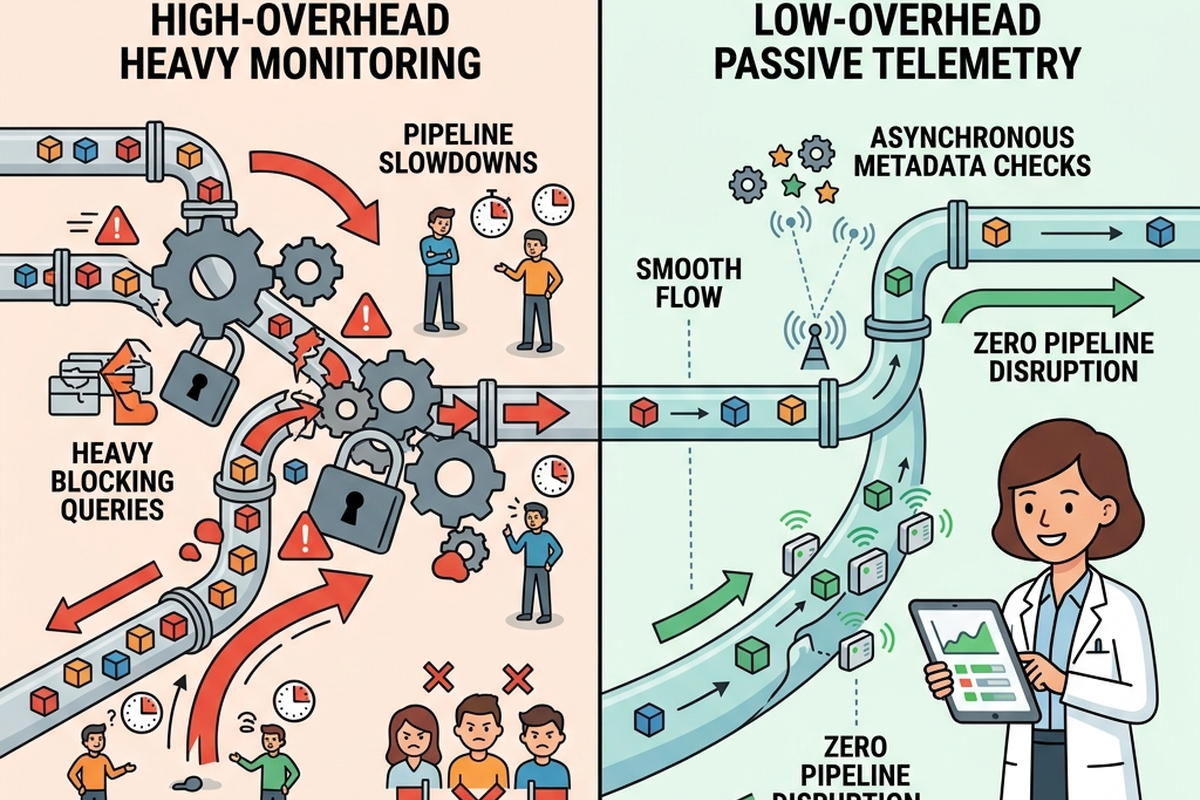
Low-overhead monitoring means checking data quality continuously without imposing significant performance cost or operational risk on the systems being monitored. This is a genuine engineering constraint, not just a nice-to-have — a quality check that noticeably slows down a production pipeline or query, every single time it runs, creates real pressure to disable it, undermining the whole point of continuous observability described earlier in this series.
The Old Way
Early quality checks were sometimes built as separate, heavyweight processes — a full scan of an entire dataset, run against the same production system actively serving real workloads, competing for the same resources. This approach could genuinely work for periodic, scheduled checks, where the overhead was accepted as a bounded, occasional cost.
Applied to continuous monitoring, this same heavyweight approach became genuinely counterproductive. Checking constantly with a resource-intensive method meant a persistent, ongoing performance tax on production systems — the exact “waking the patient every time” problem this article opened with, and a real, common reason organizations avoided expanding continuous monitoring coverage even when they knew it would help.
What’s Changing (and Why AI Is the Reason)
- Sampling-based and incremental checking techniques are making continuous monitoring genuinely lightweight. Rather than scanning an entire dataset every time, modern quality checks increasingly use statistically sound sampling or check only what’s actually changed since the last pass, dramatically reducing overhead while maintaining meaningful detection confidence.
- AI-assisted checks are getting smarter about what to actually examine, not just cheaper to run. Rather than checking everything uniformly, AI-assisted monitoring can focus computational effort on the specific fields and patterns most likely to reveal a real problem, based on what’s historically proven informative — a more efficient allocation of the same checking budget.
- Monitoring infrastructure is increasingly decoupled from production infrastructure. Similar to the compute-storage separation covered for lakehouses elsewhere on this site, quality checks increasingly run against a separated, elastically-scaled monitoring layer rather than directly competing with production workloads for the same resources.
The Metaphor, Fully Extended
| Hospital Element | Low-Overhead Monitoring Concept |
|---|---|
| Waking a patient for every single vitals check | A heavyweight quality check imposing real overhead every run |
| A quiet, wearable monitor checking continuously without disturbing sleep | Lightweight, sampling-based continuous quality checking |
| Checking every square inch of the patient every time | Scanning an entire dataset on every check, regardless of what’s actually new |
| Checking only what’s changed since the last reading | Incremental checking, examining only recently changed data |
| A separate monitoring device, not competing with the patient’s own equipment for power | Monitoring infrastructure decoupled from production system resources |
For Beginners: What to Actually Do
- When evaluating a quality check, ask specifically about its overhead — does it scan everything every time, or does it check incrementally or via sampling? That distinction matters a lot for how sustainable continuous monitoring actually is.
- Get comfortable with sampling as a legitimate, statistically sound technique, not a lesser shortcut compared to checking everything — well-designed sampling can catch most real issues at a fraction of the cost.
- Practice reasoning through the trade-off a heavyweight check creates: real detection value, weighed against a real, recurring performance cost on the system being checked.
- Notice when a team disables or reduces monitoring specifically because of its performance impact — that’s a strong signal the checking approach itself needs redesigning, not that monitoring itself was a bad idea.
For Practitioners and Leaders: The Deeper Layer
- Audit existing quality checks specifically for overhead, and prioritize migrating heavyweight, full-scan checks toward sampling-based or incremental approaches, especially for anything running against production systems.
- Treat “the monitoring itself is too expensive to run continuously” as a solvable engineering problem, not an inherent limit — modern sampling and incremental techniques have moved this trade-off significantly in monitoring’s favor.
- Invest in decoupled monitoring infrastructure specifically to remove the resource-contention pressure that historically led teams to disable or scale back checks under load.
- Track any instance of monitoring being disabled or reduced due to performance concerns as a specific signal worth investigating and fixing, rather than accepting reduced coverage as a permanent trade-off.
Quick Recap
- Low-overhead monitoring checks data quality continuously without imposing significant performance cost on the systems being checked — a real engineering constraint, not a minor detail.
- Heavyweight, full-scan checking approaches historically created a genuine performance tax that led teams to avoid expanding continuous monitoring coverage.
- Sampling-based and incremental checking techniques, along with AI-assisted focused checking, dramatically reduce overhead while maintaining meaningful detection confidence.
- Decoupling monitoring infrastructure from production infrastructure removes the resource-contention pressure that historically limited continuous monitoring adoption.
Where This Fits in the Series
Article 7 covered the chart that enables diagnosis. This article covered checking vitals without disturbing the patient. Article 9 looks at treating a fever not as a nuisance, but as useful information.
Key References
- OpenLineage Specification — Open standard for data lineage collection and pipeline observability metadata.
- Great Expectations Data Testing Framework — Open-source python tool for data quality assertions and validation.
- EU General Data Protection Regulation (GDPR) Official Text — European regulatory framework for data compliance, security, and governance.
Subscribe to the Newsletter
Get the latest DataParables articles delivered straight to your inbox.