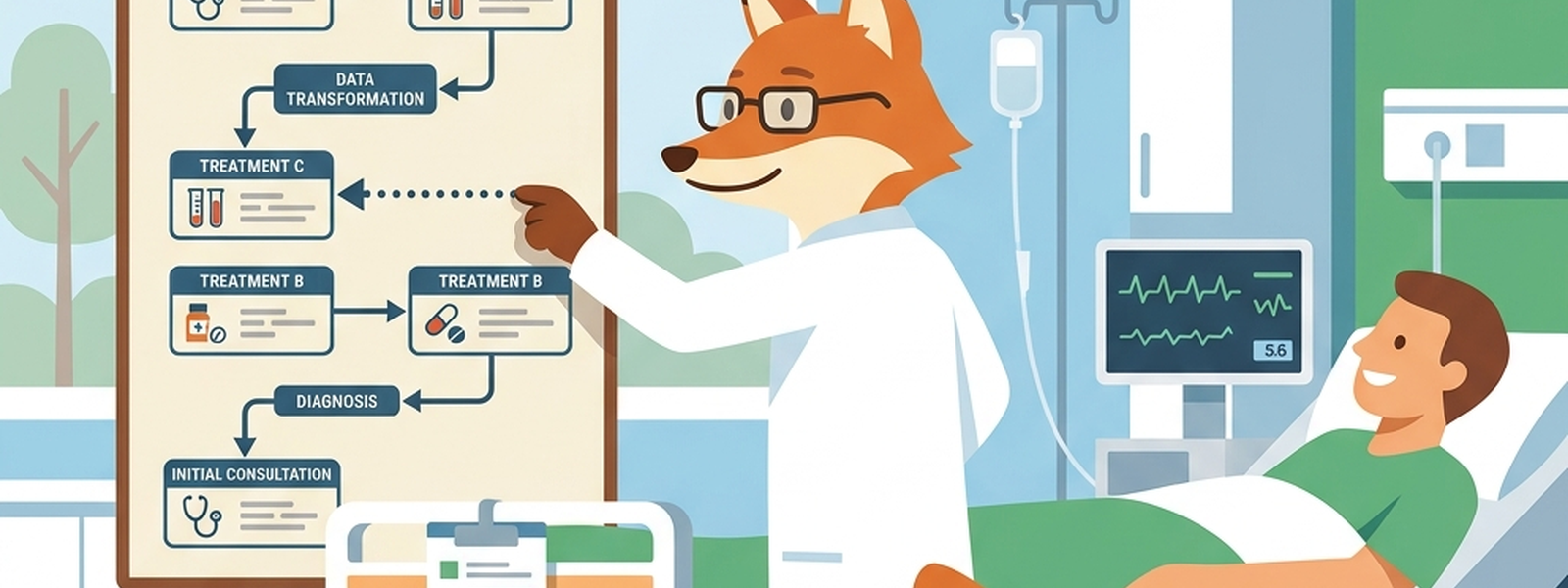
Opening Scene
Every treatment, every medication given, every test result gets recorded on the chart at the foot of the bed — not for paperwork’s sake, but because the next clinician treating this patient urgently needs to know exactly what’s already happened. Without that chart, every new shift starts from zero, guessing at a history that already exists somewhere, just not anywhere anyone can actually see.
Data lineage is that chart, and without it, root-cause investigation (Article 3) is mostly guesswork.
In Plain English
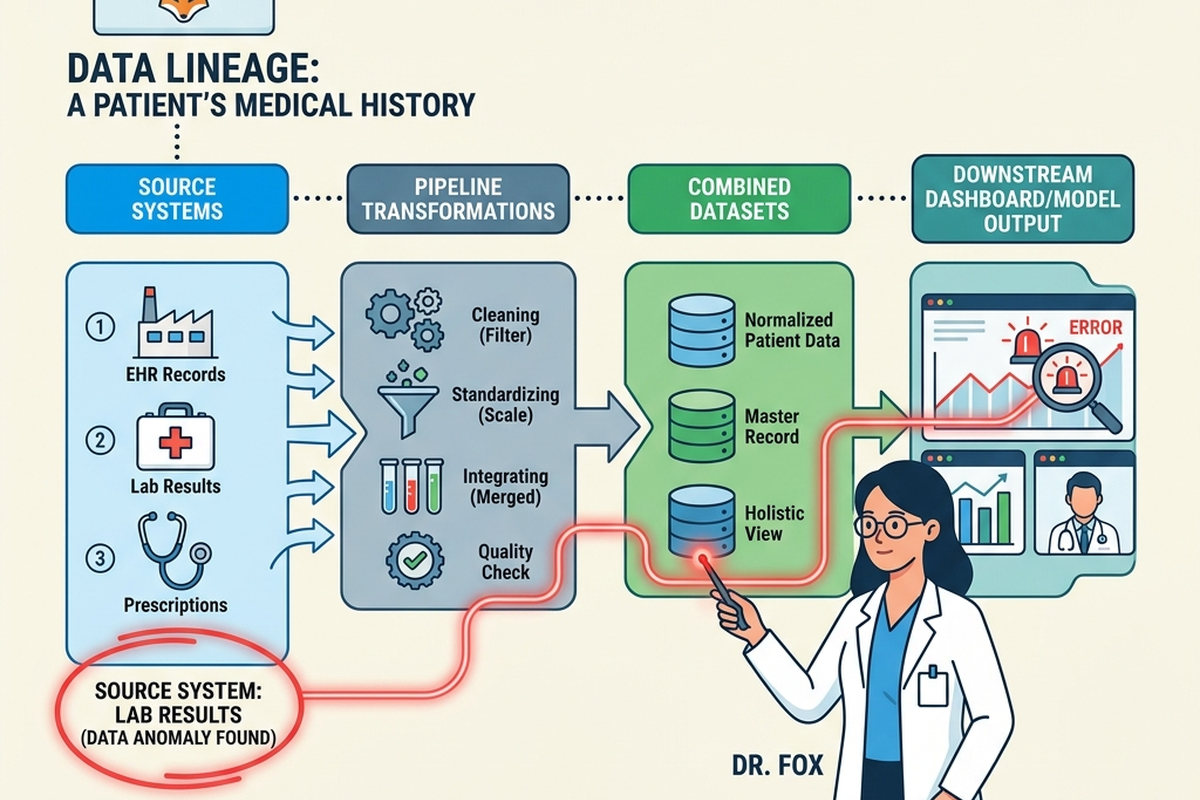
Data lineage tracks where data came from and everything that happened to it along the way — which source systems fed it, what transformations were applied, what other datasets it was combined with. When a quality problem surfaces downstream, lineage is what actually lets someone trace it back to where it originated, rather than starting an investigation with no map of the territory.
The Old Way
Many data systems, especially older ones, were built without systematic lineage tracking — pipelines transformed and combined data through steps that were understood by whoever built them at the time, but never formally documented or tracked in a way a different investigator could follow later. When something went wrong, tracing the actual cause meant relying on institutional memory or painstaking manual investigation, if it could be done at all.
This created a predictable, frustrating pattern during incidents: a bad number would surface in a report, and the team would spend a disproportionate share of total incident time simply figuring out where the data actually came from and what had happened to it, before any real diagnosis of the actual problem could even begin.
What’s Changing (and Why AI Is the Reason)
- Automated lineage tracking has become standard, not exceptional. Modern data platforms increasingly capture lineage automatically as data moves and transforms, rather than depending on manual documentation that inevitably falls out of date — directly extending the active metadata theme covered elsewhere on this site into the specific context of quality investigation.
- AI-assisted lineage analysis can trace a problem back automatically, not just display a map for a human to follow manually. Rather than requiring a person to manually trace through a lineage graph, AI-assisted tooling can follow it directly, correlating a downstream symptom with the specific upstream change most likely responsible.
- Lineage is becoming a prerequisite for trustworthy AI-generated root-cause suggestions. The AI-assisted root-cause analysis covered in Article 3 depends entirely on good lineage data underneath it — without it, an AI system has no real map to trace through, and any suggestion it offers is closer to a guess than a genuine diagnosis.
The Metaphor, Fully Extended
| Hospital Element | Data Lineage Concept |
|---|---|
| The chart at the foot of the bed | A dataset’s lineage record |
| Every treatment and test result logged as it happens | Every transformation and source tracked automatically as data moves |
| A new shift starting from zero with no chart to consult | An investigation starting with no lineage map to follow |
| A clinician quickly reviewing the chart to understand what’s already happened | An engineer or AI tool tracing lineage to understand a data problem’s origin |
| A specialist reading the whole chart at a glance to spot the likely cause | AI-assisted lineage analysis correlating a symptom with its likely upstream cause |
For Beginners: What to Actually Do
- Before investigating any data quality issue, check whether lineage information is actually available for the affected dataset, and start there rather than guessing at where the problem might have originated.
- Practice tracing a simple pipeline’s lineage by hand at least once, even manually, to build real intuition for what lineage tracking actually captures and why it matters.
- Get comfortable with the idea that lineage isn’t just documentation — it’s active investigative infrastructure, directly enabling the root-cause diagnosis Article 3 described.
- Notice how much faster an investigation goes when good lineage is available versus when it isn’t — that felt difference is the best argument for why this matters.
For Practitioners and Leaders: The Deeper Layer
- Audit your critical data pipelines for actual lineage coverage, and prioritize closing gaps for anything feeding high-severity, high-triage-priority use cases identified in Article 6.
- Favor platforms and tools with automated lineage capture over ones depending on manual documentation — manual lineage documentation reliably falls out of date and can’t be fully trusted during a real incident.
- Measure average incident investigation time as a proxy for lineage maturity — a consistently long time-to-diagnosis, relative to time-to-fix, often points to a lineage gap rather than a diagnosis-skill gap.
- Treat lineage investment as a direct prerequisite for trustworthy AI-assisted root-cause analysis — without it, AI suggestions are guesses dressed up with more confidence than they’ve earned.
Quick Recap
- Data lineage tracks where data came from and what happened to it along the way, and is essential for tracing a downstream quality problem back to its actual origin.
- Without systematic lineage tracking, incident investigation historically consumed disproportionate time just reconstructing what had happened before real diagnosis could begin.
- Automated lineage capture is now standard in modern platforms, and AI-assisted lineage analysis can trace problems back automatically rather than requiring manual tracing.
- Good lineage is a direct prerequisite for trustworthy AI-assisted root-cause analysis — without it, AI suggestions are closer to guesses than genuine diagnoses.
Where This Fits in the Series
Article 6 covered prioritizing which issues get attention first. This article covered the chart that makes real diagnosis possible. Article 8 looks at checking a patient’s vitals without disturbing them in the process.
Key References
- OpenLineage Specification — Open standard for data lineage collection and pipeline observability metadata.
- Great Expectations Data Testing Framework — Open-source python tool for data quality assertions and validation.
- EU General Data Protection Regulation (GDPR) Official Text — European regulatory framework for data compliance, security, and governance.
Subscribe to the Newsletter
Get the latest DataParables articles delivered straight to your inbox.