
Opening Scene
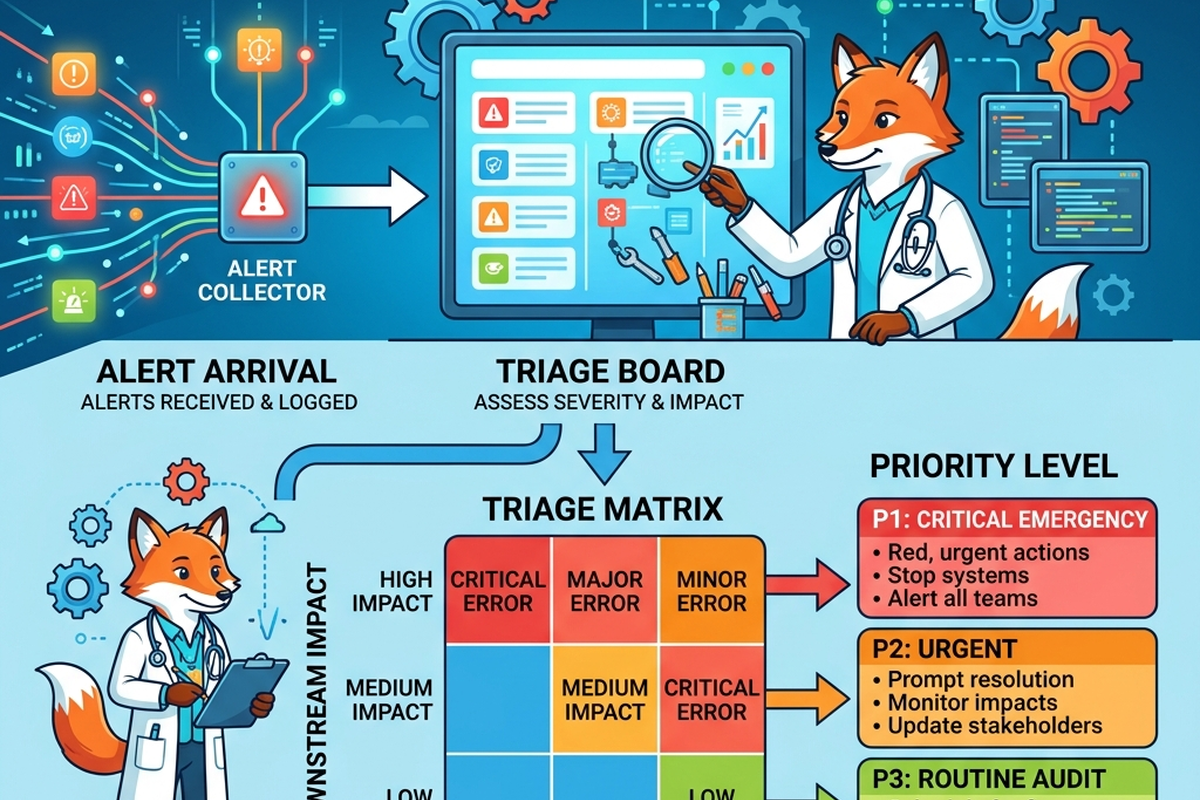
An emergency room doesn’t treat patients in the order they walked in the door. A nurse triages every arrival by actual severity, because treating a minor sprain with the same urgency as chest pain means the truly urgent case waits behind cases that could safely wait. Triage isn’t about ignoring the minor cases — it’s about making sure limited attention goes where it actually matters most, first.
A data quality program facing dozens of simultaneous alerts needs the exact same discipline, and a lot of teams never build it.
In Plain English
Quality issue triage means assessing every detected data problem by its actual severity and business impact, and responding in that priority order, rather than treating every alert as equally urgent or working through them in whatever order they happened to arrive. Severity depends on factors like how many downstream systems or decisions depend on the affected data, how wrong the data actually is, and how visible or consequential the impact would be if left unaddressed.
The Old Way
Without deliberate triage, quality alerts were often handled in arrival order, or by whoever happened to notice first — a reasonable approach when alert volume was low, but one that breaks down as monitoring coverage (Article 2) expands and the number of detected issues grows. A minor, low-impact data quality quirk could consume attention that a serious, high-impact issue badly needed.
This also produced a predictable morale problem: teams facing an undifferentiated flood of alerts, with no clear sense of what actually mattered most, tended to develop alert fatigue — a documented pattern in monitoring generally, where an overwhelming, undifferentiated stream of alerts leads people to start ignoring all of them, including the genuinely important ones.
What’s Changing (and Why AI Is the Reason)
- AI-assisted severity scoring is making genuine triage practical at real alert volume. Rather than a person manually assessing every single alert’s downstream impact, AI-assisted analysis can estimate severity based on how many systems or decisions actually depend on the affected data, drawing on the same lineage and active-metadata concepts covered elsewhere on this site.
- AI is helping correlate related alerts into one meaningful incident. Similar to the multi-signal correlation this site’s pipeline and streaming coverage describes, several individually minor-looking alerts can be recognized as symptoms of one underlying, more serious issue — directly reducing the alert-fatigue risk this article describes.
- AI systems’ own criticality is becoming a real input to triage scoring. A quality issue affecting data feeding a customer-facing AI agent or a model in active production deserves different urgency than one affecting an occasionally-viewed internal report — triage logic increasingly needs to account for this distinction explicitly.
The Metaphor, Fully Extended
| Hospital Element | Triage Concept |
|---|---|
| Treating patients in arrival order regardless of severity | Handling quality alerts in arrival order regardless of impact |
| A nurse assessing severity the moment a patient arrives | AI-assisted severity scoring for a detected quality issue |
| Chest pain versus a minor sprain, treated with appropriately different urgency | A high-impact issue versus a low-impact one, prioritized accordingly |
| Recognizing several symptoms as one underlying emergency | Correlating multiple alerts into one meaningful incident |
| Staff becoming numb to constant, undifferentiated alarms | Alert fatigue from undifferentiated, unprioritized quality alerts |
For Beginners: What to Actually Do
- Practice assessing a quality issue’s actual severity explicitly — how many downstream systems depend on this data, how wrong is it, how visible would the consequence be — rather than reacting to alert volume or noise level alone.
- Get comfortable with the idea that not every quality alert deserves the same urgency, and that’s a feature of a mature program, not a sign of neglect toward the lower-priority ones.
- Notice alert fatigue in yourself or a team you’re part of as a real, specific signal that triage discipline is missing, not just a normal cost of doing monitoring.
- When multiple alerts fire close together, practice checking whether they might actually be symptoms of one underlying issue before treating them as unrelated.
For Practitioners and Leaders: The Deeper Layer
- Build explicit severity scoring into your quality alerting pipeline, grounded in real downstream dependency data (lineage, usage), not just alert type or arbitrary rule categorization.
- Treat rising alert fatigue as a leading indicator worth tracking directly — a team that’s started ignoring alerts is a team that will eventually miss a genuinely serious one.
- Invest in AI-assisted alert correlation specifically to reduce the volume of individually-triaged items your team faces, surfacing fewer, more meaningful incidents rather than more, noisier ones.
- Explicitly weight quality issues affecting AI-consumed data higher in your triage scoring — the lack of a human in the loop downstream means these issues can cause real damage faster and more silently than ones affecting a human-reviewed report.
Quick Recap
- Quality issue triage means responding to detected problems in order of actual severity and impact, not arrival order or alert volume.
- Without deliberate triage, teams risk both misallocated attention and alert fatigue, where an undifferentiated flood of alerts leads people to start ignoring all of them.
- AI-assisted severity scoring and alert correlation make genuine triage practical even at real, high alert volume.
- Quality issues affecting AI-consumed data deserve explicitly higher triage priority, given the lack of a human in the loop to catch an obviously wrong number downstream.
Where This Fits in the Series
Article 5 covered establishing a real baseline. This article covered prioritizing which issues get attention first. Article 7 looks at the chart that makes real diagnosis possible in the first place: data lineage.
Key References
- OpenLineage Specification — Open standard for data lineage collection and pipeline observability metadata.
- Great Expectations Data Testing Framework — Open-source python tool for data quality assertions and validation.
- EU General Data Protection Regulation (GDPR) Official Text — European regulatory framework for data compliance, security, and governance.
Subscribe to the Newsletter
Get the latest DataParables articles delivered straight to your inbox.