Opening Scene
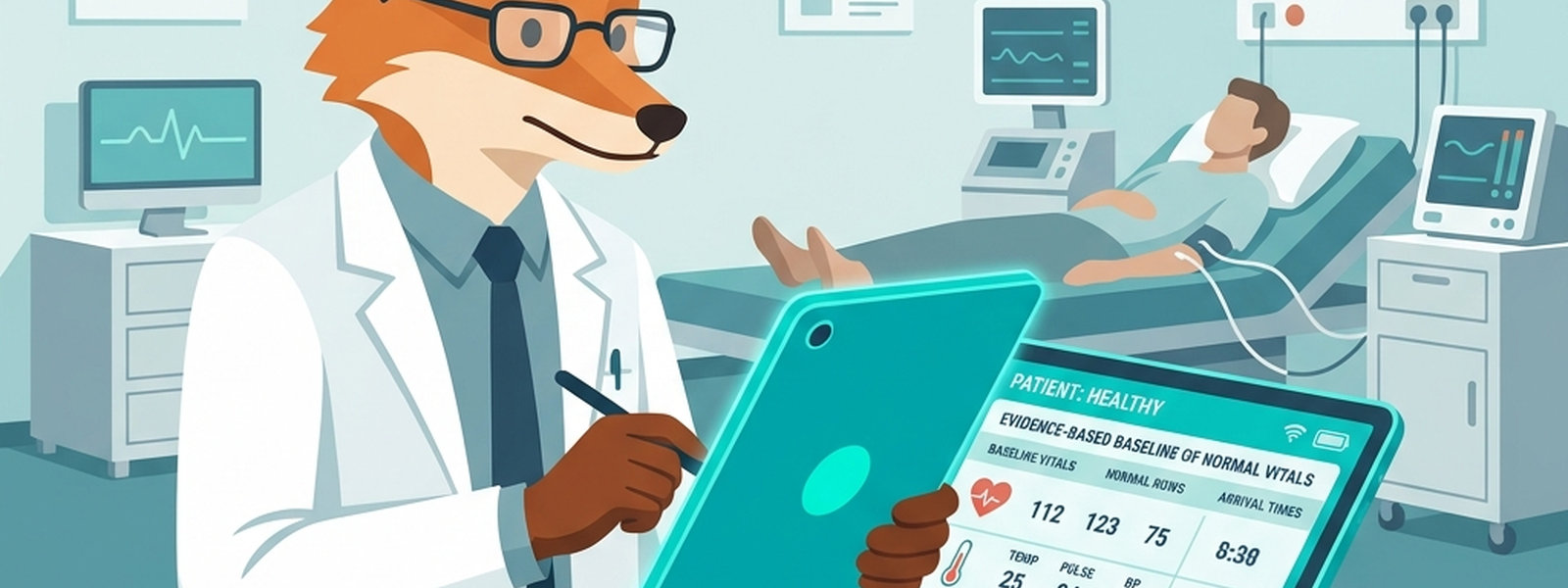
A reading of 100.4 degrees might be a mild fever for one patient and a genuine emergency for another, whose normal baseline runs unusually low. You can’t actually interpret a vital sign as abnormal without first knowing what normal looks like for this specific patient, under these specific conditions. Skip that step, and every subsequent reading is just a number with no real meaning attached.
Data quality monitoring has this exact same prerequisite, and it’s one of the most commonly skipped steps in building a real observability practice.
In Plain English
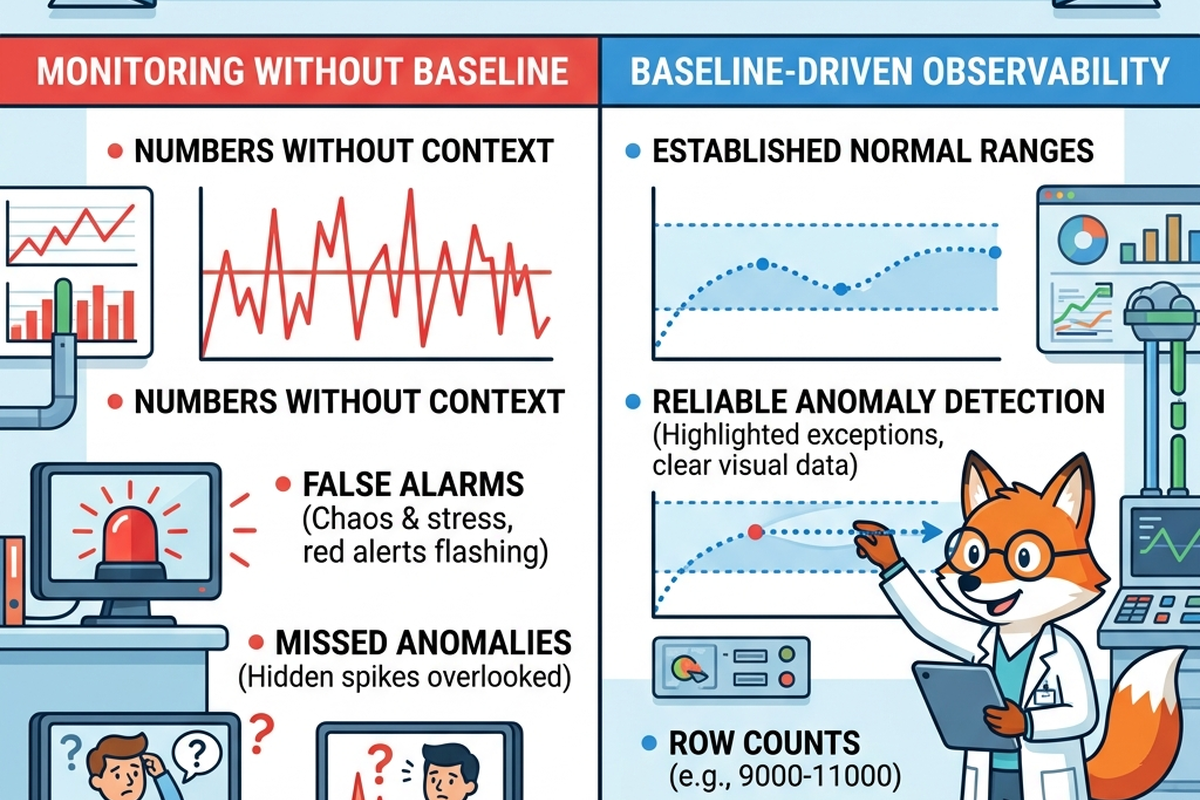
A baseline is a documented, evidence-based understanding of what normal actually looks like for a specific dataset — typical row counts, typical value ranges, typical arrival timing, typical null rates. Without an established baseline, quality monitoring has nothing to compare current behavior against, making it impossible to reliably distinguish a genuine anomaly from ordinary variation.
The Old Way
Early data quality checks often relied on fixed, manually-set thresholds decided once, sometimes based on little more than an educated guess — “alert if row count drops below 1,000.” These thresholds weren’t grounded in an actual, evidence-based understanding of the data’s real behavior, and they aged poorly as the underlying data naturally evolved.
This produced two predictable failure modes: false alarms when normal, expected variation (a seasonal dip, a weekend pattern) tripped a threshold that never accounted for it, and missed real problems when a threshold set too loosely let a genuine anomaly through unflagged. Both failure modes traced back to the same root issue — no genuine baseline behind the threshold in the first place.
What’s Changing (and Why AI Is the Reason)
- AI-learned baselines replace guessed thresholds with genuine, evidence-based understanding. Rather than a person setting a number based on intuition, AI-assisted analysis can learn a dataset’s actual historical behavior — including patterns that vary by day of week, season, or business cycle — establishing a baseline grounded in real data, not a guess.
- Baselines can now update themselves as data genuinely evolves. A static baseline set once and never revisited eventually drifts out of sync with a dataset’s legitimately changing behavior; AI-assisted baselines can adapt over time, distinguishing genuine long-term shifts from short-term anomalies.
- Establishing a baseline is now fast enough to do for far more datasets than before. Manually studying a dataset’s historical behavior to set sensible thresholds used to be a real time investment, limiting how many datasets got this treatment; AI-assisted baseline generation makes it practical to do this systematically across a much larger portion of an organization’s data.
The Metaphor, Fully Extended
| Hospital Element | Baseline Concept |
|---|---|
| A patient’s individually normal vital sign range | A dataset’s genuine, established normal behavior |
| Guessing at a “normal” temperature without ever actually checking this patient | A quality threshold set by guesswork rather than evidence |
| A false alarm because the guessed threshold didn’t account for this patient’s normal variation | A quality alert triggered by normal, expected variation |
| A missed real fever because the guessed threshold was set too loosely | A real quality issue missed because the threshold was too permissive |
| An ongoing chart tracking how a patient’s normal baseline shifts over time | An AI-learned baseline that adapts as a dataset’s behavior legitimately evolves |
For Beginners: What to Actually Do
- Before setting or trusting any quality threshold, ask whether it’s actually grounded in observed historical behavior, or whether it’s a guess someone made once — that distinction determines how much to trust it.
- Practice studying a real dataset’s actual historical pattern (row counts over time, value distributions) before assuming you know what “normal” looks like for it.
- Get comfortable with the idea that normal often varies by day of week or season — a threshold that doesn’t account for this will produce false alarms or miss real problems.
- Notice when a quality alert turns out to be a false alarm, and use it as a specific signal that the underlying baseline needs review, not just a one-off annoyance to dismiss.
For Practitioners and Leaders: The Deeper Layer
- Audit your existing quality thresholds for how many are genuinely evidence-based versus guessed once and never revisited — this is a common, often significant gap even in otherwise mature quality programs.
- Invest in AI-assisted baseline generation specifically to extend genuine, evidence-based monitoring to a much larger share of your data than manual baselining could ever practically cover.
- Treat baseline drift as an expected, normal part of operating a monitoring program, not a failure — build in periodic review so baselines stay aligned with how the data is actually, legitimately behaving now.
- Track false alarm rate and missed-issue rate as explicit signals of baseline quality — both point back to the same underlying fix: a better-grounded baseline, not just threshold tweaking in isolation.
Quick Recap
- A baseline is an evidence-based understanding of a dataset’s normal behavior, without which quality monitoring can’t reliably distinguish genuine anomalies from ordinary variation.
- Early quality checks often relied on guessed, fixed thresholds, producing both false alarms and missed real issues.
- AI-learned baselines are grounded in actual historical data, can adapt as behavior legitimately evolves, and are practical to establish across far more datasets than manual baselining allowed.
- False alarms and missed issues both trace back to the same underlying fix: a genuinely evidence-based baseline.
Where This Fits in the Series
Article 4 covered the six vital signs worth checking. This article covered knowing what normal actually looks like before checking them. Article 6 looks at what happens when multiple patients need attention at once, and who gets seen first.
Key References
- OpenLineage Specification — Open standard for data lineage collection and pipeline observability metadata.
- Great Expectations Data Testing Framework — Open-source python tool for data quality assertions and validation.
- EU General Data Protection Regulation (GDPR) Official Text — European regulatory framework for data compliance, security, and governance.
Subscribe to the Newsletter
Get the latest DataParables articles delivered straight to your inbox.