
Opening Scene
A doctor doesn’t take one measurement and call it a complete assessment. A real checkup covers a specific, established set of vital signs — temperature, pulse, blood pressure, breathing rate, and more — because any one of them alone tells an incomplete story. A patient with a perfectly normal temperature can still be in serious trouble if their blood pressure is dangerously low.
Data quality has its own established set of dimensions, and checking only one — usually “is anything obviously missing” — leaves just as much of the real picture unseen.
In Plain English
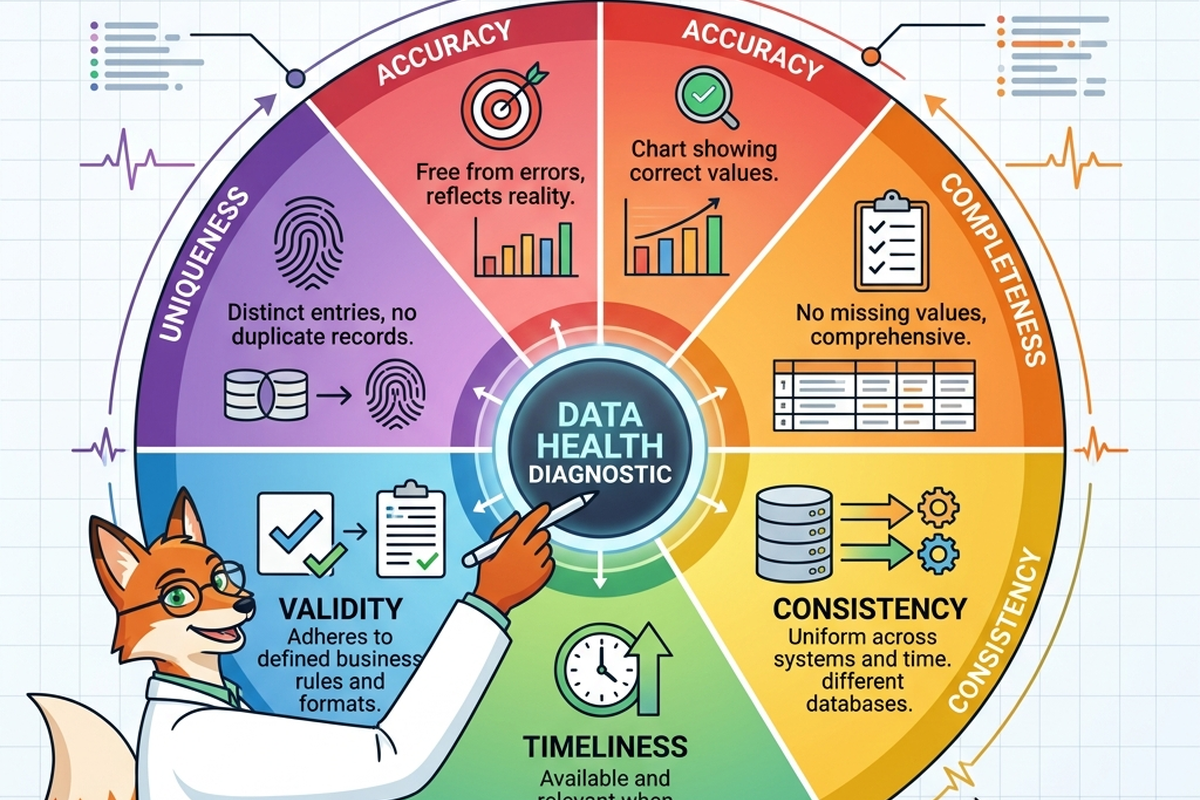
Data quality is commonly assessed across six core dimensions: accuracy (does the data reflect reality correctly), completeness (is anything missing that should be there), consistency (does the same fact agree across different places it appears), timeliness (is the data current enough to be useful), validity (does the data conform to its expected format and rules), and uniqueness (are there unwanted duplicates). A quality program that only checks one or two of these has real, predictable blind spots.
The Old Way
Many organizations’ quality checks historically focused almost entirely on completeness and validity — is a required field missing, does a value fall within an expected range — because these are the easiest dimensions to check with simple, rule-based logic. A null check or a range check is straightforward to write and run.
This left the harder-to-check dimensions largely unmonitored. Consistency issues (the same customer’s name spelled two different ways across systems), timeliness problems (data that’s technically complete and valid but three weeks stale), and accuracy issues (data that’s perfectly well-formed but simply wrong) often went undetected precisely because they required more sophisticated checking than a simple rule could provide.
What’s Changing (and Why AI Is the Reason)
- AI-assisted checking is making the harder dimensions genuinely checkable, not just theoretically important. Consistency checks across disparate systems, and even some accuracy checks (does this value look plausible given everything else known about this record), are increasingly practical with AI-assisted analysis, closing a real historical gap in what quality programs could actually monitor.
- Timeliness monitoring is directly connected to the observability themes covered earlier in this series. Knowing whether data is current enough to be useful depends on the same continuous monitoring infrastructure Article 2 described, applied specifically to freshness as one of the six dimensions.
- AI systems are exposed to failures across all six dimensions in ways that compound. An AI model trained on data that’s complete and valid but subtly inaccurate, or inconsistent across sources, can learn confidently wrong patterns — making comprehensive coverage across all six dimensions more consequential than when only human analysts, who might notice something off, were the primary consumers.
The Metaphor, Fully Extended
| Hospital Element | Data Quality Dimension |
|---|---|
| Checking only temperature and calling it complete | Checking only completeness and validity, missing the rest |
| Blood pressure, a vital sign easy to overlook without proper equipment | Consistency, a dimension requiring more sophisticated checking |
| A patient’s history matching across every chart consulted | Data consistency across different systems |
| Vitals taken recently enough to reflect current condition | Timeliness — data current enough to be useful |
| A full, established panel of vital signs, not an arbitrary partial set | The six established data quality dimensions, checked comprehensively |
For Beginners: What to Actually Do
- Memorize the six dimensions — accuracy, completeness, consistency, timeliness, validity, uniqueness — as a genuine checklist, not just terminology to recognize.
- For any dataset you work with regularly, try to identify at least one real example of a potential issue in each of the six dimensions, even hypothetically — this builds real intuition for what each one actually means in practice.
- Notice which dimensions your current tools and checks actually cover, and which are effectively unmonitored — that gap is worth naming explicitly rather than assuming coverage that doesn’t exist.
- Understand that accuracy is often the hardest dimension to check directly, since it requires knowing the actual truth, not just whether data is well-formed — that’s part of why it’s historically been under-monitored.
For Practitioners and Leaders: The Deeper Layer
- Audit your current data quality program explicitly against all six dimensions, not just the ones your existing tooling happens to cover — most programs, even mature ones, have real gaps here worth surfacing.
- Prioritize closing consistency and accuracy monitoring gaps specifically for data with real downstream consequences — these are historically the most under-monitored dimensions and often the most damaging when they fail silently.
- AI-assisted checking genuinely extends what’s practically monitorable across all six dimensions — evaluate tooling specifically on how many of the six it actually addresses, not just its coverage of the easier ones.
- For any AI training data or feature pipeline, insist on comprehensive six-dimension coverage rather than the historically-common completeness-and-validity-only approach — the compounding risk of subtle inaccuracy or inconsistency is meaningfully higher when an AI system, not a human, is the consumer.
Quick Recap
- Data quality has six established dimensions: accuracy, completeness, consistency, timeliness, validity, and uniqueness — checking only one or two leaves real, predictable blind spots.
- Traditional quality checks historically focused on completeness and validity because they’re easiest to check with simple rules, leaving consistency, accuracy, and timeliness under-monitored.
- AI-assisted checking is making the harder dimensions genuinely practical to monitor, closing a real historical gap.
- AI systems consuming data are exposed to failures across all six dimensions in ways that compound, making comprehensive coverage more consequential than before.
Where This Fits in the Series
Article 3 covered symptoms versus root causes. This article covered the full set of vital signs worth checking. Article 5 looks at what “normal” actually means before you can recognize when something’s off.
Key References
- OpenLineage Specification — Open standard for data lineage collection and pipeline observability metadata.
- Great Expectations Data Testing Framework — Open-source python tool for data quality assertions and validation.
- EU General Data Protection Regulation (GDPR) Official Text — European regulatory framework for data compliance, security, and governance.
Subscribe to the Newsletter
Get the latest DataParables articles delivered straight to your inbox.