
Opening Scene
A fever tells a doctor something is wrong. It doesn’t tell them what. Treat the fever directly, without finding the actual underlying cause, and the patient might feel better temporarily while the real problem continues untreated, likely to resurface. Good diagnosis means tracing a visible symptom back to its actual root cause, not stopping at the first visible sign of trouble.
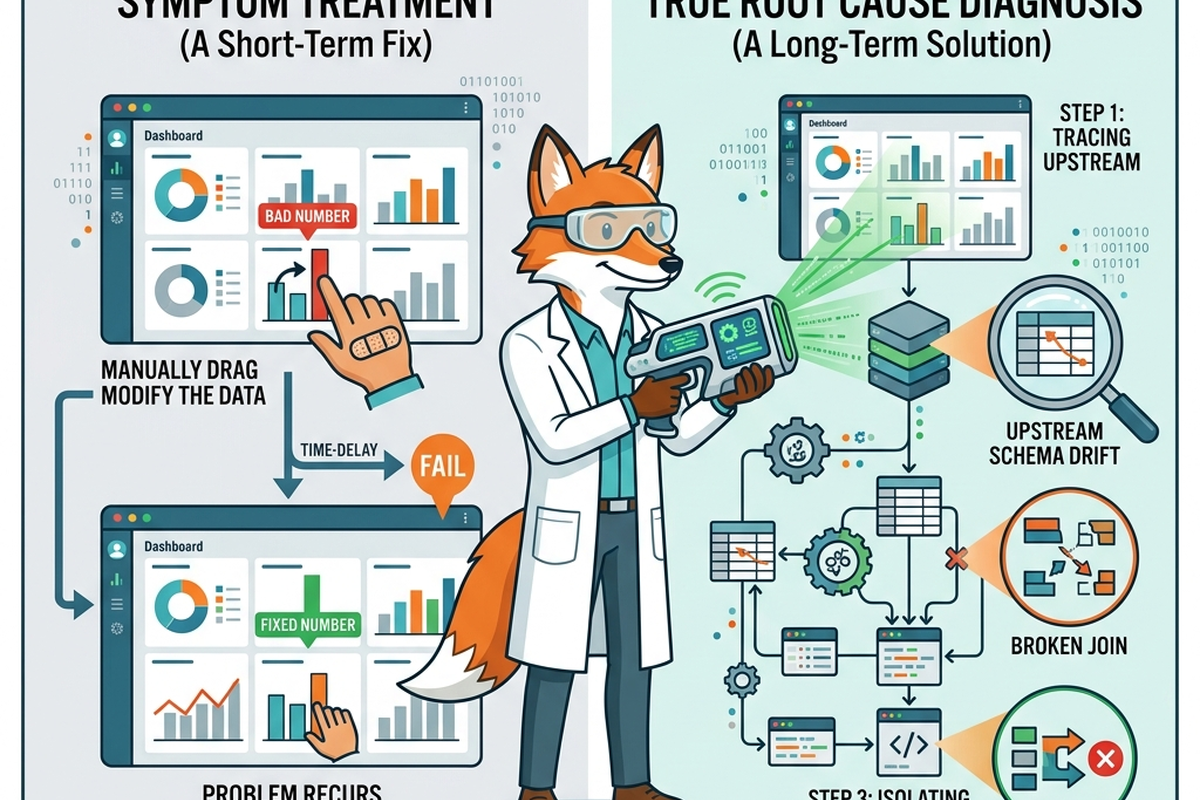
A dashboard showing a wrong number is a fever. Fixing that one number without finding what actually caused it is exactly the mistake this article is about.
In Plain English
A symptom in data quality terms is the visible sign something’s wrong — a dashboard number that looks off, a report that doesn’t reconcile, a model producing strange outputs. The root cause is the actual underlying reason: a schema change upstream, a broken join, a source system quietly changing its data format. Fixing the symptom (manually correcting one bad number) without addressing the root cause means the same problem will almost certainly recur.
The Old Way
Under time pressure, especially when a bad number is visibly affecting a stakeholder’s report right now, the fastest available fix is often to correct the specific number directly — a manual patch, applied once, to make the immediate problem go away. This is understandable, and sometimes genuinely necessary as an immediate stopgap.
The trouble comes when the stopgap becomes the whole response. Without tracing back to the actual root cause, the same underlying issue keeps generating new symptoms — a different bad number next week, a different broken report next month — each one treated as a fresh, unrelated fire rather than a recurring signal of one unaddressed problem underneath.
What’s Changing (and Why AI Is the Reason)
- AI-assisted root-cause analysis is making genuine diagnosis dramatically more practical. Rather than an engineer manually tracing a bad number back through a complex pipeline by hand, AI-assisted tooling can analyze lineage, recent changes, and related signals to suggest a likely root cause quickly — echoing the root-cause-attribution theme this site’s streaming and data-fabric-mesh coverage describes in their own contexts, now applied specifically to quality investigation.
- Lineage tracing (covered fully in the next article) is what actually makes root-cause analysis possible at all. Without a clear record of where data came from and what happened to it along the way, root-cause analysis is mostly guesswork — this article and the next are directly connected.
- AI is helping distinguish a genuinely new problem from a recurring one. By recognizing patterns across past incidents, AI-assisted analysis can flag when a new symptom actually resembles a previously “fixed” issue, surfacing the uncomfortable but valuable signal that a past fix only addressed the symptom, not the cause.
The Metaphor, Fully Extended
| Hospital Element | Root Cause Concept |
|---|---|
| A fever | A visible data quality symptom — a wrong number, a broken report |
| Treating the fever directly without further investigation | Manually patching a bad number without investigating why |
| The underlying infection the fever was actually signaling | The root cause — a schema change, a broken join, a source drift |
| The fever returning because the infection was never treated | The same quality problem recurring because the root cause wasn’t fixed |
| A doctor running tests to trace the fever to its actual cause | AI-assisted root-cause analysis tracing a symptom through data lineage |
For Beginners: What to Actually Do
- The next time you encounter a data quality issue, practice asking “why did this actually happen” at least twice before considering the investigation complete — the first answer is often still a symptom, not the cause.
- Get comfortable distinguishing a stopgap fix (correcting one bad number now) from a real fix (addressing why it went wrong) — both have their place, but only one prevents recurrence.
- Notice recurring quality issues at your organization as a specific, valuable signal: a problem that keeps coming back in slightly different forms is a strong sign a past fix only treated the symptom.
- Practice using whatever lineage or history information is available to you to trace a real quality issue back one step further than feels immediately necessary.
For Practitioners and Leaders: The Deeper Layer
- Track recurring versus genuinely novel quality incidents as a distinct metric — a rising rate of recurrence is a strong signal your team is treating symptoms rather than causes, even if individual incidents are being resolved quickly.
- Build root-cause investigation into your incident response process explicitly, not just symptom resolution — a fast fix that doesn’t address the cause should be flagged as incomplete, not closed out as resolved.
- Invest in the lineage infrastructure the next article covers as a direct enabler of effective root-cause analysis — without it, genuine diagnosis is significantly harder and slower.
- AI-assisted root-cause suggestions are a genuine accelerator, but should be verified by someone who understands the actual system before being trusted fully, the same caution this site applies to AI-generated analysis throughout.
Quick Recap
- A symptom is the visible sign something’s wrong; the root cause is the actual underlying reason — fixing only the symptom means the problem is likely to recur.
- Time pressure often pushes teams toward quick symptom fixes, which are sometimes necessary as stopgaps but shouldn’t be mistaken for genuine resolution.
- AI-assisted root-cause analysis, built on good lineage tracking, makes genuine diagnosis dramatically more practical than manual tracing.
- Recurring quality issues are a valuable signal worth tracking deliberately, since they often reveal past fixes that only addressed symptoms.
Where This Fits in the Series
Article 2 covered why periodic checks leave blind spots. This article covered the difference between a symptom and its cause. Article 4 looks at the actual vital signs worth checking in the first place.
Key References
- OpenLineage Specification — Open standard for data lineage collection and pipeline observability metadata.
- Great Expectations Data Testing Framework — Open-source python tool for data quality assertions and validation.
- EU General Data Protection Regulation (GDPR) Official Text — European regulatory framework for data compliance, security, and governance.
Subscribe to the Newsletter
Get the latest DataParables articles delivered straight to your inbox.