
Opening Scene
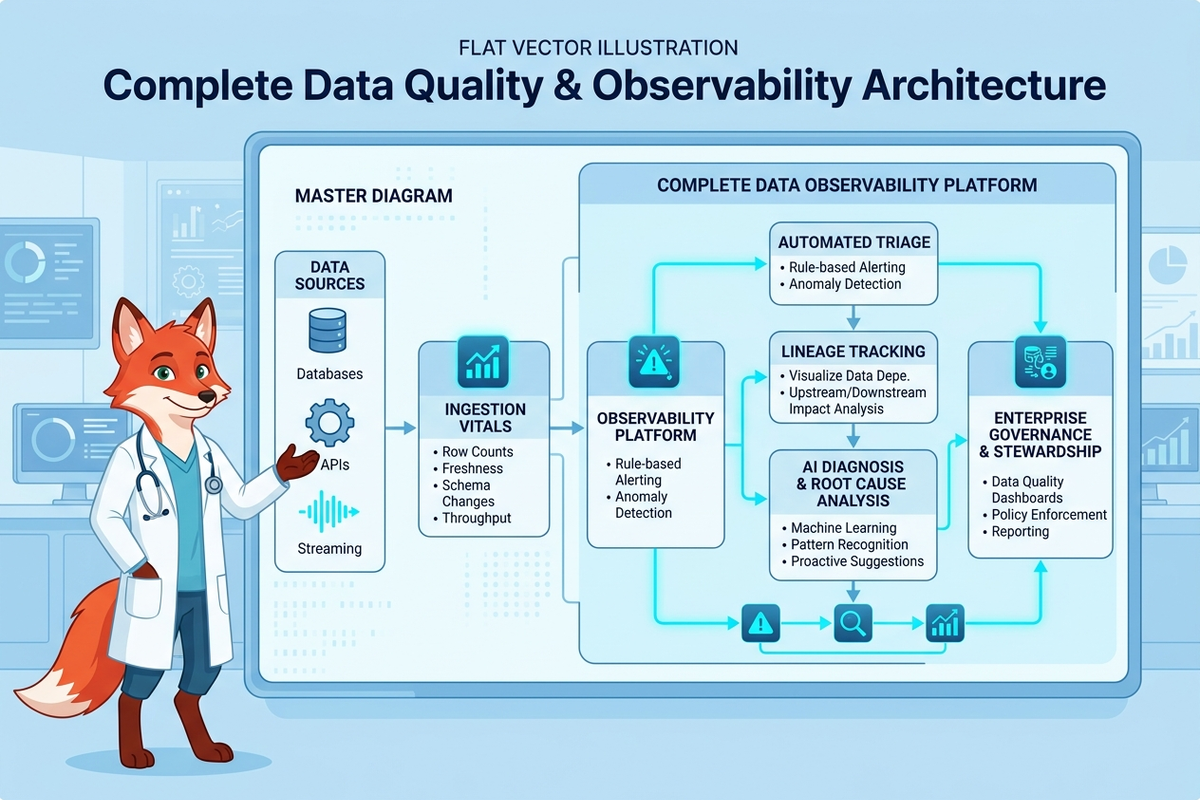
Walk the whole hospital now, ward by ward. Vitals are checked continuously, not once a year, against baselines actually grounded in each patient’s real history. Alerts are triaged by genuine severity, not arrival order, and a complete chart lets a specialist trace any symptom back to its real cause quickly, often with the diagnosis largely drafted before they arrive. Contagious risks are quarantined before they reach the ward. Known conditions are documented, so nobody mistakes them for new emergencies, and even patients who can’t describe their own symptoms — the AI agents in this hospital’s care — get monitoring calibrated specifically to that harder reality. And a triage board over the whole floor makes sure the ICU’s intensity goes where it’s actually needed, not everywhere at once.
That’s the hospital this series has built, one ward at a time, since Article 1.
In Plain English
This final article doesn’t introduce a new concept — it’s a deliberate walk back through everything the series has covered, reassembled as one connected system. The point is simple: every piece of good data quality and observability practice, from a single vital sign to a full quality program, exists to answer one question well — can the people and AI systems relying on this data trust that it’s actually correct, and find out quickly if it isn’t.
The Old Way
The “old way,” across this entire series, was consistent: a single thorough checkup at launch, quality treated as a one-time event rather than an ongoing discipline, with a built-in blind spot between whenever something went wrong and whenever anyone happened to notice. None of that history became irrelevant — every “new way” this series covered was built as a genuine response to real limits in that original model, not a dismissal of what a single careful checkup still gets right. The throughline across all twenty articles has been matching monitoring rigor to real, honestly assessed stakes, not applying maximum intensity everywhere out of anxiety.
What’s Changing (and Why AI Is the Reason): The Series, Recapped
- Detection got continuous, and genuinely evidence-based. From the shift away from periodic checkups (Article 2) to real baselines (Article 5) and comprehensive six-dimension coverage (Article 4), monitoring moved from a guess-based, occasional activity to a continuous, grounded discipline.
- Response got faster and more proportional. Triage (Article 6), quarantine (Article 10), known-issue documentation (Article 12), and AI-assisted diagnosis (Article 14) each solved a genuine problem with how teams historically responded to detected issues — reactively, undifferentiated, and slowly.
- The stakes shifted toward AI systems as a primary consumer. Silent failures (Article 13) and AI-consumed data (Article 17) named a genuinely new category of risk this series had to address directly — a patient that can’t tell you anything’s wrong, requiring monitoring rigor a human-consumer-only world never needed.
The Metaphor, Fully Extended: The Whole Hospital
| Hospital Element | Series Article & Core Lesson |
|---|---|
| The vitals nobody was checking | Article 1 — Why data quality needs ongoing attention, not a one-time check |
| A checkup once a year isn’t a checkup | Article 2 — Periodic checks versus continuous observability |
| The symptom isn’t the diagnosis | Article 3 — Root cause versus surface symptom |
| Six vital signs, one patient | Article 4 — The six data quality dimensions |
| Taking a baseline before anyone gets sick | Article 5 — Evidence-based baselines |
| Triage: who gets seen first | Article 6 — Severity-based alert triage |
| The chart at the foot of the bed | Article 7 — Data lineage |
| Reading vitals without waking the patient | Article 8 — Low-overhead monitoring |
| A fever is useful information | Article 9 — Anomalies as signal, not just noise |
| Quarantine before it reaches the ward | Article 10 — Quarantine-by-default patterns |
| Always get a second opinion | Article 11 — Cross-validation |
| Pre-existing conditions | Article 12 — Documenting known, accepted issues |
| When the patient can’t tell you what’s wrong | Article 13 — Silent data quality failures |
| The diagnosis that writes itself | Article 14 — AI-assisted root-cause diagnosis |
| Bedside manner for the data team | Article 15 — Incident communication |
| Preventive care beats the ER | Article 16 — Shifting quality checks left |
| When the patient is an AI agent | Article 17 — Data quality’s stakes for AI consumers |
| Not every patient needs the ICU | Article 18 — Proportional, tiered monitoring |
| Designing the hospital’s quality program | Article 19 — A practical, integrated program framework |
| The whole hospital, healthy | Article 20 — Every piece, reassembled as one connected whole |
For Beginners: What to Actually Do
- If you’re new to this space, treat Articles 1 through 4 as the essential foundation — the shift from periodic to continuous monitoring, and the full six-dimension picture, underlie almost everything else this series covered.
- Revisit any article covering a concept you use regularly at work, and practice re-explaining its metaphor in your own words. That’s a genuine test of whether it’s actually landed, not just been read.
- Hold onto Article 18’s honesty as a permanent lens, not just a late-series caveat — good monitoring is proportional to real stakes, not maximized everywhere by default.
- Don’t let “AI can diagnose this now” (Article 14) become a reason to skip understanding the underlying discipline. Every article in this series showed AI accelerating a process that still depends on good baselines, lineage, and documentation being in place first.
For Practitioners and Leaders: The Deeper Layer
- Audit your own organization against this series’ throughline: where is monitoring still a one-time checkup rather than an ongoing discipline, and where has it perhaps outgrown its actual stakes?
- The recurring theme of AI systems as consumers with no independent judgment (Article 17) deserves deliberate, prioritized investment across every component this series covered, not an afterthought layered on at the end.
- Consider where your organization still treats quality incidents as purely technical events, missing the communication discipline (Article 15) that preserves trust through and beyond them.
- The most durable skill for a data professional going forward isn’t memorizing any single monitoring tool’s current feature set — it’s the judgment to match rigor to real stakes (Article 19), and to know what an AI-generated diagnosis or baseline doesn’t yet know about your specific data and business. That judgment is what every article in this series, in different language, has ultimately been about.
Quick Recap
- This series treated data quality and observability as a working hospital — continuous vitals monitoring, genuine baselines, triaged response, and proportional care matched to actual patient need.
- Across twenty articles, AI consistently made detection, diagnosis, and communication faster and more evidence-based, but never replaced the human judgment needed to match rigor to genuine stakes.
- A clear throughline: AI systems consuming data directly, with no independent judgment to notice something’s wrong, raised the stakes on nearly every concept covered, from baselining to silent-failure detection.
- The disciplines covered — continuous monitoring, six-dimension coverage, baselining, triage, lineage, quarantine, cross-validation, known-issue tracking, diagnosis, communication, and proportional rigor — combine into one connected practice, not eleven separate ones.
- The most durable skill going forward is judgment: knowing which patients need the ICU, and what an AI-generated diagnosis doesn’t yet know about your business.
Where This Fits in the Series
This article closes the loop opened in Article 1, reassembling every ward covered since as one working hospital. There’s no next article to point toward within this topic — but every concept covered here remains a living discipline, not a finished one, as observability technology and AI-assisted tooling continue to evolve.
Key References
- OpenLineage Specification — Open standard for data lineage collection and pipeline observability metadata.
- Great Expectations Data Testing Framework — Open-source python tool for data quality assertions and validation.
- EU General Data Protection Regulation (GDPR) Official Text — European regulatory framework for data compliance, security, and governance.
Subscribe to the Newsletter
Get the latest DataParables articles delivered straight to your inbox.