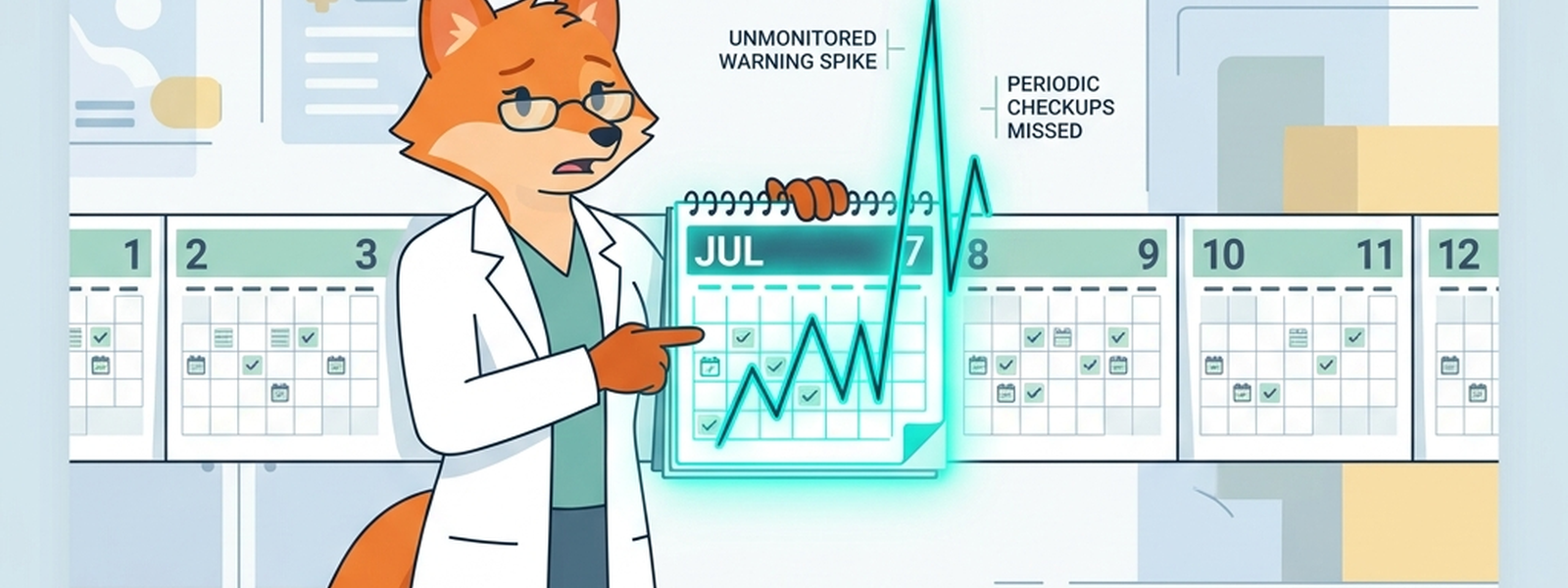
Opening Scene
An annual physical is genuinely useful — it catches real problems, establishes a baseline, gives a doctor something to compare against next year. But it has an obvious blind spot: whatever developed and resolved, or developed and worsened, in month seven never gets seen until the next appointment rolls around, months later. A condition that would have been easy to treat early can become serious by the time anyone’s actually looking again.
Periodic data quality checks — a weekly script, a monthly audit — have exactly this same blind spot, just measured in a different unit of time.
In Plain English
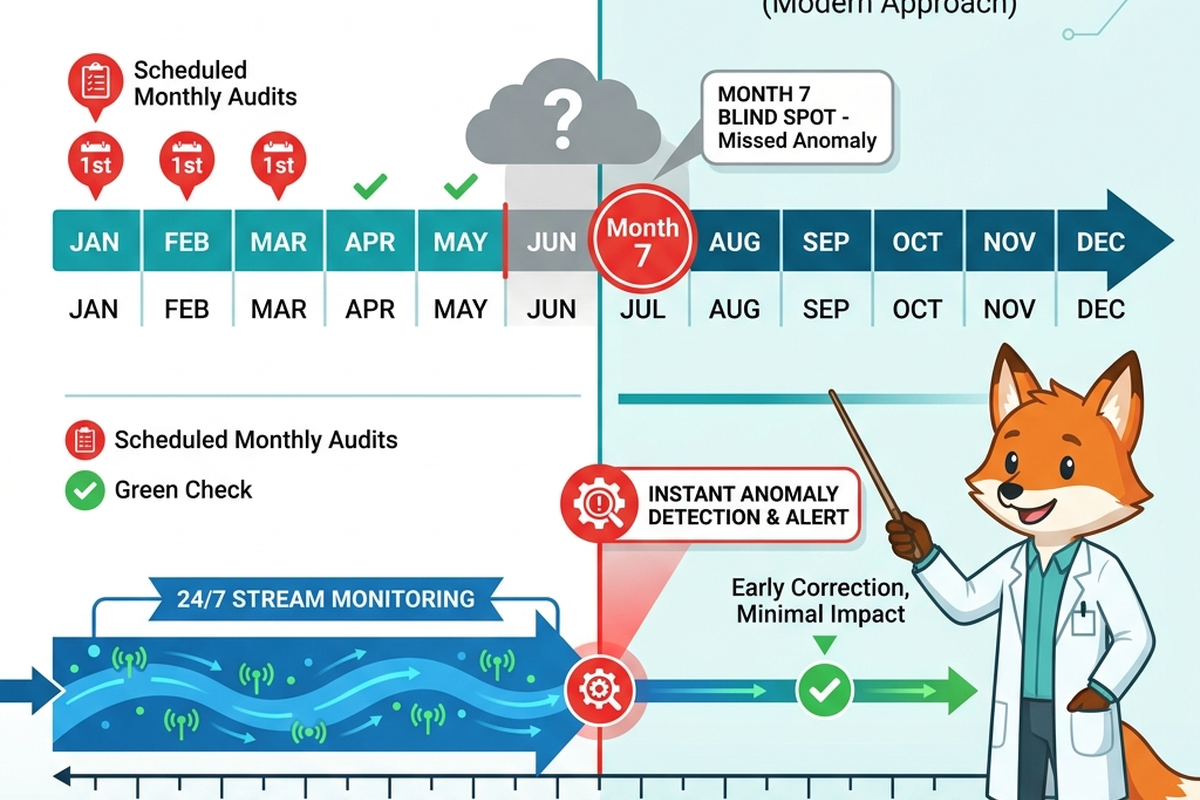
Periodic quality checks run on a fixed schedule, checking data at intervals rather than continuously. Continuous observability monitors data quality constantly, catching problems close to the moment they occur rather than at the next scheduled check. The gap between the two isn’t just about speed — it’s about how much damage can accumulate, and how much context is lost, in the interval between checks.
The Old Way
Periodic checks were the traditional default for understandable reasons: continuous monitoring used to require infrastructure and effort that periodic checks didn’t. A weekly data quality script, reviewed manually, was a real and reasonable practice given what was actually achievable at the time.
The cost of this approach was real but often invisible: a quality problem that emerged the day after a check ran could persist, undetected, for nearly the entire interval until the next one — and by the time it was caught, the root cause might be harder to trace, and any decisions made using the bad data during that window were already made.
What’s Changing (and Why AI Is the Reason)
- Continuous monitoring no longer requires proportionally continuous human effort. AI-assisted observability tooling can check data quality constantly without requiring a person to manually review results at the same frequency — closing the gap between “we should check this more often” and what a team can actually sustain.
- Faster detection means faster, cheaper root-cause diagnosis. A problem caught within minutes of occurring is dramatically easier to trace back to its cause than one discovered a week later, after other changes have happened in the meantime — this series returns to root-cause diagnosis directly in a later article.
- AI systems consuming data can’t wait for the next scheduled check. An AI agent or model using data that went bad three days ago, with the next quality check not scheduled for another four, is making decisions on known-bad information the whole time — raising the practical urgency of closing this gap specifically for AI-consumed data.
The Metaphor, Fully Extended
| Hospital Element | Monitoring Frequency Concept |
|---|---|
| An annual physical | A periodic, scheduled data quality check |
| Whatever happened in month seven, unseen until next year | A quality problem persisting undetected for the whole interval |
| Continuous vital-signs monitoring | Continuous data quality observability |
| A condition caught early, easy to treat | A quality problem caught quickly, easy to trace and fix |
| A condition caught late, now much harder to diagnose | A quality problem discovered long after it started, harder to root-cause |
For Beginners: What to Actually Do
- For any data system you rely on, find out its actual quality-check frequency, and think concretely about what could go wrong and go undetected in that interval.
- Get comfortable with the idea that continuous monitoring isn’t simply “checking more often” — it’s built differently, similar to the event-driven-versus-polling distinction this site’s streaming coverage describes.
- Practice reasoning through a scenario: a data quality issue starts the day after a weekly check runs — trace through what decisions might get made on bad data before it’s caught.
- Notice that closing this gap matters most for data with real downstream consequences, not uniformly for everything.
For Practitioners and Leaders: The Deeper Layer
- Inventory your data systems by quality-check frequency and prioritize closing the gap for anything with real business or AI-model consequences riding on it — you don’t need continuous monitoring everywhere at once.
- Quantify the realistic cost of your current check interval: what’s the worst plausible scenario for a problem persisting undetected for that long, and what would it actually cost the business?
- AI-assisted continuous monitoring tooling significantly changes the cost-benefit calculation that historically justified periodic checks — revisit old assumptions about what’s “worth” continuous monitoring in light of that changed cost.
- Prioritize continuous monitoring specifically for data feeding AI systems first — the gap between problem and detection is most costly exactly where no human is in the loop to catch an obviously wrong number before it’s acted on.
Quick Recap
- Periodic quality checks catch real problems but leave a blind spot for the entire interval between checks; continuous observability closes that gap.
- Periodic checks were the traditional default because continuous monitoring used to require effort most teams couldn’t sustain.
- AI-assisted tooling now makes continuous monitoring achievable without proportional continuous human effort, and speeds root-cause diagnosis significantly.
- AI systems consuming data can’t wait for the next scheduled check, making this gap especially costly for AI-consumed data specifically.
Where This Fits in the Series
Article 1 introduced the vitals nobody was checking. This article covered why periodic checkups leave a real blind spot. Article 3 looks at the difference between noticing a symptom and actually understanding what’s wrong.
Key References
- OpenLineage Specification — Open standard for data lineage collection and pipeline observability metadata.
- Great Expectations Data Testing Framework — Open-source python tool for data quality assertions and validation.
- EU General Data Protection Regulation (GDPR) Official Text — European regulatory framework for data compliance, security, and governance.
Subscribe to the Newsletter
Get the latest DataParables articles delivered straight to your inbox.