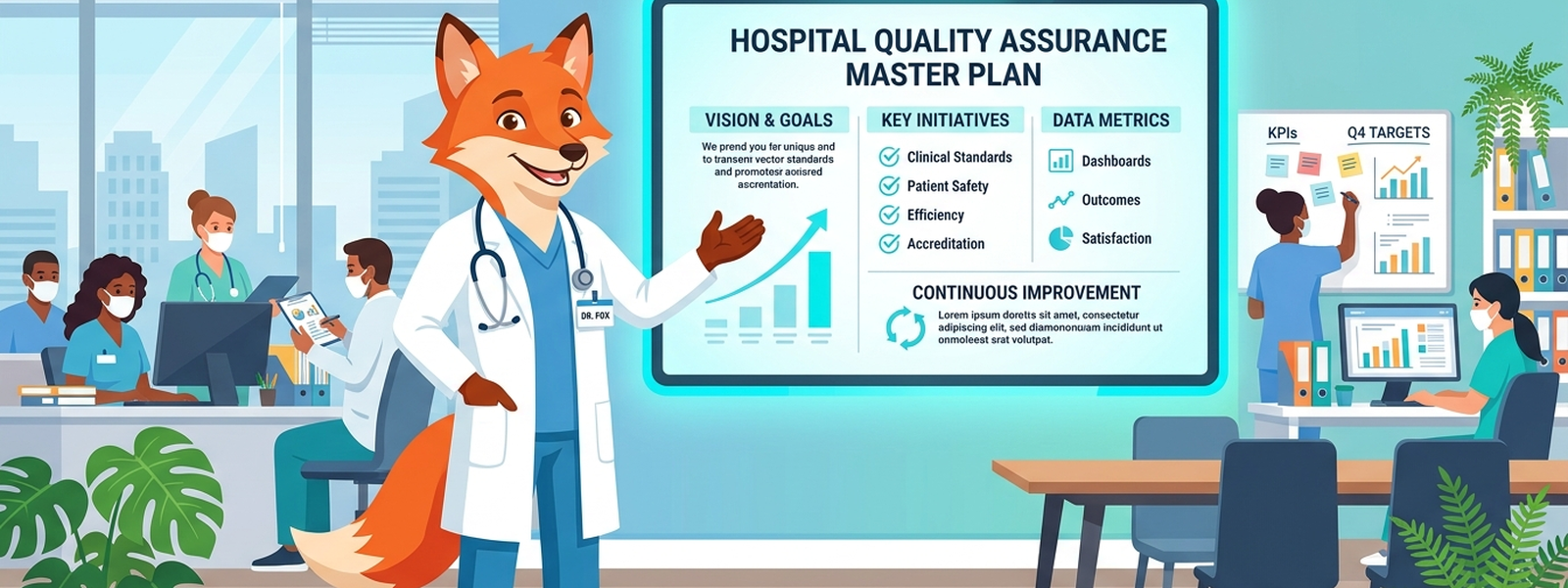
Opening Scene
After touring the whole hospital — the vitals worth checking, the baselines that make sense of them, the triage that prioritizes attention, the charts that enable diagnosis, the quarantine that contains risk, and the honest recognition that not every patient needs the ICU — a hospital administrator still has to answer one very practical question: what does a real, complete quality program actually look like, put together as one working system?
This article is a deliberate synthesis, pulling together everything the last eighteen articles have covered into a practical design.
In Plain English
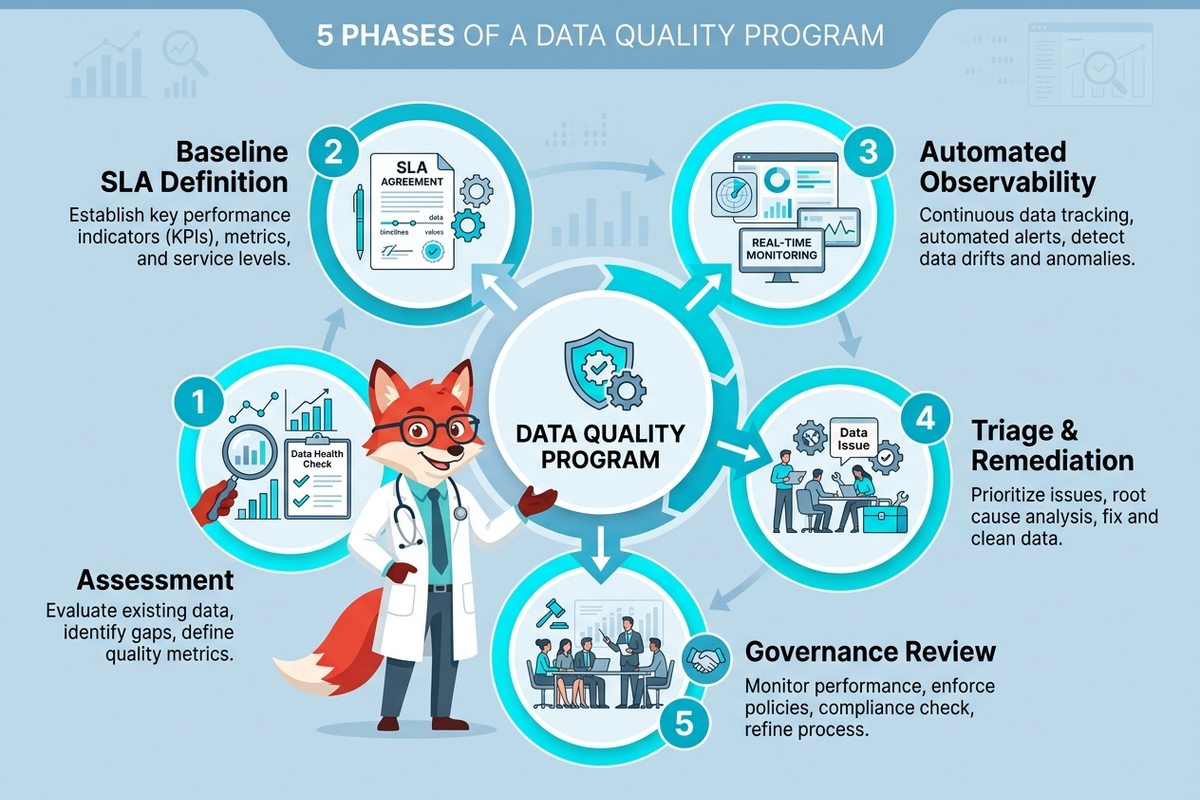
A well-designed data quality and observability program combines several components working together: comprehensive coverage across all six quality dimensions (Article 4), genuine evidence-based baselines (Article 5), tiered monitoring proportional to actual stakes (Article 18), quarantine-by-default for high-risk data (Article 10), good lineage enabling real diagnosis (Article 7), documented known issues (Article 12), and proactive communication when something goes wrong (Article 15) — none of these pieces alone constitutes a real program; the design is in how they fit together.
The Old Way
Historically, data quality investment often happened piecemeal — a team would adopt one component (maybe a rule-based validation tool) without the others, creating a program with real gaps that weren’t obvious until an incident exposed exactly which piece was missing. A team with excellent alerting but no lineage could detect problems quickly and then spend days manually tracing their cause. A team with great baselines but no triage discipline could drown in undifferentiated alerts.
This piecemeal pattern reflected how quality tooling itself often evolved — vendors and teams built individual point solutions for individual problems, rather than designing toward a genuinely complete, integrated program from the start.
What’s Changing (and Why AI Is the Reason)
- AI-assisted platforms increasingly integrate these components natively, rather than requiring them to be stitched together from separate tools. Modern observability platforms increasingly combine baselining, lineage, alerting, and diagnosis in one connected system, directly reducing the piecemeal-adoption risk this article’s “old way” section described.
- AI-assisted maturity assessment can help identify which specific component is your program’s weakest link. Rather than guessing at what to invest in next, AI-assisted analysis of your incident history can reveal whether your actual bottleneck is detection speed, root-cause diagnosis time, or communication clarity — informing genuinely evidence-based prioritization of next investment.
- AI is lowering the cost of building each individual component, changing the realistic order of operations for smaller teams. A team that couldn’t previously afford comprehensive lineage tracking or continuous monitoring can now reasonably build toward a complete program faster than was previously realistic, changing what a sensible maturity roadmap actually looks like.
The Metaphor, Fully Extended
| Hospital Element | Quality Program Component |
|---|---|
| A full panel of vital signs, checked comprehensively | Coverage across all six data quality dimensions |
| A genuine, evidence-based sense of each patient’s normal | Established, evidence-based baselines |
| A triage system directing attention where it’s actually needed | Tiered, proportional monitoring |
| Isolation protocols containing risk before it spreads | Quarantine-by-default for high-risk data |
| A complete, accurate chart enabling real diagnosis | Comprehensive data lineage |
| Documentation distinguishing known conditions from new problems | A maintained known-issue registry |
| Clear, honest communication with patients and their care team | Proactive incident communication |
| A hospital administrator designing all of this as one connected system | A data leader designing a complete, integrated quality program |
For Beginners: What to Actually Do
- Use this article as a genuine checklist: for any quality program you encounter or work within, identify which of these seven components are actually present, and which are missing.
- Revisit the specific articles behind each component (4, 5, 7, 10, 12, 15, 18) for the depth this synthesis can’t fully repeat — this article is an index, not a replacement for that underlying detail.
- Practice diagnosing a hypothetical program’s weakest link from a described incident — what would have caught this faster, or diagnosed it more quickly, or communicated it more clearly?
- Get comfortable with the idea that a complete program is built incrementally, component by component, not assembled all at once — expect and plan for a genuine maturity journey.
For Practitioners and Leaders: The Deeper Layer
- Audit your current quality program explicitly against these seven components, and identify your actual weakest link through real incident analysis, not assumption.
- Sequence investment deliberately: lineage and baselines are typically prerequisites that make the other components meaningfully more effective, so consider prioritizing them early in a maturity roadmap if they’re not already solid.
- Evaluate integrated observability platforms specifically for how many of these seven components they genuinely combine, rather than assembling a program from disconnected point solutions that each solve one piece well in isolation.
- Revisit your program’s maturity roadmap periodically as AI-assisted tooling continues to lower the cost of each component — a roadmap that made sense eighteen months ago may now be achievable meaningfully faster than originally planned.
Quick Recap
- A complete data quality program combines coverage across all six dimensions, evidence-based baselines, tiered monitoring, quarantine, lineage, known-issue documentation, and proactive communication, working together as one system.
- Historically, quality investment happened piecemeal, creating programs with real gaps that only became obvious once an incident exposed exactly which component was missing.
- AI-assisted platforms increasingly integrate these components natively, and AI-assisted maturity assessment can identify a program’s actual weakest link from real incident history.
- AI is lowering the cost of building each component, changing what a realistic maturity roadmap looks like for teams building toward a complete program.
Where This Fits in the Series
Article 18 covered proportional monitoring. This article pulled the whole series’ components into one practical program design. Article 20 closes the series, walking the entire hospital once more as one connected system.
Key References
- OpenLineage Specification — Open standard for data lineage collection and pipeline observability metadata.
- Great Expectations Data Testing Framework — Open-source python tool for data quality assertions and validation.
- EU General Data Protection Regulation (GDPR) Official Text — European regulatory framework for data compliance, security, and governance.
Subscribe to the Newsletter
Get the latest DataParables articles delivered straight to your inbox.