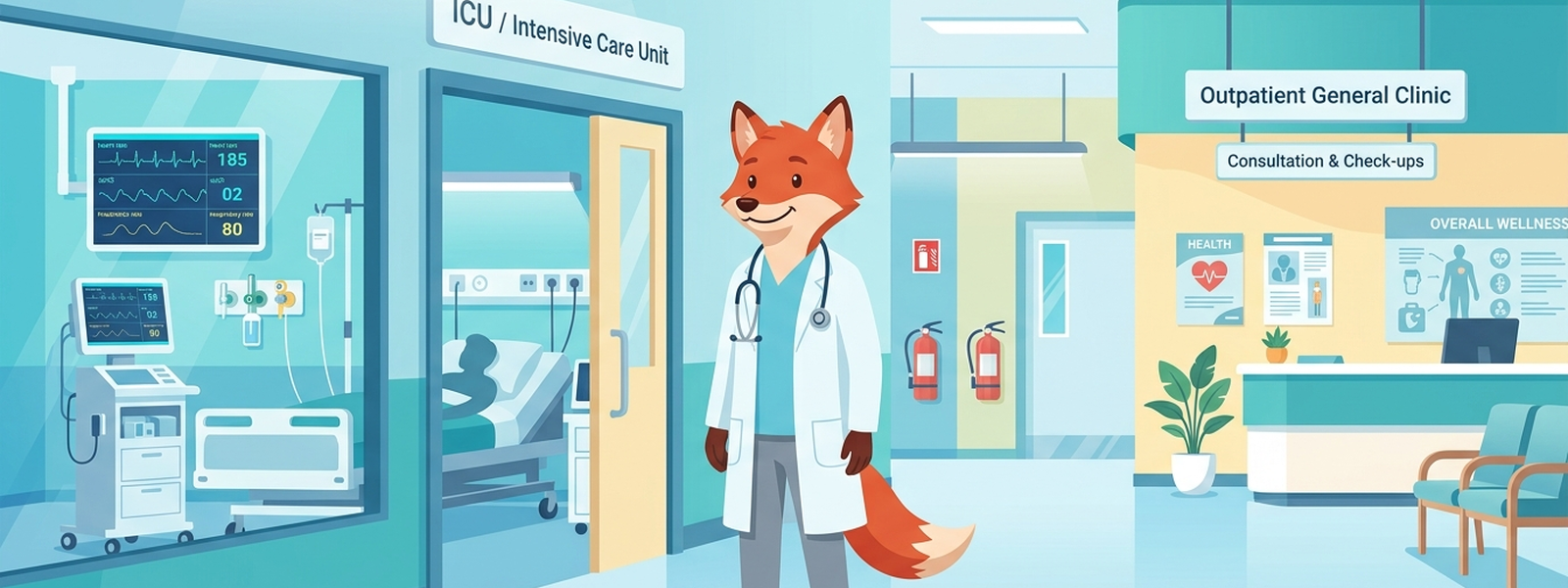
Opening Scene
The ICU delivers the most intensive monitoring a hospital can offer — constant vitals tracking, immediate specialist attention, equipment ready for any sudden change. It’s also enormously expensive to run, and reserved deliberately for patients whose condition genuinely warrants that level of intensity. Putting every patient in the ICU regardless of actual need wouldn’t make the hospital safer overall — it would just exhaust resources the genuinely critical cases actually need.
After seventeen articles building the case for rigorous data quality monitoring, this article makes the case for applying that rigor proportionally, not uniformly.
In Plain English
Comprehensive data quality monitoring — continuous checks, cross-validation, low-latency alerting, full lineage tracking — is genuinely valuable, but it comes with real ongoing cost in engineering effort, infrastructure, and attention. Applying ICU-level monitoring rigor to every single dataset in an organization, regardless of how consequential it actually is, isn’t more responsible — it’s a misallocation that leaves less capacity for the datasets that genuinely need that level of care.
The Old Way
Some data quality initiatives, especially newly funded ones eager to demonstrate thoroughness, apply monitoring uniformly across an entire data estate — the same check frequency, the same alerting rigor, the same cross-validation depth, applied to a business-critical revenue pipeline and a rarely-used internal exploratory dataset alike.
This uniform approach predictably produces two problems at once: genuinely critical datasets don’t get meaningfully more attention than they’d get under a smarter, prioritized approach, while low-stakes datasets consume real monitoring budget and alert volume that would be better spent elsewhere — quietly worsening the alert fatigue problem this series covered in Article 6.
What’s Changing (and Why AI Is the Reason)
- AI-assisted criticality scoring is making proportional monitoring genuinely practical to design. Determining which datasets actually warrant intensive monitoring, based on downstream dependencies, business impact, and AI consumption, benefits from AI-assisted analysis of actual usage patterns rather than a uniform default or subjective guesswork.
- AI-assisted tooling has lowered the cost of monitoring generally, which shifts the honest threshold, but doesn’t eliminate the case for proportionality. Just as this site’s other topics have noted, lower cost doesn’t mean every dataset now deserves the highest tier of monitoring — it means the threshold for what’s worth doing moves, not that the concept of proportionality disappears.
- AI is helping monitor dataset criticality itself as it changes over time. A dataset that was genuinely low-stakes at launch can become business-critical as usage grows, and AI-assisted tracking of actual consumption patterns can flag when a dataset’s monitoring tier should be reconsidered, rather than leaving that decision to whoever happened to configure it initially.
The Metaphor, Fully Extended
| Hospital Element | Proportional Monitoring Concept |
|---|---|
| The ICU, delivering the most intensive monitoring available | Comprehensive, continuous, cross-validated quality monitoring |
| Every patient placed in the ICU regardless of actual condition | Uniform, maximum-rigor monitoring applied to every dataset regardless of stakes |
| ICU resources exhausted on patients who didn’t need that level of care | Monitoring budget and attention consumed by low-stakes datasets |
| A triage system determining who actually needs ICU-level care | AI-assisted criticality scoring determining appropriate monitoring tier |
| A patient’s condition changing, warranting a move to more intensive monitoring | A dataset’s business criticality growing, warranting a higher monitoring tier |
For Beginners: What to Actually Do
- Resist treating “more monitoring is always better” as a universal principle — the previous seventeen articles built a case for real, specific value, and that value has to be weighed against real, ongoing cost.
- Practice assessing, for a dataset you’re familiar with, what monitoring tier it actually warrants based on its real downstream impact, rather than assuming uniform treatment is the safe default.
- Get comfortable concluding, when it’s genuinely true, “this dataset doesn’t need ICU-level monitoring” — that’s a legitimate, well-reasoned decision, not a shortcut or a failure of diligence.
- Notice that this article isn’t a contradiction of the previous seventeen — it’s their necessary complement, and reading this series as “maximize monitoring everywhere” would be a real misreading of its actual argument.
For Practitioners and Leaders: The Deeper Layer
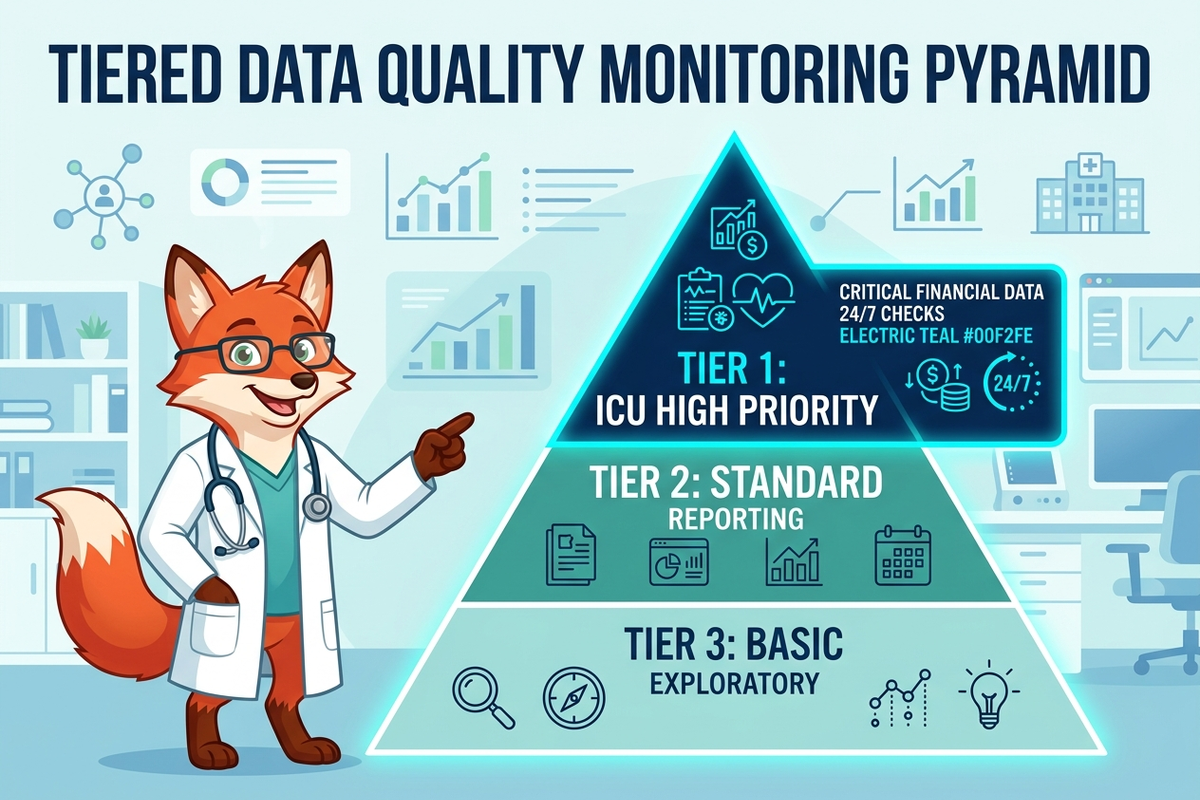
- Build an explicit, tiered monitoring framework — informed by AI-assisted criticality scoring — rather than either uniform maximum rigor or ad hoc, inconsistent coverage decided dataset by dataset without a clear rationale.
- Quantify the real ongoing cost of your current monitoring approach (engineering time, infrastructure, alert volume) and weigh it explicitly against the actual business value at stake for each tier of dataset.
- Revisit monitoring tier assignments periodically as datasets grow or shrink in actual importance — a dataset’s criticality is not fixed at the moment monitoring was first configured.
- Reserve your most intensive monitoring investment specifically for data feeding AI systems (Article 17) and other high-consequence use cases, rather than spreading that same rigor thin across your entire data estate.
Quick Recap
- Comprehensive data quality monitoring is genuinely valuable but comes with real ongoing cost — applying it uniformly regardless of a dataset’s actual stakes is a misallocation, not extra diligence.
- Uniform maximum-rigor approaches don’t give critical datasets meaningfully more protection while consuming resources low-stakes datasets don’t need, worsening alert fatigue in the process.
- AI-assisted criticality scoring makes proportional, tiered monitoring genuinely practical to design and maintain.
- This article is the necessary complement to the rest of the series, not a contradiction of the case built for rigorous monitoring where it actually matters.
Where This Fits in the Series
Article 17 covered the stakes when the patient is an AI agent. This article covered honestly asking whether every patient needs the ICU. Article 19 builds directly on this honest assessment into a full, practical framework for designing a real quality program.
Key References
- OpenLineage Specification — Open standard for data lineage collection and pipeline observability metadata.
- Great Expectations Data Testing Framework — Open-source python tool for data quality assertions and validation.
- EU General Data Protection Regulation (GDPR) Official Text — European regulatory framework for data compliance, security, and governance.
Subscribe to the Newsletter
Get the latest DataParables articles delivered straight to your inbox.