
Opening Scene
A patient who can describe their own symptoms — where it hurts, when it started, what makes it worse — gives a doctor enormously valuable information no external test alone provides. A patient who can’t communicate at all, for whatever reason, is harder to help precisely because that channel is closed; the care team has to rely entirely on external signs and tests to know something’s wrong.
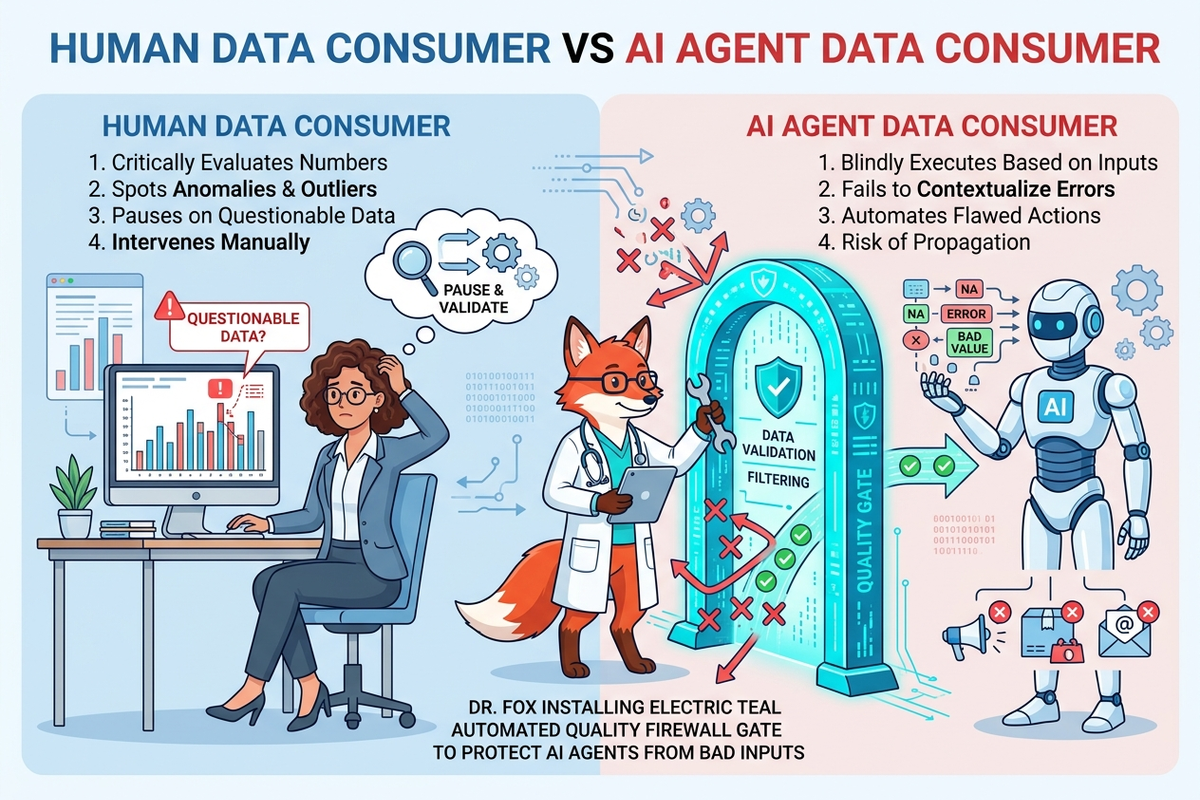
An AI agent consuming bad data is exactly this second kind of patient. It doesn’t experience discomfort, doesn’t flag that something feels off, doesn’t ask a clarifying question when a number looks strange. It just acts on whatever it’s given, confidently and immediately.
In Plain English
AI agents and models consuming data have no independent judgment to notice that something looks wrong the way a human analyst reviewing a dashboard might. A person seeing a wildly implausible number often pauses and questions it. An AI system, absent explicit safeguards, typically has no equivalent instinct — it processes the input it’s given and produces an output, whether or not that input was actually correct. This makes every concept covered earlier in this series more urgent, not less, when the consumer is an AI system rather than a person.
The Old Way
Traditional data quality practices developed in an era where the ultimate consumer of most data was a human being — an analyst building a report, a manager reading a dashboard. This meant even imperfect quality practices had a real backstop: a person who might notice an obviously wrong number and question it before acting on it, catching problems that formal checks missed.
As AI systems became direct consumers of data — training models, feeding retrieval systems, driving autonomous agent decisions — that human backstop quietly disappeared for an increasing share of an organization’s total data usage, without quality practices necessarily catching up to reflect that change.
What’s Changing (and Why AI Is the Reason)
- Every concept in this series compounds specifically around AI-consumed data. Six-dimension coverage (Article 4), genuine baselines (Article 5), quarantine-by-default (Article 10), cross-validation (Article 11), silent-failure detection (Article 13) — all of it matters more, not less, for data an AI system will act on without any human review in between.
- AI-assisted validation is, somewhat ironically, one of the best defenses for AI-consumed data specifically. The same AI-assisted checking techniques covered throughout this series can be applied specifically to validate data before it reaches another AI system, effectively rebuilding the “someone would notice” backstop that human review used to provide, now automated.
- New failure modes are emerging that are specific to AI consumption. Beyond traditional data quality dimensions, AI systems can be sensitive to issues like distributional shift (the data an agent sees in production drifting from what it was trained or tuned on) in ways that wouldn’t necessarily bother a human analyst at all — a genuinely new category of quality concern this series hasn’t needed to name until this point.
The Metaphor, Fully Extended
| Hospital Element | AI-Consumed Data Concept |
|---|---|
| A patient who can describe their own symptoms | A human analyst who might notice and question a wrong number |
| A patient who can’t communicate discomfort at all | An AI agent that acts on bad data with no independent judgment to flag it |
| Relying entirely on external tests since the patient can’t self-report | Relying entirely on formal quality checks since no human review backstops AI consumption |
| A care team building more rigorous monitoring specifically for a non-communicative patient | A quality program building more rigorous, automated checks specifically for AI-consumed data |
| A condition that wouldn’t bother most patients but is dangerous for this one specifically | A distributional shift that wouldn’t bother a human analyst but degrades an AI system’s behavior |
For Beginners: What to Actually Do
- Practice identifying, for any AI system you’re familiar with, what data it actually consumes and whether that data passes through any human review before reaching it.
- Get comfortable with the idea that “an AI system is using this data” is a specific reason to apply more rigorous quality practices, not fewer, precisely because the human backstop is absent.
- Learn the basic concept of distributional shift — data an AI system sees drifting from what it was originally trained or tuned on — as a genuinely new quality concern specific to AI consumption.
- Notice this article as a synthesis point: nearly every earlier concept in this series applies here, just with higher stakes and less margin for error.
For Practitioners and Leaders: The Deeper Layer
- Audit your data quality investment specifically against where AI systems, not humans, are the primary or sole consumer — this is where the historical human backstop has quietly disappeared, and where investment often hasn’t caught up.
- Build automated validation specifically to serve as the “someone would notice” backstop for AI-consumed data, effectively rebuilding what human review used to provide informally.
- Add distributional shift monitoring as a genuinely new quality dimension for any AI system in production, tracking not just traditional quality metrics but whether current data still resembles what the system was built and validated against.
- Treat this article’s message as a call to revisit prioritization across this entire series’ concepts — six-dimension coverage, baselining, quarantine, cross-validation — specifically weighted toward wherever AI systems are consuming your data directly.
Quick Recap
- AI systems consuming data have no independent judgment to notice something looks wrong, removing the informal human backstop that historically caught many quality problems before real damage occurred.
- Traditional quality practices developed assuming a human consumer would eventually review the data, an assumption that no longer holds for a growing share of AI-consumed data.
- AI-assisted validation can rebuild an automated version of that missing backstop, and every concept covered earlier in this series matters more, not less, for AI-consumed data.
- Distributional shift is a genuinely new quality concern specific to AI consumption, worth monitoring explicitly alongside traditional quality dimensions.
Where This Fits in the Series
Article 16 covered catching problems earlier. This article covered why the stakes are higher when the patient is an AI agent. Article 18 asks honestly: does every dataset actually need the ICU level of monitoring?
Key References
- OpenLineage Specification — Open standard for data lineage collection and pipeline observability metadata.
- Great Expectations Data Testing Framework — Open-source python tool for data quality assertions and validation.
- EU General Data Protection Regulation (GDPR) Official Text — European regulatory framework for data compliance, security, and governance.
Subscribe to the Newsletter
Get the latest DataParables articles delivered straight to your inbox.