
Opening Scene
How a doctor delivers a diagnosis matters almost as much as the diagnosis itself. A confusing, alarming, poorly-explained delivery leaves a patient more frightened and less informed than a clear one, even when the underlying facts are identical. Bedside manner isn’t a soft skill layered on top of real medicine — it’s part of doing the job well, because a patient who doesn’t understand what’s happening can’t meaningfully participate in their own care.
Communicating a data quality incident — to stakeholders, to the business, to whoever’s relying on the affected data — deserves that same deliberate care, and it’s a skill this series hasn’t addressed directly until now.
In Plain English
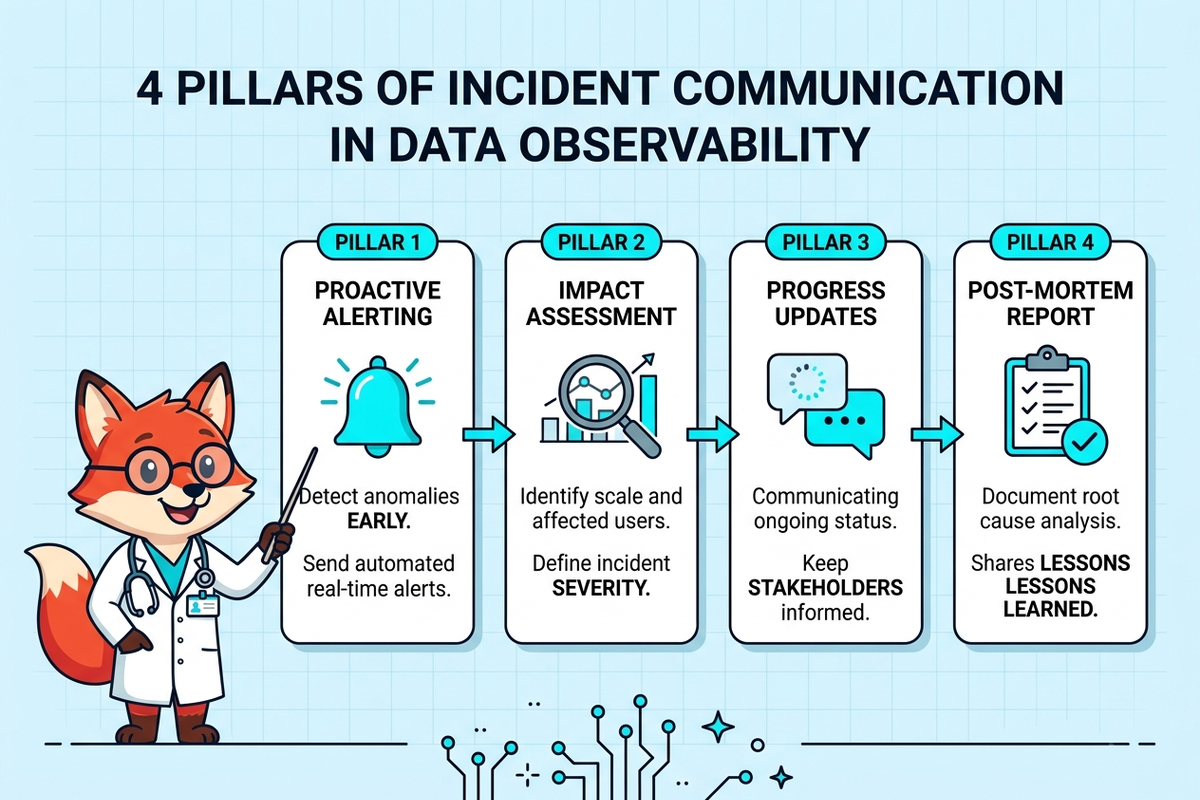
Incident communication means clearly, honestly, and proportionately informing affected stakeholders about a data quality problem — what happened, what’s affected, what’s being done, and what they should or shouldn’t trust in the meantime. Done well, it maintains trust even through a real incident. Done poorly, or skipped entirely, it damages trust in the data platform generally, well beyond the specific incident itself.
The Old Way
Data quality incidents were often handled as purely technical events — fixed quietly, with no proactive communication to the people who’d been relying on the affected data, unless someone happened to ask directly. This left stakeholders making decisions on data they didn’t know was compromised, sometimes for the entire duration of an incident.
When communication did happen, it was often reactive and defensive — triggered only after a stakeholder noticed something wrong themselves and asked pointed questions, rather than proactive and transparent. This pattern taught stakeholders, over time, that they couldn’t fully trust the data team to tell them when something was actually wrong, which is a genuinely corrosive outcome for a data platform’s long-term credibility.
What’s Changing (and Why AI Is the Reason)
- AI-assisted impact analysis makes proactive communication genuinely practical. Knowing exactly who’s affected by a given incident — which dashboards, which reports, which downstream teams — used to require manual investigation; AI-assisted analysis of lineage and usage data (Article 7) can identify affected stakeholders quickly enough to notify them proactively, before they ask.
- AI-assisted drafting is making clear, well-calibrated incident communication faster to produce. Writing a clear, appropriately-scoped incident summary — not too alarming, not too dismissive — takes real skill and time under pressure; AI-assisted drafting can help produce a solid first draft quickly, freeing a person to focus on judgment calls about tone and framing rather than starting from a blank page mid-incident.
- AI systems as stakeholders raise new questions about what “communication” even means. When an AI agent is a direct consumer of the affected data, “informing” it about an incident might mean automatically pausing its use of that data or flagging outputs derived from it during the affected window — a genuinely new form of incident communication this series hasn’t had to consider until this point.
The Metaphor, Fully Extended
| Hospital Element | Incident Communication Concept |
|---|---|
| A doctor’s careful, clear delivery of a diagnosis | Clear, honest communication about a data quality incident |
| A patient left uninformed until they ask pointed questions themselves | Stakeholders discovering an incident only by noticing something wrong themselves |
| A doctor who knows exactly who else needs to be informed of a diagnosis | AI-assisted impact analysis identifying every affected stakeholder |
| Clear, well-prepared language for delivering difficult news | AI-assisted drafting of a clear, well-calibrated incident summary |
| Informing a care team member, not just the patient directly | Notifying an AI agent consumer, not just human stakeholders |
For Beginners: What to Actually Do
- Practice drafting a short, clear incident summary for a hypothetical data quality problem — what happened, what’s affected, what’s being done — as a genuinely transferable communication skill.
- Get comfortable with the idea that proactive communication, even about an unresolved incident, builds more trust than silence followed by a stakeholder discovering the problem themselves.
- Notice the difference between a defensive, minimizing incident communication and an honest, appropriately-scoped one — the latter, even when the news is bad, tends to preserve trust better over time.
- Think concretely about what “informing an AI agent” of an incident might actually mean for a system you’re familiar with — this is a genuinely emerging question worth reasoning through.
For Practitioners and Leaders: The Deeper Layer
- Build proactive incident communication into your standard response process, not as an afterthought once the technical fix is complete — use AI-assisted impact analysis to identify affected stakeholders quickly enough to notify them promptly.
- Track stakeholder trust in the data platform as a genuine, ongoing signal, and treat incident communication quality as a direct lever on it — a well-communicated incident can preserve trust even when the underlying problem was serious.
- Establish clear protocols for what happens when an AI agent, not just a human, is a stakeholder affected by an incident — should its use of the affected data pause automatically, and how does it get “informed” once the issue is resolved?
- Use AI-assisted drafting to speed up incident communication without sacrificing quality, but keep a human making the final judgment calls about tone, framing, and how much detail is genuinely appropriate to share.
Quick Recap
- Incident communication means clearly, honestly, and proactively informing affected stakeholders about a data quality problem, which is essential to maintaining trust through and beyond the incident itself.
- Reactive, defensive, or absent communication historically taught stakeholders they couldn’t fully rely on the data team to surface problems, damaging trust well beyond any single incident.
- AI-assisted impact analysis and drafting make proactive, well-calibrated communication genuinely practical, even under real incident time pressure.
- AI agents as direct data consumers raise new questions about what “communicating” an incident actually means, beyond informing human stakeholders alone.
Where This Fits in the Series
Article 14 covered diagnosis that writes itself. This article covered communicating what’s found, clearly and honestly. Article 16 looks at preventing illness in the first place, rather than only treating it after it appears.
Key References
- OpenLineage Specification — Open standard for data lineage collection and pipeline observability metadata.
- Great Expectations Data Testing Framework — Open-source python tool for data quality assertions and validation.
- EU General Data Protection Regulation (GDPR) Official Text — European regulatory framework for data compliance, security, and governance.
Subscribe to the Newsletter
Get the latest DataParables articles delivered straight to your inbox.