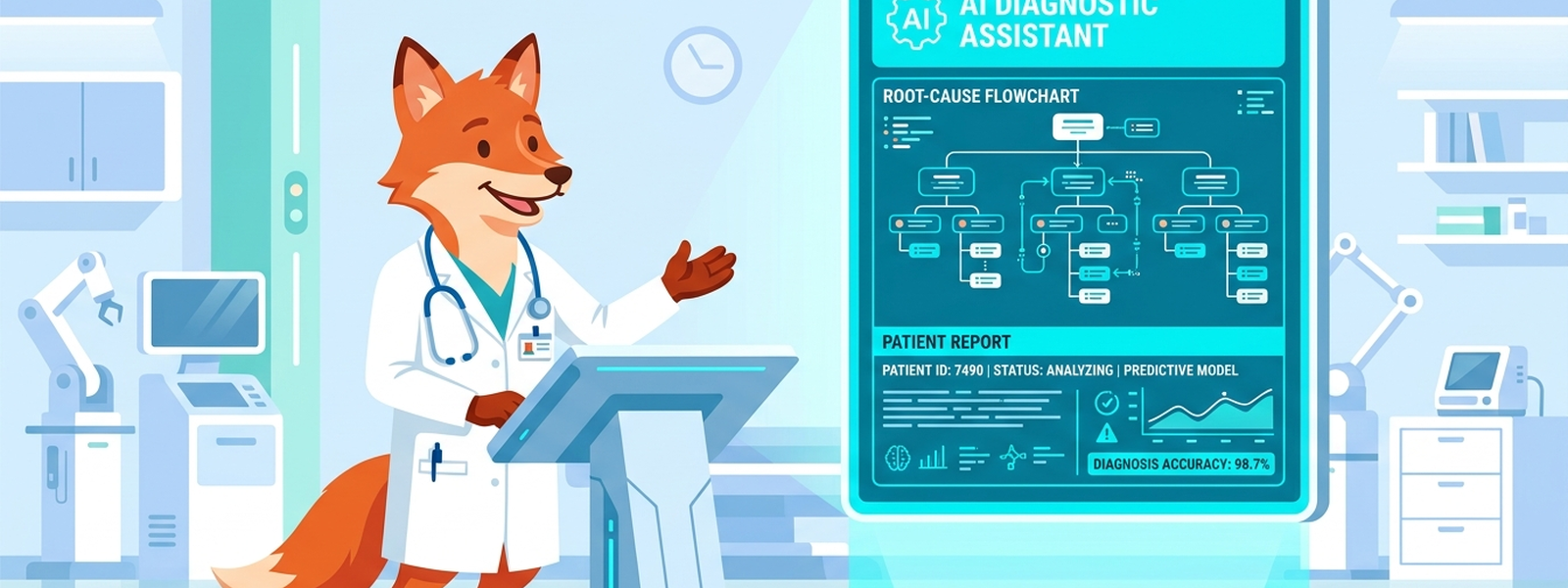
Opening Scene
A specialist reviewing a complex chart doesn’t just note that something looks off. A truly great one reads the pattern — this symptom, combined with that lab value, combined with this history — and drafts a likely diagnosis on the spot, before a single additional test is ordered. That’s not magic; it’s pattern recognition built from having seen thousands of similar cases before, applied instantly to a new one.
AI-assisted quality diagnosis is starting to offer that same capability, directly to data teams facing a fresh incident.
In Plain English
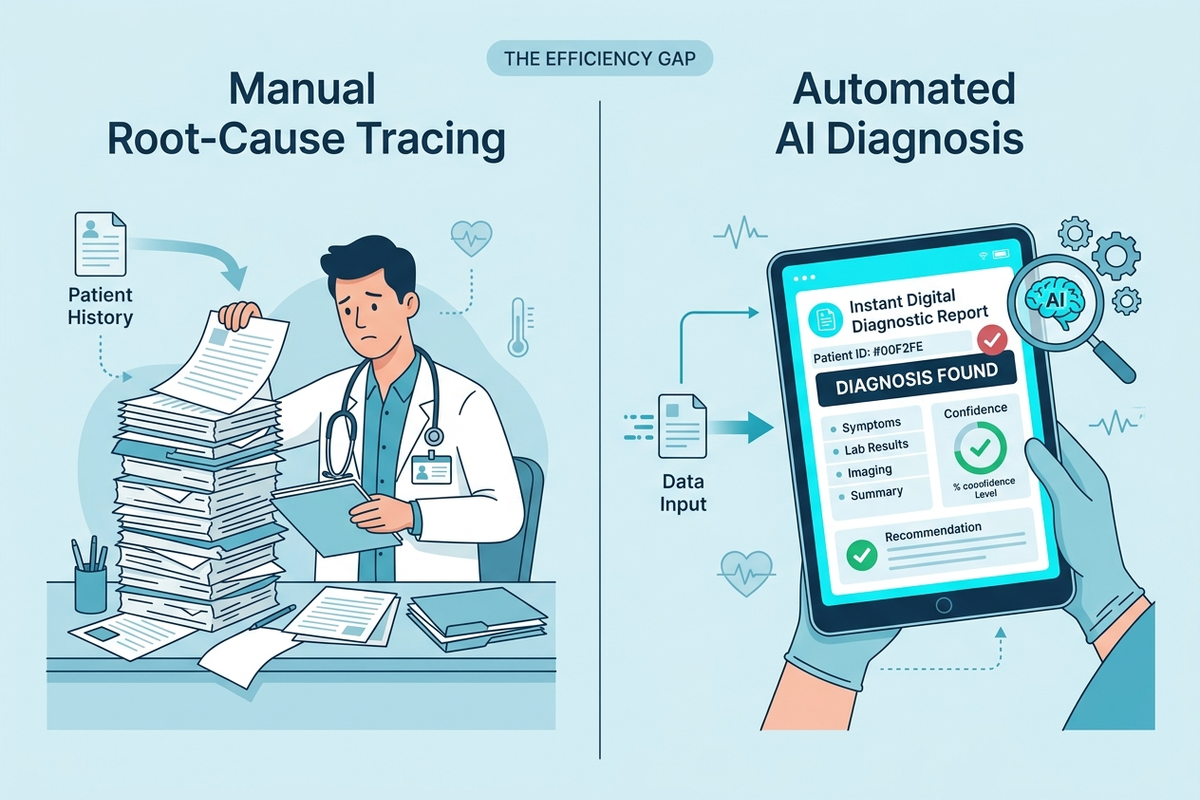
AI-assisted diagnosis goes beyond detecting that a data quality anomaly exists — it analyzes the anomaly’s pattern, combined with lineage information (Article 7) and historical incident data, to suggest a likely root cause automatically, before a human investigator has manually traced through the pipeline. This is the natural extension of the root-cause themes this series has built up across earlier articles, now delivered as an automatic, immediate suggestion rather than a manual investigative process.
The Old Way
Root-cause investigation, even with good lineage available, traditionally required a person to manually trace through the data, compare it against what they knew about recent changes, and reason through what was most likely responsible — genuinely skilled work, but slow, and dependent on a specific person’s accumulated experience and familiarity with the system.
This created real bottlenecks: incidents often waited on whichever specific person had the deepest institutional knowledge of a given pipeline, and that knowledge didn’t transfer easily to new team members or scale across a growing number of pipelines and datasets.
What’s Changing (and Why AI Is the Reason)
- AI-assisted diagnosis draws on lineage, recent changes, and historical incident patterns simultaneously. Rather than one person’s accumulated experience, AI-assisted tooling can draw on comprehensive lineage data (Article 7), recent schema or pipeline changes, and patterns from every past incident the organization has ever documented — a much broader base of pattern recognition than any single person could hold in memory.
- This capability directly compounds with everything else this series has covered. Good lineage (Article 7), documented known issues (Article 12), and cross-validation results (Article 11) all feed into making an AI-assisted diagnosis genuinely accurate, rather than a plausible-sounding guess — this article is as much a payoff of prior investment as a new capability in its own right.
- AI-assisted diagnosis is democratizing incident response beyond a small group of specialists. A newer team member facing an incident no longer has to wait for or lean entirely on the one person with deep institutional knowledge — an AI-assisted first-pass diagnosis gives everyone a genuine, informed starting point.
The Metaphor, Fully Extended
| Hospital Element | AI-Assisted Diagnosis Concept |
|---|---|
| A specialist drafting a likely diagnosis from pattern recognition alone | AI-assisted analysis suggesting a likely root cause from an anomaly’s pattern |
| Years of experience with thousands of similar cases | Historical incident data and lineage informing the AI’s suggestion |
| Waiting for the one specialist who knows this specific case type best | Waiting for the one team member with deep institutional knowledge of a pipeline |
| A junior clinician getting a strong diagnostic starting point from a specialist’s input | A newer team member getting a strong, AI-assisted starting point for an incident |
| A diagnosis that’s only as good as the patient’s actual chart history | A root-cause suggestion that’s only as good as the underlying lineage and incident data |
For Beginners: What to Actually Do
- Treat an AI-assisted root-cause suggestion the same way you’d treat a specialist’s initial diagnosis: a strong, informed starting point, still worth verifying rather than accepting blindly.
- Practice comparing an AI-assisted suggestion against your own manual reasoning at least a few times, to build a genuine sense of how reliable it tends to be for your specific systems.
- Notice how much this capability depends on the lineage and documentation work covered in earlier articles — a good outcome here isn’t magic, it’s the payoff of that underlying investment.
- If you’re new to a team, use AI-assisted diagnosis as a genuine learning tool, not just a shortcut — understanding why it suggested a particular cause builds real system knowledge over time.
For Practitioners and Leaders: The Deeper Layer
- Recognize AI-assisted diagnosis as a direct return on lineage, documentation, and cross-validation investment covered earlier in this series — teams without that foundation will get meaningfully weaker suggestions, since there’s less good information to draw on.
- Use this capability specifically to reduce bottlenecks around institutional knowledge concentrated in a small number of specialists — track whether incident response time and quality actually become less dependent on specific individuals being available.
- Validate AI-assisted diagnostic accuracy over time with real tracking, not just anecdotal impression — a system that’s confidently wrong some fraction of the time and goes unmonitored can quietly erode trust in the whole approach.
- Treat this as a genuine force multiplier for less experienced team members specifically, and measure whether it’s actually closing the gap between newer and more experienced staff during real incidents.
Quick Recap
- AI-assisted diagnosis analyzes an anomaly’s pattern alongside lineage and historical incident data to suggest a likely root cause automatically, rather than requiring purely manual investigation.
- Traditional root-cause investigation depended heavily on specific individuals’ accumulated institutional knowledge, creating real bottlenecks and knowledge-transfer challenges.
- This capability is a direct payoff of the lineage, documentation, and cross-validation investments covered earlier in this series, not a standalone new tool.
- AI-assisted diagnosis is democratizing effective incident response beyond a small group of specialists, though suggestions still deserve verification, not blind trust.
Where This Fits in the Series
Article 13 covered patients who look fine but aren’t. This article covered diagnosis that increasingly writes itself. Article 15 looks at how a care team actually communicates about what’s wrong, to each other and to the people depending on the outcome.
Key References
- OpenLineage Specification — Open standard for data lineage collection and pipeline observability metadata.
- Great Expectations Data Testing Framework — Open-source python tool for data quality assertions and validation.
- EU General Data Protection Regulation (GDPR) Official Text — European regulatory framework for data compliance, security, and governance.
Subscribe to the Newsletter
Get the latest DataParables articles delivered straight to your inbox.