
Opening Scene
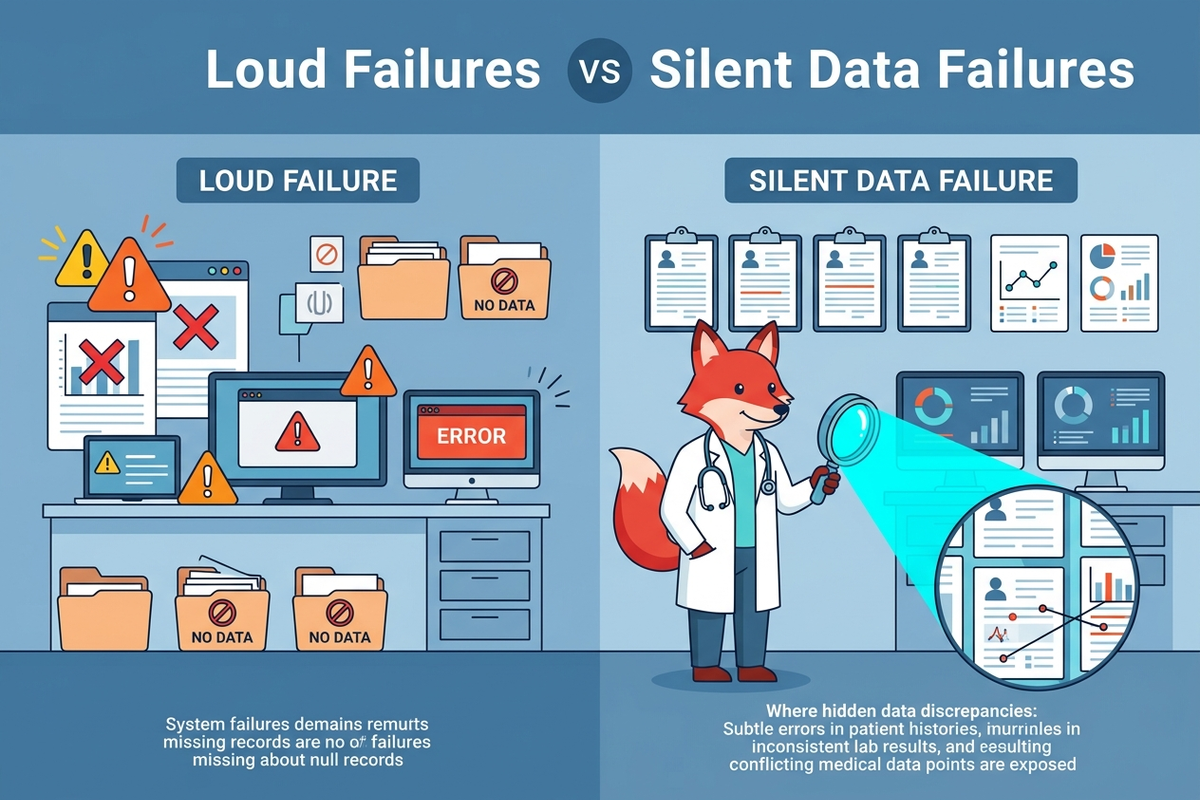
The most dangerous medical cases often aren’t the dramatic, obviously distressed ones — those get attention fast, almost by default. The genuinely dangerous cases are sometimes the ones that look and feel completely fine on the surface, with nothing obviously wrong, while something serious develops quietly underneath, undetected until it’s already advanced. A patient who feels fine has no reason to ask for help.
Data has this exact same dangerous category: values that are silently, confidently wrong, with nothing about their appearance suggesting anything’s amiss.
In Plain English
Silent data quality failures are errors that produce data which looks entirely normal — well-formed, in range, passing every standard validation check — but is actually incorrect. Unlike a null value or an obvious outlier, which trigger visible alarms, a silent failure gives no obvious signal that anything’s wrong, making it the most dangerous category of quality issue precisely because nothing about it prompts anyone to look closer.
The Old Way
Traditional quality checks were built almost entirely to catch loud failures — missing values, out-of-range numbers, malformed formats — because these produce a clear, checkable signal. This coverage genuinely mattered and caught real problems, but it left silent failures essentially invisible to the very systems built to catch quality issues.
A classic example: a unit conversion error that shifts every value by a consistent factor still produces numbers that look entirely plausible individually — in range, well-formed, internally consistent — while being systematically wrong throughout. No standard rule-based check, built to catch loud failures, was ever going to flag this on its own.
What’s Changing (and Why AI Is the Reason)
- Cross-validation (Article 11) is one of the few reliable defenses against silent failures, and AI makes it practical at scale. Because silent failures pass individual rule checks by definition, catching them requires comparing data against independent sources or related fields — exactly the cross-validation discipline this series covered, now essential specifically for this category of risk.
- AI-assisted plausibility checking can catch systematic, silent shifts that individual rules miss entirely. By learning what a dataset’s values typically look like in relation to each other, AI-assisted checking can flag a systematic shift — every value in a field being consistently, subtly wrong — that no single-record rule check would ever catch.
- AI systems are simultaneously more exposed to silent failures and better positioned to help catch them. An AI model trained on silently-wrong data learns confidently incorrect patterns with no obvious warning sign; the same AI-assisted analytical techniques that create this exposure are also what’s most capable of detecting the subtle statistical signature silent failures often leave behind.
The Metaphor, Fully Extended
| Hospital Element | Silent Failure Concept |
|---|---|
| A patient who looks and feels completely fine while something develops underneath | Data that looks well-formed and passes checks but is actually wrong |
| A dramatic, obviously distressed patient getting immediate attention | An obvious data error (a null, an outlier) triggering an immediate alert |
| Screening tests designed specifically to catch conditions with no obvious symptoms | Cross-validation and plausibility checks designed to catch silent failures |
| A condition discovered only through comparison against independent test results | A silent error caught only by comparing against an independent data source |
| Advanced diagnostic tools detecting subtle patterns invisible to a routine exam | AI-assisted analysis detecting subtle statistical signatures of systematic error |
For Beginners: What to Actually Do
- Get comfortable with the specific danger of silent failures: they pass every standard check precisely because standard checks weren’t designed to catch this category of error.
- Practice thinking of at least one plausible silent-failure scenario for a dataset you’re familiar with — a unit conversion, a systematic offset, a consistently mislabeled category — to build genuine intuition for this risk.
- Treat cross-validation (Article 11) as your primary defense against this specific category of risk, since single-method rule checks are structurally unable to catch it.
- Notice that “everything passed validation” is a genuinely weaker claim than it sounds, and hold that awareness specifically for your most consequential data.
For Practitioners and Leaders: The Deeper Layer
- Prioritize cross-validation investment specifically for your most consequential datasets, understanding that this is close to the only reliable defense against silent, systematically-wrong data.
- Periodically audit “everything looks fine” data with a genuinely skeptical, independent check — the absence of alerts should never be mistaken for confirmed correctness, especially for data that’s been running quietly for a long time without a real audit.
- For AI training data and model inputs specifically, invest disproportionately in silent-failure detection, since this category of error is uniquely dangerous when there’s no human reviewer positioned to notice something looks subtly off.
- Treat any confirmed silent failure discovery as a genuine wake-up call worth investigating broadly, not just fixing narrowly — if one systematic, silent error existed undetected, it’s worth actively checking whether similar ones exist elsewhere.
Quick Recap
- Silent data quality failures produce data that looks entirely normal and passes standard checks while actually being incorrect, making them the most dangerous category of quality issue.
- Traditional rule-based checks were built to catch loud failures and are structurally unable to catch silent ones by design.
- Cross-validation and AI-assisted plausibility checking are the primary practical defenses against silent failures, since they compare data against independent sources rather than checking it in isolation.
- AI systems are both especially exposed to silent failures and, through the same analytical techniques, well positioned to help detect them.
Where This Fits in the Series
Article 12 covered distinguishing known conditions from new problems. This article covered the danger of a patient who looks perfectly fine. Article 14 looks at diagnosis that increasingly happens on its own, without waiting for a specialist to review every case.
Key References
- OpenLineage Specification — Open standard for data lineage collection and pipeline observability metadata.
- Great Expectations Data Testing Framework — Open-source python tool for data quality assertions and validation.
- EU General Data Protection Regulation (GDPR) Official Text — European regulatory framework for data compliance, security, and governance.
Subscribe to the Newsletter
Get the latest DataParables articles delivered straight to your inbox.