
Opening Scene
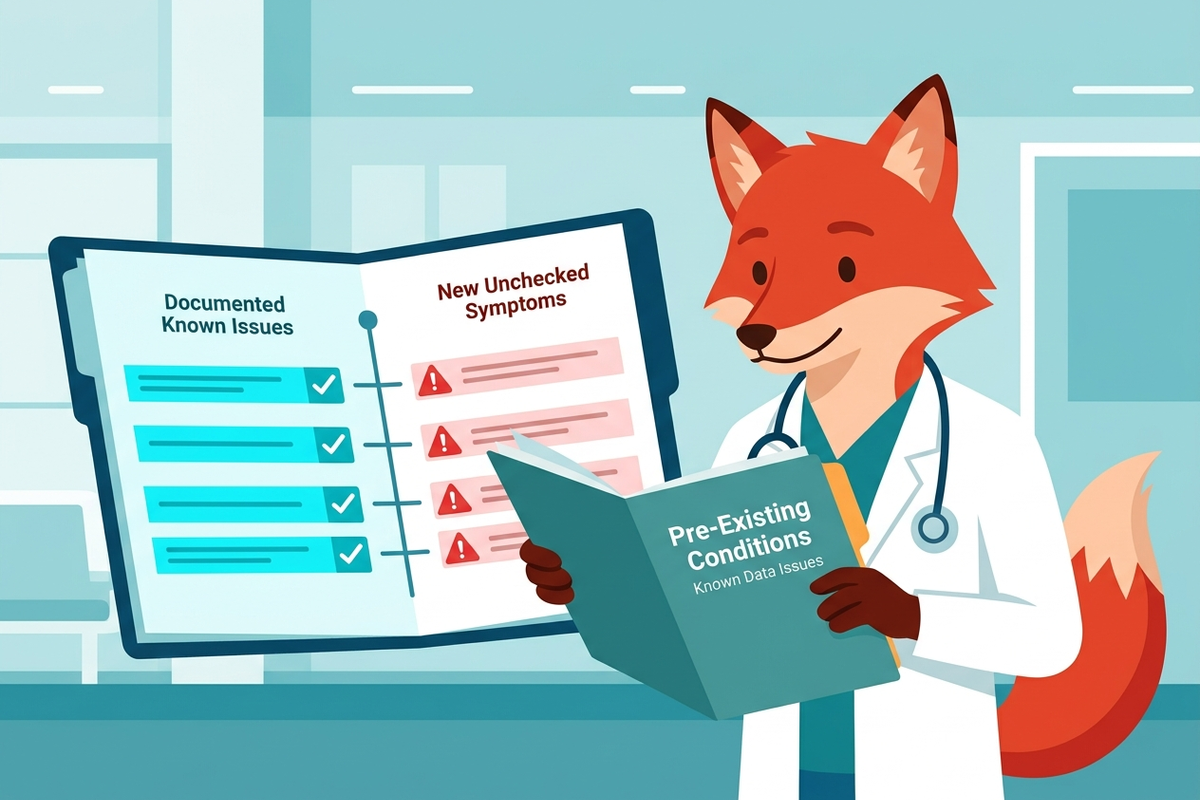
Not every unusual reading on a patient’s chart is a new emergency. Some are documented, long-standing, well-understood conditions — a naturally low resting heart rate, a chronic but stable condition that’s been managed for years. A good chart records these explicitly, so a new clinician doesn’t sound a false alarm over something that’s actually been normal for this specific patient for a decade.
Data quality programs need this same concept: a documented, deliberate record of known, accepted data issues, distinct from genuinely new problems.
In Plain English
Known issue documentation (sometimes discussed alongside the broader idea of data debt) is an explicit, maintained record of data quality issues that are known, understood, and deliberately accepted for now — distinct from undocumented, unknown problems. Without this record, every quality check re-discovers the same known issue repeatedly, either generating alert fatigue (Article 6) or, worse, training a team to distrust and ignore alerts generally.
The Old Way
Without deliberate documentation, known data quality issues often lived only in individual team members’ memory — “oh, that field’s always been a little off, don’t worry about it” — informal, undocumented knowledge that worked fine as long as the same people stayed on the team, and broke down completely the moment they left or simply forgot.
This created a recurring, wasteful pattern: new team members, or automated monitoring without documented context, would repeatedly flag the same known issue as if it were new, consuming investigation time on something that was already understood and deliberately deprioritized, while genuinely new issues competed for the same limited attention.
What’s Changing (and Why AI Is the Reason)
- AI-assisted systems can automatically suppress re-flagging of documented known issues. Rather than a person manually remembering to filter out already-known problems, a monitoring system with access to documented known-issue records can automatically recognize and appropriately deprioritize them, reducing wasted investigation effort directly.
- AI-assisted analysis can help distinguish a genuinely new issue from a known one that’s slightly changed shape. This is a real, subtle distinction — sometimes an anomaly that looks like a known issue has actually evolved into something new and worth fresh attention, and AI-assisted comparison against documented history can help catch that shift rather than reflexively dismissing every familiar-looking alert.
- Known-issue documentation is becoming a genuine input to AI-assisted severity scoring (Article 6). A documented, accepted issue should generally score lower priority than a genuinely novel one of similar surface severity — explicit documentation makes this distinction something a triage system can actually act on systematically, not just something a person happens to remember.
The Metaphor, Fully Extended
| Hospital Element | Known Issue Documentation Concept |
|---|---|
| A chronic, well-understood condition documented on the chart | A known, deliberately accepted data quality issue |
| Undocumented knowledge living only in one clinician’s memory | Undocumented tribal knowledge about a known data issue |
| A new clinician sounding a false alarm over something long-documented | A new team member or monitoring system re-flagging an already-known issue |
| A chart flag that automatically tells the care team “this is known, don’t panic” | Automated suppression of alerts for documented known issues |
| Noticing a chronic condition has actually changed in a new, concerning way | AI-assisted detection that a known issue has evolved into something genuinely new |
For Beginners: What to Actually Do
- If you encounter a data quality issue that a colleague describes as “yeah, that’s always been like that,” treat that as a signal to ask whether it’s actually documented anywhere, not just remembered informally.
- Practice documenting a known issue you’re aware of, even briefly — what it is, why it’s accepted for now, what would need to change for it to become a priority — as a habit worth building.
- Get comfortable with the idea that “known and accepted” is a legitimate, deliberate status for a data quality issue, not a failure to have fixed it yet — some issues genuinely aren’t worth fixing immediately.
- Notice when a “known issue” might actually have changed shape recently — don’t let familiarity become an excuse to stop looking closely.
For Practitioners and Leaders: The Deeper Layer
- Build and maintain an explicit, accessible known-issue registry rather than relying on institutional memory — this is a small investment that pays back repeatedly in avoided wasted investigation time.
- Treat known-issue documentation as living, not static — periodically review whether accepted issues are still genuinely acceptable, given how the business or the data’s actual usage may have changed since the issue was first documented.
- Integrate known-issue status directly into your alerting and triage systems (Article 6), so documented issues are automatically deprioritized rather than depending on a person remembering to do so manually.
- Watch specifically for known issues quietly evolving into something worse — a documented “minor, accepted” issue that’s grown in scope or impact deserves fresh evaluation, not permanent, unquestioned deprioritization.
Quick Recap
- Known issue documentation explicitly records data quality issues that are understood and deliberately accepted for now, distinct from genuinely new, undocumented problems.
- Without documentation, known issues live only in individual memory, causing repeated wasted investigation when that memory isn’t available or simply forgotten.
- AI-assisted systems can automatically suppress alerts for documented known issues, while also helping detect when a known issue has actually evolved into something new.
- Known-issue status should feed directly into triage and severity scoring, and should be periodically reviewed rather than treated as a permanent, unquestioned status.
Where This Fits in the Series
Article 11 covered getting a second opinion. This article covered distinguishing known, accepted conditions from new problems. Article 13 looks at what happens when a patient’s chart looks completely normal, but something is actually wrong.
Key References
- OpenLineage Specification — Open standard for data lineage collection and pipeline observability metadata.
- Great Expectations Data Testing Framework — Open-source python tool for data quality assertions and validation.
- EU General Data Protection Regulation (GDPR) Official Text — European regulatory framework for data compliance, security, and governance.
Subscribe to the Newsletter
Get the latest DataParables articles delivered straight to your inbox.