
Opening Scene
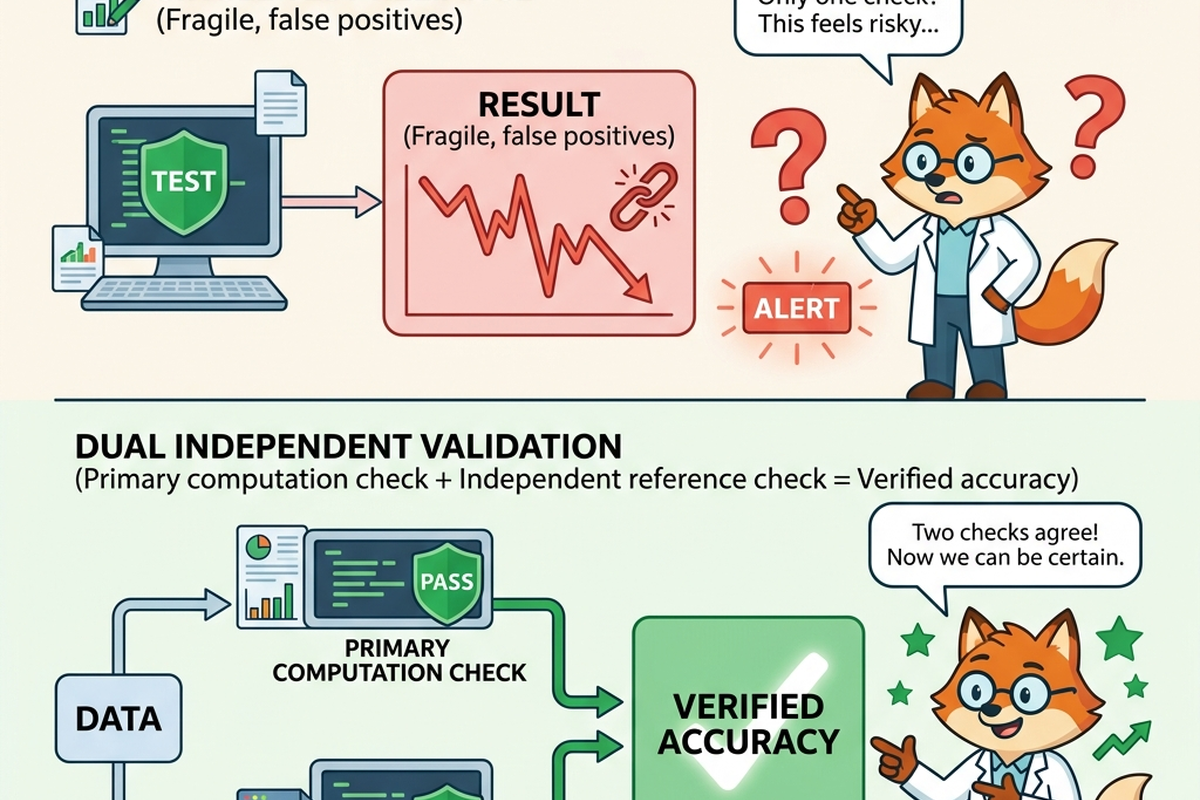
A single test result, taken in isolation, can mislead even a careful doctor — a lab error, an unusual but harmless individual variation, a mislabeled sample. A second, independent check, especially one using a different method or angle, is what actually builds real confidence in a diagnosis. Two independent tests agreeing is much stronger evidence than one test alone, however thorough that one test seemed.
Data quality validation benefits from the exact same discipline: cross-checking a result through more than one independent method before trusting it fully.
In Plain English
Cross-validation in a data quality context means checking a piece of data or a computed result through more than one independent method — comparing a computed total against an independently-sourced total, checking that a value makes sense against related fields, running two different validation approaches and confirming they agree — rather than relying on a single check as sufficient proof of correctness.
The Old Way
Many quality programs historically relied on a single validation method per concern — one rule checking for nulls, one range check per field — treating a pass on that single check as sufficient confirmation the data was fine. This is efficient, and it catches a real category of problems, but it has a specific blind spot: a value can pass every individual rule check and still be wrong in a way no single rule was designed to catch.
This blind spot showed up most often with subtly incorrect data — values that were technically well-formed, within range, and non-null, but simply wrong due to a calculation error or a misapplied business rule somewhere upstream. Single-method validation, by construction, has no way to catch this category of error.
What’s Changing (and Why AI Is the Reason)
- AI-assisted cross-validation can check consistency across many more angles than manual rule-writing ever could. Rather than a person writing individual comparison rules one at a time, AI-assisted tooling can check a value’s plausibility against many related fields and historical patterns simultaneously, catching subtle inconsistencies that single-method validation misses entirely.
- Independent recomputation is becoming a practical, automatable check, not just a manual audit technique. Recomputing a value through an entirely separate logical path and comparing it against the original — a classic manual audit technique — is increasingly automatable, giving genuine independent confirmation rather than relying on a single code path’s correctness.
- AI models themselves increasingly serve as one of the independent checking methods. An AI model trained to recognize what plausible data looks like, given everything else known about a record, can serve as a genuinely independent second opinion alongside traditional rule-based checks, catching a different category of error than either approach would catch alone.
The Metaphor, Fully Extended
| Hospital Element | Cross-Validation Concept |
|---|---|
| Trusting a single test result without confirmation | Relying on a single validation rule as sufficient proof of correctness |
| A lab error or unusual individual variation misleading one test | A subtly incorrect value that passes every individual rule check |
| Ordering a second, independent test to confirm | Cross-checking a value through an independent method |
| Two independent tests agreeing, building real diagnostic confidence | Two independent validation methods agreeing, building real confidence in the data |
| A specialist recognizing something looks off, even though every individual number checks out | An AI model flagging implausibility based on the full pattern, not just individual rule checks |
For Beginners: What to Actually Do
- Practice identifying, for a critical dataset you rely on, whether its validation relies on a single method or genuine cross-checking through independent approaches.
- Get comfortable with the idea that passing every individual rule check doesn’t guarantee correctness — that’s specifically the blind spot cross-validation is meant to address.
- If you’re building validation logic, practice designing at least one independent cross-check (a recomputation, a comparison against a related field) alongside standard rule-based checks.
- Notice when a value “looks off” even though it technically passes all checks — that instinct is worth taking seriously and investigating, not dismissing because the rules didn’t flag it.
For Practitioners and Leaders: The Deeper Layer
- Audit your highest-stakes data pipelines for single-method-only validation, and prioritize adding genuine cross-validation for anything where subtle, rule-passing errors would be particularly costly.
- Invest in independent recomputation checks specifically for critical calculated fields — a second, entirely separate logical path computing the same value is one of the strongest confirmation signals available.
- Evaluate AI-assisted plausibility checking as a genuinely complementary validation method, not a replacement for rule-based checks — the two catch different categories of error, and both matter.
- Treat cross-validation investment as proportional to consequence: build it deliberately and thoroughly for your most consequential data, rather than applying it uniformly everywhere at equal cost.
Quick Recap
- Cross-validation checks data through more than one independent method, catching subtly incorrect values that pass every individual rule check but are still wrong.
- Single-method validation, however well-designed, has a specific blind spot for errors that are technically well-formed but simply incorrect.
- AI-assisted cross-validation and automated independent recomputation make genuine cross-checking practical at scale, beyond what manual rule-writing could achieve.
- AI models can serve as a genuinely independent checking method alongside traditional rules, catching a different category of error than either approach alone.
Where This Fits in the Series
Article 10 covered containing bad data before it spreads. This article covered why a second, independent check matters even when the first seemed conclusive. Article 12 looks at conditions a patient has always had, and how a good chart handles them differently from a new problem.
Key References
- OpenLineage Specification — Open standard for data lineage collection and pipeline observability metadata.
- Great Expectations Data Testing Framework — Open-source python tool for data quality assertions and validation.
- EU General Data Protection Regulation (GDPR) Official Text — European regulatory framework for data compliance, security, and governance.
Subscribe to the Newsletter
Get the latest DataParables articles delivered straight to your inbox.