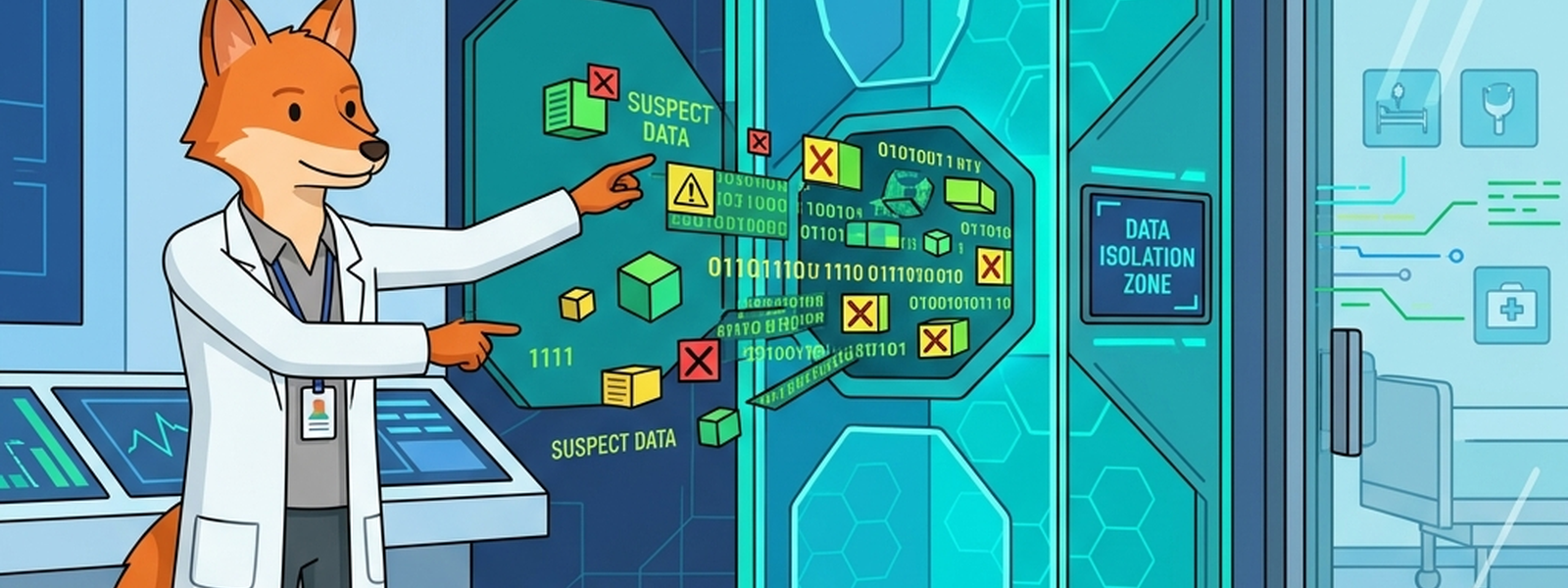
Opening Scene
A hospital doesn’t wait to see whether a suspected contagious case actually spreads before isolating it. The moment something’s identified as a real risk, it gets contained — moved to isolation, handled with protocols that prevent it from reaching the rest of the ward — precisely because waiting for confirmed spread before acting means the damage is already underway by the time anyone responds.
Data quality needs the same reflex: containing a detected bad batch of data before it reaches downstream systems, not after.
In Plain English
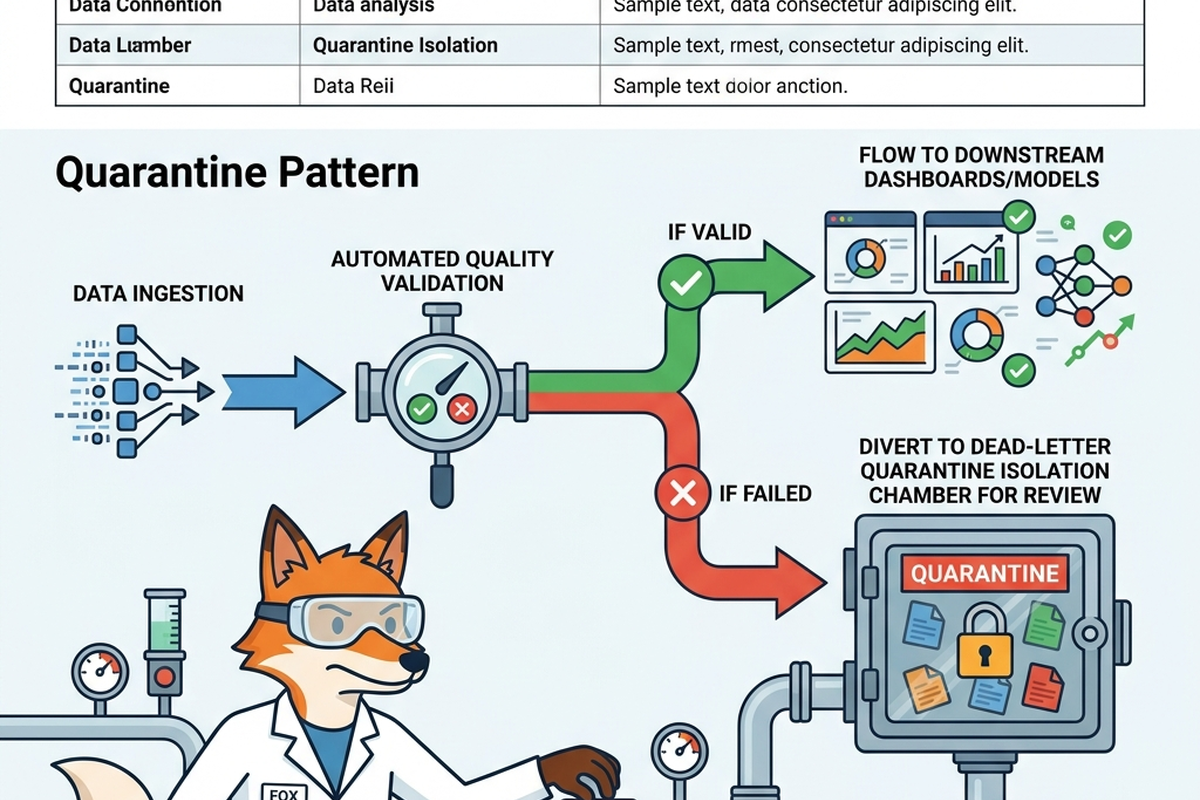
Quarantine patterns in data quality mean isolating data that fails validation before it reaches downstream consumers — holding it in a separate location, flagging it clearly, and only releasing it once it’s been reviewed or fixed — rather than letting it flow through to dashboards, models, and dependent pipelines by default. This is the data-quality-specific application of the dead-letter-queue and reject-bin concepts covered for pipelines elsewhere on this site.
The Old Way
Without deliberate quarantine, the traditional default was to let data flow through the pipeline unless something explicitly stopped it — an opt-out model, where bad data reached downstream systems by default unless a specific check happened to catch it first. This meant any gap in check coverage translated directly into bad data reaching production, dashboards, and models.
This default posture also created a common, frustrating incident pattern: bad data would propagate through several downstream systems before being caught, meaning the cleanup effort wasn’t just fixing the original problem, but also tracing and correcting every downstream system the bad data had already reached in the meantime.
What’s Changing (and Why AI Is the Reason)
- Quarantine-by-default is becoming a more common architectural posture, especially for high-stakes data. Rather than data flowing through by default unless caught, an increasing number of systems flip the default: data must pass validation to proceed, and anything uncertain gets held for review rather than assumed safe — an opt-in model that better matches the real cost asymmetry between a false quarantine and a real, undetected bad-data incident.
- AI-assisted validation is making it more practical to quarantine confidently, without excessive false positives. A quarantine-by-default posture only works well if the validation deciding what gets held is accurate enough not to block large amounts of genuinely good data — AI-assisted checking, grounded in the baselines covered in Article 5, makes this posture practical rather than overly disruptive.
- AI systems consuming data raise the stakes on quarantine discipline specifically. Since an AI model or agent has no independent judgment to notice an obviously wrong number the way a human reviewer might, quarantine is often the only real backstop preventing bad data from directly influencing an AI system’s behavior.
The Metaphor, Fully Extended
| Hospital Element | Quarantine Concept |
|---|---|
| A suspected contagious case moved to isolation immediately | Data failing validation held before reaching downstream systems |
| Letting a patient onto the general ward unless something explicitly flags a risk | An opt-out model where data flows by default unless caught |
| Requiring clearance before entering the general ward | An opt-in, quarantine-by-default model requiring validation to proceed |
| Contact tracing after an unisolated case has already spread through the ward | Tracing and fixing every downstream system a bad batch already reached |
| A rapid, accurate screening test enabling confident isolation decisions | AI-assisted validation accurate enough to quarantine confidently without excessive disruption |
For Beginners: What to Actually Do
- Practice identifying, for a pipeline you’re familiar with, whether it operates as opt-out (flows by default) or opt-in (must pass validation to proceed) — that distinction has a real effect on how much bad data actually reaches production.
- Get comfortable with the idea that a quarantine system will sometimes hold genuinely good data by mistake — that’s an expected cost of the approach, not a sign it’s broken, as long as the rate stays reasonably low.
- Notice, for any quality incident you encounter, how far the bad data actually propagated before being caught — that distance is a direct measure of how much quarantine discipline was actually in place.
- Understand quarantine as directly connected to the reject-bin and dead-letter-queue patterns covered elsewhere on this site’s pipeline coverage — same underlying idea, applied specifically to quality validation.
For Practitioners and Leaders: The Deeper Layer
- Evaluate whether your highest-stakes data pipelines operate as opt-out or opt-in with respect to validation, and prioritize shifting the most consequential ones toward quarantine-by-default.
- Track propagation distance for quality incidents as an explicit metric — how many downstream systems did bad data actually reach before being caught — as a direct measure of quarantine effectiveness across your platform.
- Invest in AI-assisted validation accuracy specifically to make quarantine-by-default practical without excessive false positives disrupting legitimate data flow.
- Prioritize quarantine discipline first and most rigorously for any pipeline feeding AI training data, models, or autonomous agents, where there’s no human reviewer positioned to catch an obviously wrong number before it’s acted on.
Quick Recap
- Quarantine patterns isolate data that fails validation before it reaches downstream systems, rather than letting it flow through by default until something happens to catch it.
- Traditional opt-out defaults meant any gap in check coverage translated directly into bad data reaching production, often propagating through multiple systems before detection.
- Quarantine-by-default is becoming more common for high-stakes data, made practical by AI-assisted validation accurate enough to avoid excessive false positives.
- AI systems consuming data raise the stakes on quarantine discipline, since there’s often no human reviewer to catch an obviously wrong number downstream.
Where This Fits in the Series
Article 9 covered treating anomalies as signal. This article covered containing bad data before it spreads. Article 11 looks at why a second opinion matters even when the first check seemed conclusive.
Key References
- OpenLineage Specification — Open standard for data lineage collection and pipeline observability metadata.
- Great Expectations Data Testing Framework — Open-source python tool for data quality assertions and validation.
- EU General Data Protection Regulation (GDPR) Official Text — European regulatory framework for data compliance, security, and governance.
Subscribe to the Newsletter
Get the latest DataParables articles delivered straight to your inbox.