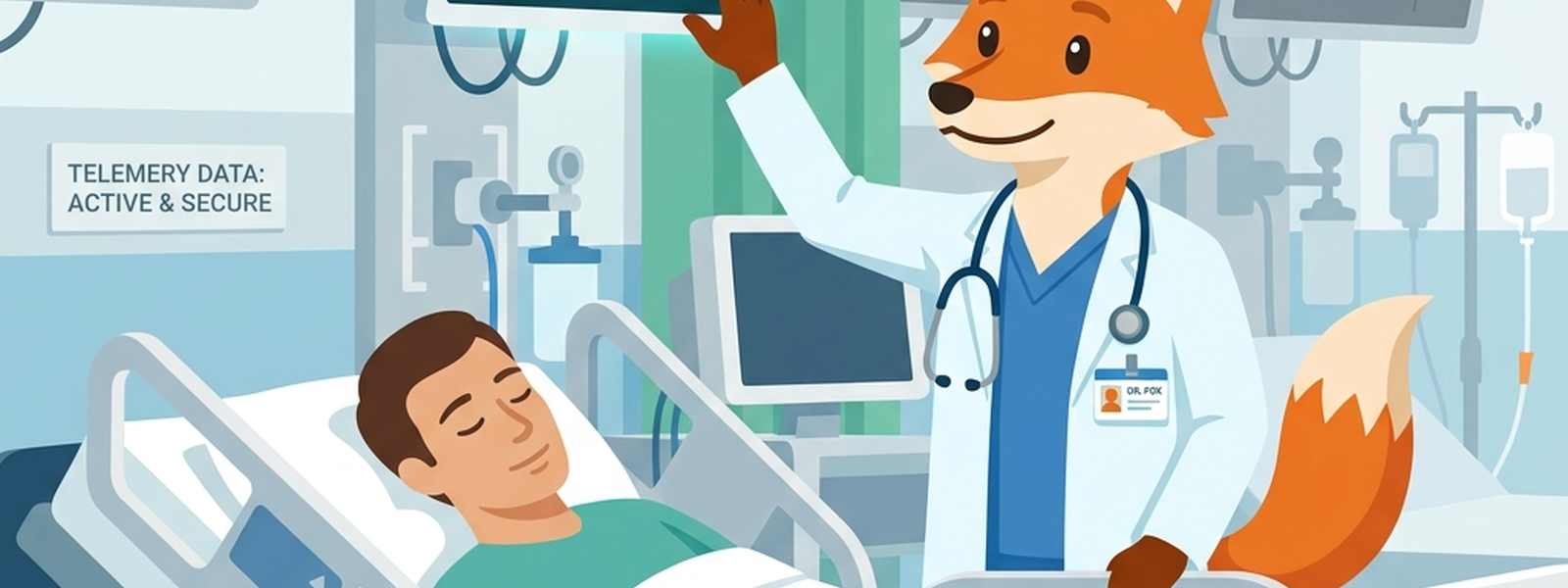
Opening Scene
A patient admitted to a hospital gets checked thoroughly once, at intake — vitals recorded, history taken, a baseline established. If nobody checks again after that, the hospital has no way of knowing whether the patient’s condition is stable, improving, or quietly deteriorating. The whole discipline of modern patient monitoring exists because a single checkup, however thorough, only tells you about one moment in time.
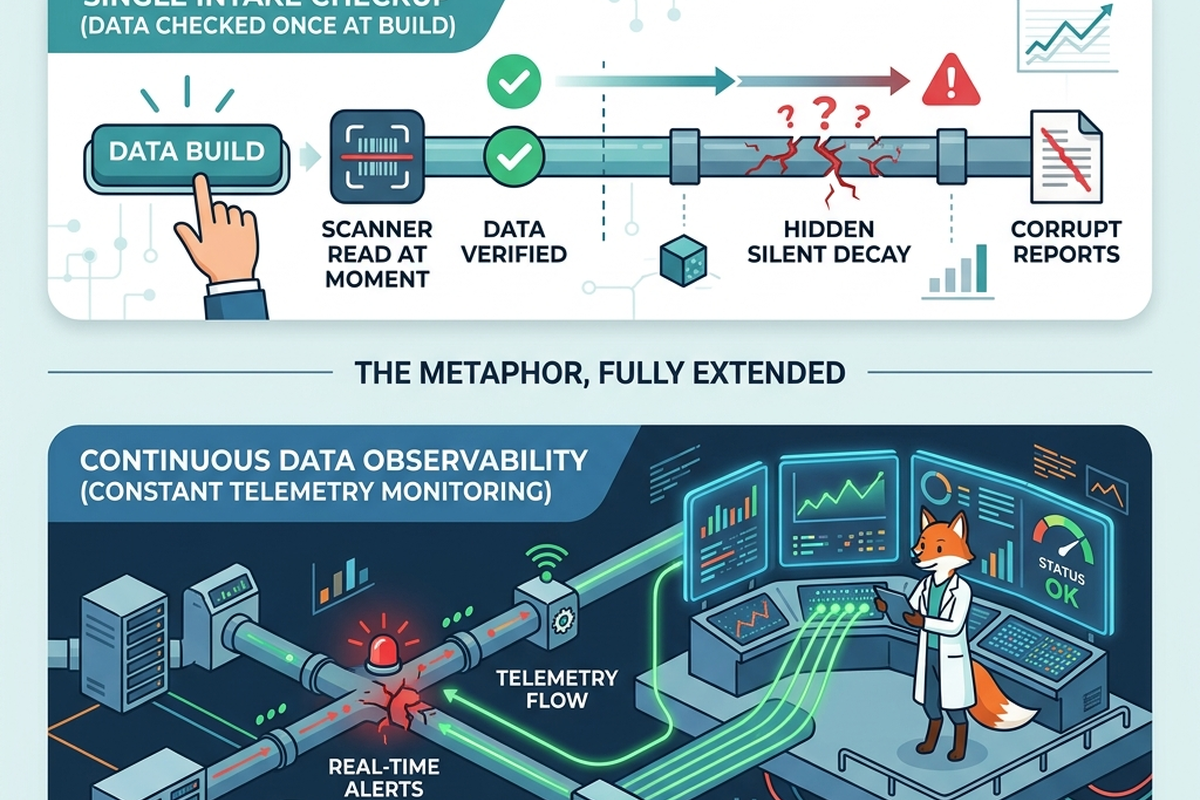
Most organizations’ data gets exactly one thorough checkup too: when it’s first built. After that, an enormous amount of it is never checked again until something visibly breaks.
In Plain English
Data quality describes whether data is accurate, complete, and fit for its intended use. Observability is the broader, ongoing discipline of being able to see what’s actually happening inside a data system at any given moment — not just whether it’s technically running, but whether what it’s producing is actually correct. Together, they’re the difference between building something once and assuming it stays healthy, and continuously watching whether it actually does.
The Old Way
Traditionally, data quality got real attention exactly once: during initial pipeline or system design, when a team carefully validated that everything worked correctly before launch. After that, quality checking often stopped, or shrank to checking whether a job finished successfully, not whether its output was actually still correct.
This pattern quietly assumed something false: that a data system, once verified correct, stays correct indefinitely. In reality, upstream sources change, business logic drifts from what a schema assumes, and small errors compound silently. A system that was genuinely healthy at launch can degrade for months before anyone notices, especially if nobody’s actually checking.
What’s Changing (and Why AI Is the Reason)
- AI systems have made silent data quality failures dramatically more expensive. A bad number reaching a human analyst might get questioned. A bad number feeding an AI model’s training data, or an autonomous agent’s decision, often gets acted on directly, with no human in the loop to notice something looks wrong — raising the real cost of quality failures that used to be merely embarrassing.
- Continuous monitoring is now genuinely achievable, not just theoretically ideal. AI-assisted observability tooling can check data quality continuously, automatically, at a scale that would be impractical for a human team to replicate manually — turning “we should check this more often” from an aspiration into an actual, deployable practice.
- AI is helping catch quality issues that traditional rule-based checks miss. Beyond simple validation rules (is this field null, is this number in range), AI-assisted anomaly detection can catch subtler, harder-to-specify quality problems — patterns this series explores throughout.
The Metaphor, Fully Extended
| Hospital Element | Data Quality Concept |
|---|---|
| A thorough checkup at admission | Careful validation during initial data system design |
| No follow-up checks after that | No ongoing quality monitoring after launch |
| A patient’s condition quietly deteriorating unnoticed | Data quality degrading silently over time |
| Continuous vital-signs monitoring | Ongoing, automated data quality observability |
| A monitor that flags what a single checkup would miss | AI-assisted checks catching subtler quality issues |
For Beginners: What to Actually Do
- Before assuming a data system you rely on is healthy, ask specifically when it was last actually checked for quality, not just whether it’s still running.
- Get comfortable with the distinction between data quality (is this specific data correct) and observability (can we see what’s actually happening across the whole system) — this series uses both terms throughout, and they’re related but different.
- Practice identifying the difference between “the job succeeded” and “the output is correct” for any pipeline you work with — that gap is where most undetected quality problems hide.
- Notice how much more consequential a bad number becomes once an AI system, not just a person, is acting on it directly.
For Practitioners and Leaders: The Deeper Layer
- Audit your organization’s data systems for how recently each one was actually checked for quality, not just uptime — you’ll likely find a significant gap between systems checked at launch and never revisited.
- Treat “the job finished successfully” as a genuinely different, weaker claim than “the output is correct,” and make sure your monitoring actually verifies the stronger claim where it matters.
- AI systems consuming your data raise the real cost of undetected quality issues — prioritize observability investment specifically for data feeding AI training, models, or autonomous agents.
- This is the first of a twenty-article arc — resist jumping straight to specific tools. The next several articles build the conceptual foundation (what to actually check, how to baseline, how to prioritize) that makes tool selection meaningful.
Quick Recap
- Data quality is whether data is accurate and fit for use; observability is the ongoing ability to see what’s actually happening in a data system.
- Traditionally, thorough checking happened once at launch, with an unfounded assumption that a system stays correct indefinitely afterward.
- AI systems consuming bad data directly, with no human in the loop, have made silent quality failures dramatically more consequential.
- Continuous, automated observability is now genuinely achievable, catching both simple rule violations and subtler anomalies traditional checks miss.
Where This Fits in the Series
This is the opening article — the hospital, and the vitals nobody was checking. Article 2 looks at why a single annual checkup, however thorough, was never actually a substitute for real ongoing monitoring.
Key References
- OpenLineage Specification — Open standard for data lineage collection and pipeline observability metadata.
- Great Expectations Data Testing Framework — Open-source python tool for data quality assertions and validation.
- EU General Data Protection Regulation (GDPR) Official Text — European regulatory framework for data compliance, security, and governance.
Subscribe to the Newsletter
Get the latest DataParables articles delivered straight to your inbox.