
Opening Scene
A crate of tomatoes arrives and half of them are bruised beyond use. A panicked kitchen either throws out the entire delivery, including the good half, or — worse — uses the bruised ones anyway because stopping to sort them feels like it’ll slow service down too much. A well-run kitchen does neither: the bad tomatoes go in a clearly marked bin, the good ones go into service, and someone reviews the bin later to figure out what happened and whether the supplier needs a conversation.
That bin is a dead-letter queue, and the instinct behind it — don’t let bad records stop good ones, but don’t lose track of the bad ones either — is one of the most important habits a reliable pipeline can have.
In Plain English
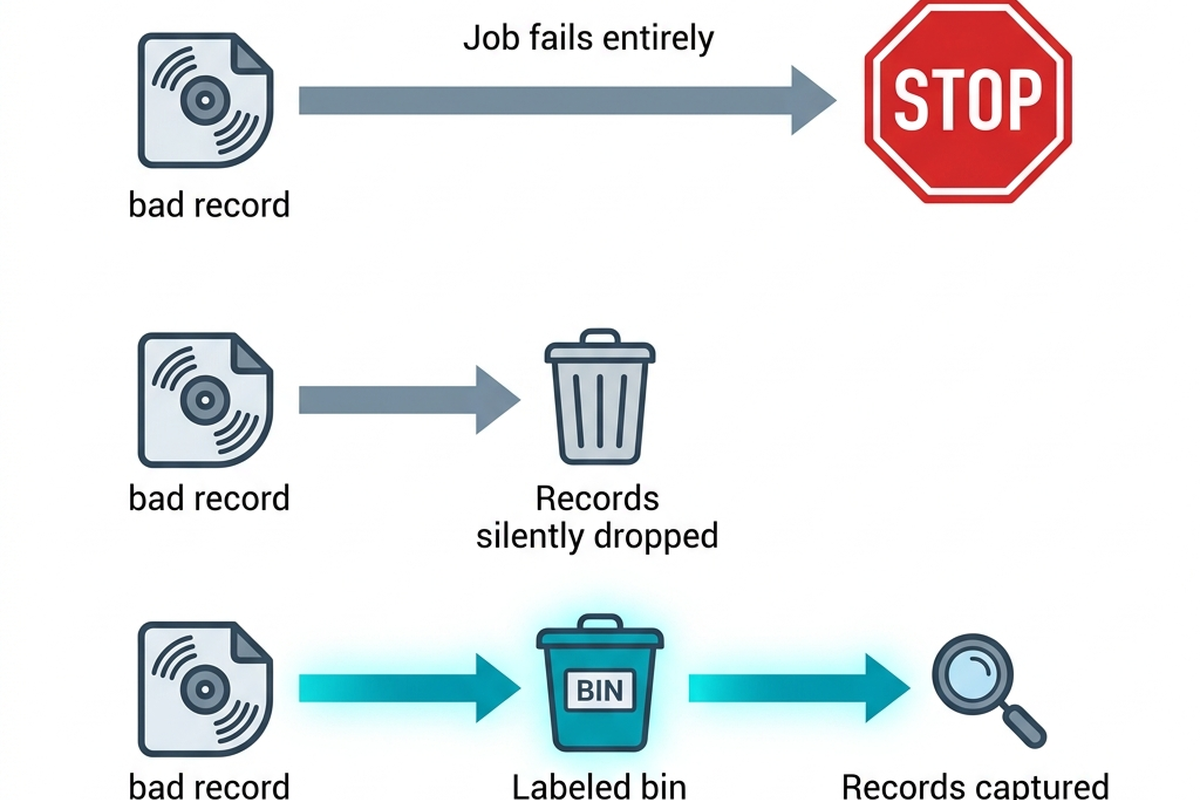
A dead-letter queue (or reject path) is where a pipeline routes records that fail validation — malformed, missing required fields, out of expected range — instead of either crashing the whole job or silently letting bad data through. The goal is to keep the pipeline moving on the records that are fine, while preserving the bad ones somewhere reviewable, rather than making an all-or-nothing choice between “stop everything” and “let it all through.”
The Old Way
Traditionally, pipelines handled bad records in one of two blunt ways. Some failed the entire job the moment a single record looked wrong — safe, in that nothing bad ever got through, but brittle, because one malformed row could block an entire night’s processing, the equivalent of canceling dinner service over a few bruised tomatoes. Others simply skipped or dropped anything that failed validation without recording it anywhere, which kept things running but quietly lost data and any trace that something had gone wrong — the equivalent of tossing the bruised tomatoes straight in the trash without ever telling the kitchen manager there was a problem with that supplier.
Neither approach gave anyone the information needed to actually fix the underlying issue. A dead-letter queue splits the difference: bad records get set aside, not lost and not blocking, with enough detail to actually diagnose what went wrong.
What’s Changing (and Why AI Is the Reason)
- AI can triage the reject bin. Instead of a person manually reviewing every rejected record, AI tools can now group similar failures together, flag likely root causes, and suggest whether a batch of rejects reflects one systemic issue (a supplier’s format changed) or a handful of unrelated one-off problems — cutting review time from hours of manual scanning to a quick, categorized summary.
- Some rejects can be automatically repaired. For well-understood failure patterns — a date in the wrong format, a field that’s clearly just mistyped — AI-assisted correction can now propose (or, with the right guardrails, automatically apply) a fix and reprocess the record, rather than every reject requiring manual intervention.
- Reject patterns feed back into the pipeline faster. Instead of the dead-letter queue being a place records go to be forgotten, AI-assisted monitoring can surface a spike in a particular kind of rejection almost immediately, closer to a kitchen manager getting an alert the moment a supplier’s delivery quality drops, rather than noticing weeks later while cleaning out the bin.
The Metaphor, Fully Extended
| Kitchen Element | Dead-Letter Queue Concept |
|---|---|
| The marked reject bin for bruised produce | The dead-letter queue for failed records |
| Canceling service over one bad crate | A pipeline that fails entirely on any invalid record |
| Quietly tossing bad produce with no record of it | Silently dropping bad records with no trace |
| A kitchen manager reviewing the bin later | An engineer reviewing rejected records to diagnose root cause |
| Sorting the bin by which supplier caused the problem | AI-assisted grouping of rejects by likely root cause |
| Trimming a slightly bruised vegetable instead of discarding it | Automatically repairing a well-understood, minor validation failure |
| An alert the moment a supplier’s quality drops | Real-time monitoring of reject rate spikes |
For Beginners: What to Actually Do
- Never design a pipeline with only two options for bad data: crash entirely, or silently let it through. Always build a third path that captures and preserves what failed.
- When you set up a dead-letter queue, make sure it captures enough context to actually diagnose the problem later — not just “this record failed,” but why, and what the original record looked like.
- Get in the habit of actually reviewing the reject bin periodically. A dead-letter queue nobody looks at is just a slower way of silently losing data.
- Before trusting an AI-suggested automatic repair, understand exactly what pattern it’s fixing and confirm it’s the kind of failure that’s genuinely safe to auto-correct, not one that needs a human judgment call.
For Practitioners and Leaders: The Deeper Layer
- A dead-letter queue is only valuable if someone owns reviewing it — an unreviewed reject path accumulates the same silent data loss as no reject path at all, just with better bookkeeping about what was lost.
- Reject rate is a genuinely useful health metric for a pipeline and its upstream sources — a rising trend is often the earliest available signal that something changed at the source, well before it shows up as a wrong number in a report.
- AI-assisted automatic repair is powerful but needs clear boundaries: define explicitly which failure categories are safe to auto-correct versus which ones must always go to a person, and revisit that boundary periodically as confidence (or evidence of mistakes) accumulates.
- Treat a spike in rejections as an incident-worthy signal, not routine noise — the earlier a systemic source problem is caught in the reject bin, the cheaper it is to fix compared to discovering it downstream in a report someone already acted on.
Quick Recap
- A dead-letter queue routes records that fail validation somewhere reviewable, instead of crashing the whole pipeline or silently dropping them.
- Traditional pipelines often handled bad data in one of two blunt ways: fail everything, or lose it silently — both had real costs.
- AI tools can now triage rejected records by likely root cause and even propose automatic fixes for well-understood failure patterns.
- A dead-letter queue only earns its keep if someone actually reviews it; otherwise it’s just organized data loss.
- Reject rate trends are an early warning signal worth monitoring, often surfacing source problems before they show up anywhere else.
Where This Fits in the Series
Article 8 covered making sure pipeline jobs run in the right order. This article covered what happens to the individual records that shouldn’t go through at all. Article 10 follows a value further back than validation can reach — tracing exactly where a piece of data actually came from.
Key References
- dbt Core Documentation — Official documentation for data transformation workflows, DAG creation, and testing.
- Apache Airflow Architecture Guide — Open-source platform standards for orchestrating complex data pipelines.
- Apache Kafka Documentation — Industry standard specification for real-time event streaming pipelines.
Subscribe to the Newsletter
Get the latest DataParables articles delivered straight to your inbox.