
Opening Scene
Tickets don’t get cooked in the order they happen to print. The expo running the rail knows the appetizer has to go out before the entree, that table four’s dishes all need to land at the same time even though they take different lengths of time to cook, and that nothing gets fired until the walk-in confirms an ingredient is actually in stock. None of that coordination happens by accident — someone, or something, is actively managing the order and the dependencies.
That coordination role — deciding what runs, in what order, and only after what else has finished — is what a pipeline orchestrator does.
In Plain English
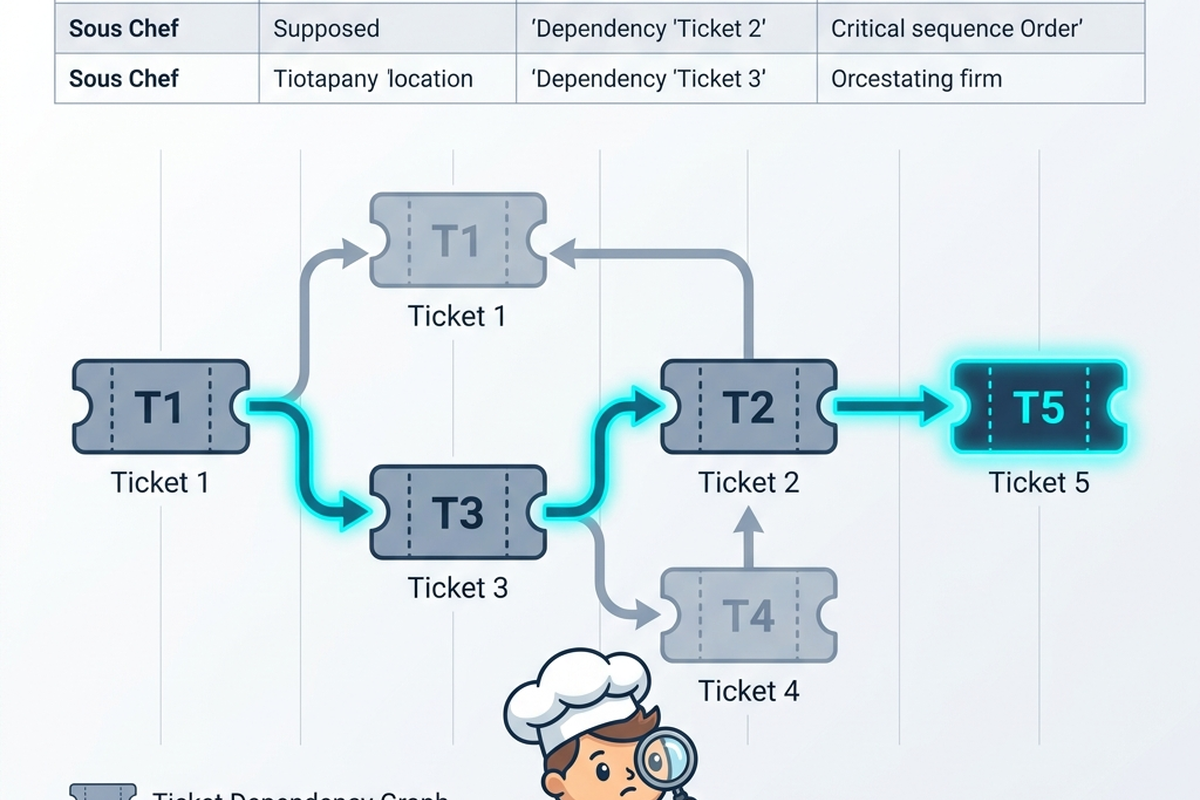
Orchestration is the layer that decides when each step of a pipeline runs, in what order, and what has to succeed first before the next step is allowed to start. A single pipeline might depend on another pipeline’s output; a nightly job might need three upstream sources to all finish before it can run correctly. Orchestration is the ticket rail for all of that — not doing the cooking itself, but making sure everything fires in the right order, at the right time, with the right dependencies satisfied.
The Old Way
Traditionally, orchestration meant a scheduler running each job at a fixed time and hoping the timing worked out — job A at 1am, job B at 2am, on the assumption A would definitely finish within the hour. This was the kitchen equivalent of firing every ticket exactly ten minutes after it printed, whether or not the previous course was actually ready. It worked until it didn’t: a slow run of job A would mean job B started too early, silently working with incomplete data, and nobody would know until something downstream looked wrong.
More mature orchestration tools eventually made dependencies explicit — job B waits for job A to actually finish successfully, not just for the clock to hit 2am — but building and maintaining that dependency graph was manual, detailed work, and a wrong dependency (or a missing one) was a common, hard-to-spot source of pipeline bugs.
What’s Changing (and Why AI Is the Reason)
- AI can help draft the dependency graph. Given a set of pipelines and a description of what each one produces and consumes, AI tools can now propose a likely dependency structure — suggesting the rail’s order — rather than requiring an engineer to trace every relationship by hand from scattered documentation or tribal knowledge.
- Orchestrators are getting better at reacting, not just scheduling. Instead of purely time-based triggers, orchestration is shifting toward event-based triggers — starting a job the moment its actual input is ready, the way a good expo fires a dish the moment the walk-in confirms an ingredient, not at a pre-agreed time regardless of readiness.
- Failures are getting diagnosed faster. When something in a complex dependency chain fails, AI-assisted tooling can now help trace which upstream failure actually caused a downstream problem, cutting through a tangle of dependent jobs faster than a person manually working backward through logs.
The Metaphor, Fully Extended
| Kitchen Element | Orchestration Concept |
|---|---|
| The ticket rail | The orchestrator |
| The expo managing ticket order | The orchestration engine deciding execution order |
| Appetizer before entree | A pipeline dependency (job B waits for job A) |
| Firing a dish based on a fixed clock, regardless of readiness | Purely time-based scheduling |
| Firing a dish the moment the walk-in confirms stock | Event-based triggering |
| A missed dependency causing a dish to go out too early | A missing or wrong pipeline dependency causing incomplete data downstream |
| Tracing which delayed course held up the whole table | Diagnosing which upstream job failure caused a downstream problem |
For Beginners: What to Actually Do
- Before scheduling a new pipeline job, ask what it actually depends on finishing first — don’t default to “run it at a convenient time” without checking.
- Learn to read a dependency graph (a DAG) the way you’d read a ticket rail: what has to be true before this step is allowed to start?
- When something breaks in a chain of dependent jobs, start by tracing backward to the earliest failure, not by re-running everything downstream and hoping it resolves itself.
- If an AI tool proposes a dependency structure for your pipelines, verify it against a case you already understand well before trusting it on the parts you don’t.
For Practitioners and Leaders: The Deeper Layer
- Purely time-based scheduling is a common source of silent, hard-to-diagnose data quality issues — a downstream job quietly running against incomplete upstream data because the clock, not actual readiness, decided when it started. Auditing for this is worth doing proactively, not just after an incident.
- Event-based orchestration is a real reliability improvement, but it shifts complexity rather than eliminating it — now the system has to reliably detect “is this actually ready,” which is its own failure mode if that detection is wrong.
- AI-assisted dependency inference is most valuable exactly where dependency documentation has decayed or never existed — but the output should be validated against a few known-correct cases before it’s trusted to represent an entire pipeline estate.
- As pipeline dependency graphs grow, invest in making failures traceable to their true root cause quickly. A team that can’t quickly answer “which upstream job actually caused this” ends up firefighting downstream symptoms repeatedly instead of fixing the real problem once.
Quick Recap
- Orchestration decides when each pipeline step runs and what has to succeed first — the ticket rail that keeps everything firing in the right order.
- Traditional, purely time-based scheduling is simple but risks running jobs against incomplete upstream data.
- Explicit dependency graphs solve that, at the cost of manual effort to build and maintain them correctly.
- AI tools can now help draft dependency structures and trace failures back to their true root cause faster.
- Event-based triggering — firing a job the moment its input is actually ready — is a meaningful reliability improvement over pure scheduling.
Where This Fits in the Series
Article 7 covered doing the right amount of work on each run. This article covered making sure that work happens in the right order. Article 9 looks at what happens to the tickets that shouldn’t have been fired at all — how a pipeline handles records that fail validation along the way.
Key References
- dbt Core Documentation — Official documentation for data transformation workflows, DAG creation, and testing.
- Apache Airflow Architecture Guide — Open-source platform standards for orchestrating complex data pipelines.
- Apache Kafka Documentation — Industry standard specification for real-time event streaming pipelines.
Subscribe to the Newsletter
Get the latest DataParables articles delivered straight to your inbox.