
Opening Scene
The dish is cooked exactly right. Every prep step went well, every ingredient is fresh and properly seasoned. Then it sits under the heat lamp too long before anyone picks it up, or it goes to table nine instead of table twelve, or it arrives at a table that ordered something entirely different. All that careful work upstream doesn’t matter if the plate doesn’t land, correctly and on time, in front of the person who ordered it.
Load is a pipeline’s version of that final walk from the kitchen to the table, and it fails in exactly the same unglamorous ways.
In Plain English
Loading is the step where transformed data actually lands in its destination — a data warehouse, a lakehouse, an application database, a search index — in a form that whoever’s waiting on it can actually use. It sounds like the simple, mechanical last step after all the “real” work of extraction and transformation. In practice, loading decisions — how often, in what shape, with what guarantees — shape how useful the data actually turns out to be.
The Old Way
Traditionally, loading meant writing transformed data into a warehouse on a fixed schedule, often overnight, in bulk — the kitchen equivalent of plating every dish for the whole evening at once and holding it under heat lamps until each table’s turn comes. This worked when everyone eating was fine waiting until morning to see yesterday’s numbers. It broke down whenever someone needed to know something now: a dish that’s only ever served in one big overnight batch can’t answer “what just happened five minutes ago.”
Loading also had to handle the awkward reality of updates: what happens when a plate needs to change after it’s already been served? Traditional approaches ranged from careful, well-managed strategies (a clear process for sending a corrected dish back out) to blunt ones (reload the whole meal from scratch every time anything changed, whether or not it needed to).
What’s Changing (and Why AI Is the Reason)
- Plates go out continuously, not all at once. Loading increasingly happens in a steady stream rather than one nightly batch, so a destination system reflects reality within minutes instead of by the next morning — closer to a kitchen that plates and sends dishes as they’re ready rather than holding everything for one big service.
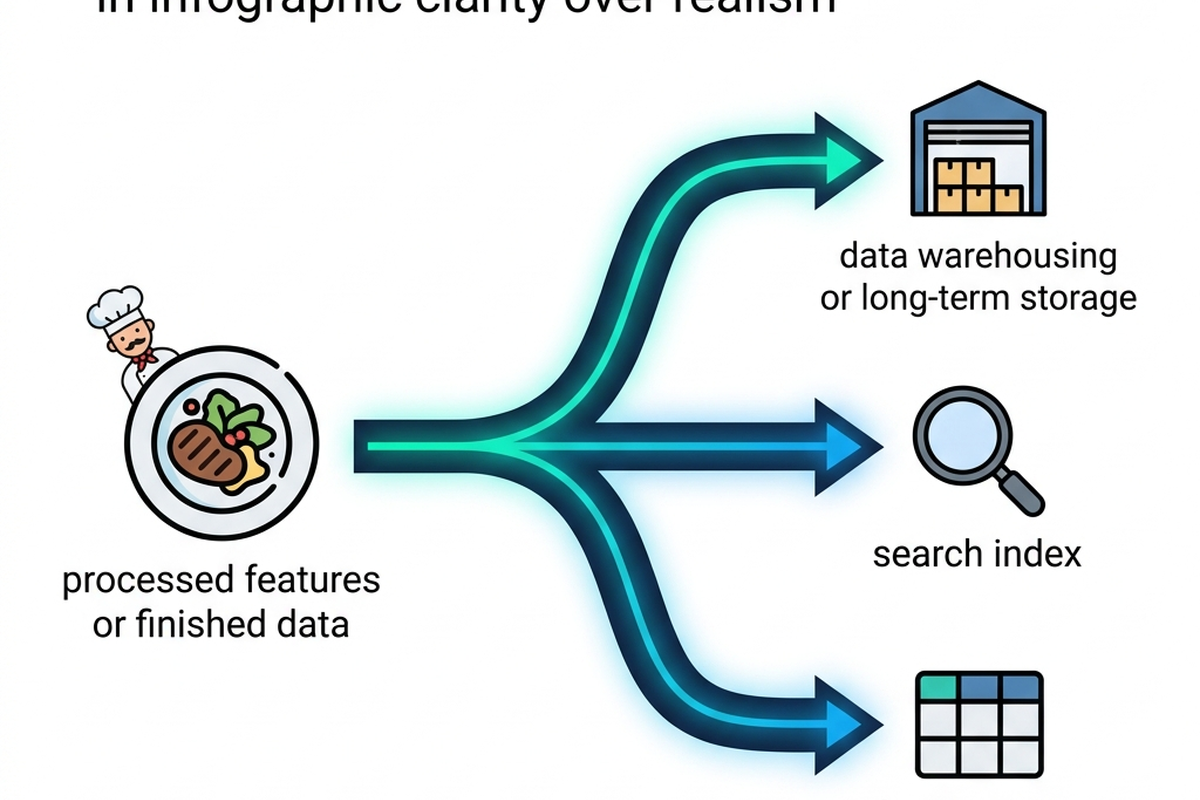
- The kitchen serves more than one dining room now. Loaded data increasingly needs to land in multiple destinations at once — a warehouse for analysts, a search index for an application, a feature store for a model — each with different shape and freshness needs. Getting one plate to several different tables, correctly, at the same time is a harder logistics problem than serving one.
- AI agents are impatient diners. An agent querying a destination system directly doesn’t wait for a human to notice stale data and ask about it — it acts on whatever’s there. That raises the practical cost of loading delays or inconsistencies in a way a once-a-day human dashboard check never did.
The Metaphor, Fully Extended
| Kitchen Element | Data Loading Concept |
|---|---|
| The final walk from kitchen to table | The load step, delivering data to its destination |
| Plating the whole evening’s dishes at once | Bulk, scheduled batch loading |
| A dish sitting too long under the heat lamp | Stale data in the destination system |
| Sending a corrected dish back out | An update or upsert to previously loaded data |
| Reordering the whole meal because one dish was wrong | A full reload instead of a targeted update |
| Plating dishes as they’re ready, continuously | Streaming or micro-batch loading |
| One dish needing to reach several different tables | Loading data into multiple destinations |
| An impatient diner who won’t wait for the next course | An AI agent querying data that must already be current |
For Beginners: What to Actually Do
- Before choosing how often to load data, ask who’s actually waiting on it and how quickly they need it — loading every five minutes for a report someone checks monthly is wasted effort in the other direction.
- Learn the difference between an update (correcting one dish) and a full reload (redoing the whole meal) early — knowing which one a situation actually calls for saves enormous, unnecessary work.
- When data needs to land in more than one destination, check whether they can actually end up saying different things at different moments — and know what your system does when that happens, even briefly.
- Watch for the moment a “just check the dashboard tomorrow” mindset stops being good enough for a given use case. That’s usually the signal that loading frequency needs to change.
For Practitioners and Leaders: The Deeper Layer
- The shift from batch to continuous loading is as much an operating-model change as a technical one — it means monitoring, alerting, and on-call practices built around “the numbers land at 6am” need to be rebuilt around data that’s always in motion.
- Loading into multiple destinations introduces a genuine consistency question: for a brief window, is it acceptable for the warehouse and the search index to disagree? Decide that explicitly, rather than discovering the answer during an incident.
- AI agents consuming loaded data directly remove the human buffer that used to catch loading problems informally — someone noticing a dashboard “looks off.” Loading correctness now needs to be verified by the system itself, not by a person’s gut check.
- Full reloads are expensive and often used as a blunt fallback when targeted updates feel too risky to get right. That’s a reasonable short-term choice, but it’s worth periodically asking whether it’s become a permanent crutch masking a transformation or matching problem that should actually be fixed upstream.
Quick Recap
- Loading delivers transformed data into its final destination — the walk from kitchen to table, where all the prep work either lands or doesn’t.
- Traditionally, loading happened in large overnight batches, fine for data nobody needed until the next morning.
- Loading is increasingly continuous and increasingly needs to reach multiple destinations at once, each with different freshness needs.
- AI agents querying data directly remove the informal human check that used to catch stale or inconsistent loads.
- Knowing when a situation calls for a targeted update versus a full reload is a genuinely important, easy-to-get-wrong judgment call.
Where This Fits in the Series
Articles 2 through 4 walked the full extract-transform-load journey, one station at a time. Article 5 steps back to compare two whole philosophies of running this kitchen — prepping everything before it’s stored, or storing it raw and prepping to order — the classic ETL versus ELT question.
Key References
- dbt Core Documentation — Official documentation for data transformation workflows, DAG creation, and testing.
- Apache Airflow Architecture Guide — Open-source platform standards for orchestrating complex data pipelines.
- Apache Kafka Documentation — Industry standard specification for real-time event streaming pipelines.
Subscribe to the Newsletter
Get the latest DataParables articles delivered straight to your inbox.