
Opening Scene
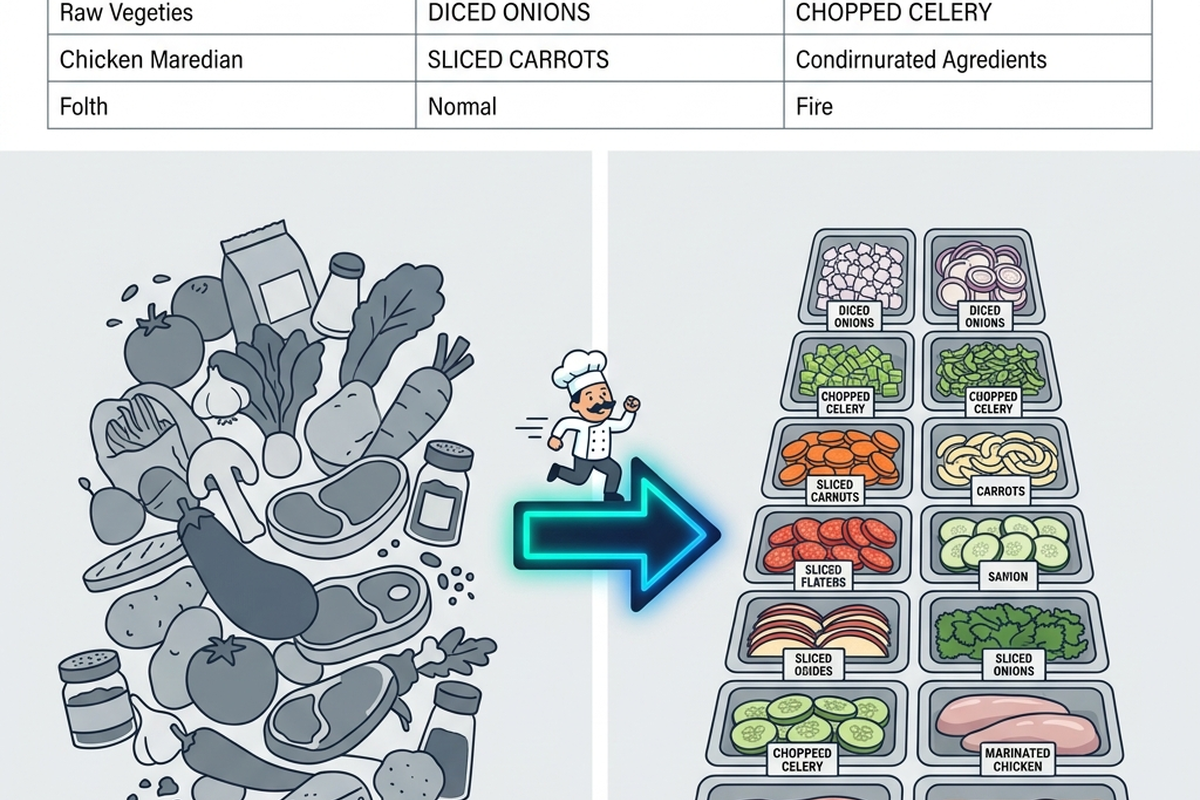
Raw ingredients don’t go straight from the walk-in cooler to a plate. Someone washes the dirt off the vegetables, trims what’s unusable, cuts everything to a consistent size, and portions it out the way the recipe actually calls for. Two chefs could receive the exact same crate of tomatoes and produce completely different results, depending entirely on what happens at the prep station before any of it hits a pan.
Transformation is a data pipeline’s prep station — and just like in a kitchen, it’s where the real craft and the real risk both live.
In Plain English
Transformation is the step where extracted data gets cleaned, reshaped, standardized, and combined into a form that’s actually useful — fixing inconsistent formats, removing duplicates, calculating derived values, joining data from multiple sources into one coherent record. It’s the least visible part of a pipeline and usually the most labor-intensive, the same way prep work rarely gets mentioned on a menu but takes up most of a kitchen’s actual working hours.
The Old Way
Traditionally, transformation logic was written by hand, one rule at a time: strip whitespace from this field, standardize date formats in that one, map three different “status” spellings to one canonical value, join customer records across two systems that don’t quite agree on what counts as the same customer. Every rule reflected a specific, hard-won piece of institutional knowledge — the data equivalent of a chef who knows exactly how thin to slice an onion for this particular dish, learned the same way: by getting it wrong once and adjusting.
This worked, but it scaled by hiring more people who knew more rules, and it broke quietly whenever the underlying data changed in a way an old rule didn’t anticipate. A transformation rule written for one supplier’s produce doesn’t automatically work when a new supplier’s crates show up looking slightly different.
What’s Changing (and Why AI Is the Reason)
- AI can propose the recipe, not just follow it. Given messy sample data, AI tools can now suggest cleaning and standardization rules directly — “these five spellings of ‘status’ probably mean the same three things” — turning what used to be a slow, manual audit into a fast first draft a human refines.
- Matching and joining got smarter. Deciding whether two records from different systems represent the “same” real-world thing — the same customer, the same product — used to rely on exact key matches or brittle manual rules. AI-assisted matching can now recognize likely matches despite typos, formatting differences, or missing keys, the way an experienced chef recognizes the same cut of meat under three different supplier labels.
- Enrichment happens closer to the moment data arrives. Instead of transformation happening only in a scheduled batch job, AI-powered enrichment — tagging, classifying, translating, flagging anomalies — increasingly happens continuously, station work done throughout service rather than only in one long prep block beforehand.
The Metaphor, Fully Extended
| Kitchen Element | Data Transformation Concept |
|---|---|
| Washing and trimming vegetables | Cleaning raw data (removing nulls, fixing formats) |
| Cutting everything to a consistent size | Standardizing values into a common format |
| The recipe card | Transformation logic and business rules |
| A chef combining ingredients into one dish | Joining data from multiple sources |
| Recognizing the same cut of meat under different supplier labels | Entity matching across inconsistent records |
| A seasoned chef’s memorized adjustments | Hand-written, hard-won transformation rules |
| A new line cook proposing a first-pass recipe | AI suggesting cleaning and standardization rules from sample data |
| Prep work happening throughout service, not just before | Continuous, real-time enrichment |
| A dish that tastes different depending on who prepped it | Inconsistent transformation logic producing inconsistent results |
For Beginners: What to Actually Do
- Before writing a transformation rule, look at real examples of what you’re trying to fix — messy data has a way of surprising you with edge cases a clean example never shows.
- Practice the habit of naming what a transformation is actually for (“standardizing country names to ISO codes”) rather than just what it does — it makes the logic reviewable by someone else later, including your future self.
- When an AI tool proposes a cleaning or matching rule, test it against the messiest, most unusual records you can find, not just the typical ones — that’s where proposed rules most often fall apart.
- Keep transformation logic separate and readable rather than buried inside one giant script. A prep station where every tool has its place is faster and safer than one where a chef has to hunt for the knife.
For Practitioners and Leaders: The Deeper Layer
- AI-suggested transformation rules are a genuine productivity gain, but they inherit whatever bias or gaps exist in the sample data they were shown — a matching rule trained on mostly-clean records can behave unpredictably on the messy long tail that matters most in practice.
- Entity matching decisions (is this the same customer? the same product?) quietly encode business judgment, not just technical logic. Treat AI-assisted matching suggestions as proposals for a human to ratify, especially anywhere a wrong match has financial, legal, or safety consequences.
- Continuous, near-real-time enrichment changes your monitoring requirements — a bad transformation rule in a nightly batch job affects one day’s data; the same bad rule running continuously can propagate errors for hours before anyone notices. Alerting needs to keep pace with how much faster transformation now runs.
- Audit how much transformation logic exists only in one person’s head versus written down and reviewable. That risk didn’t start with AI, but AI tools proposing new rules faster makes an undocumented, tribal-knowledge transformation layer even harder to safely hand off or scale.
Quick Recap
- Transformation cleans, standardizes, and combines extracted data into something actually usable — a pipeline’s prep station.
- Traditionally, transformation rules were hand-written, one hard-won rule at a time, and scaled by hiring more people who knew more rules.
- AI can now propose cleaning and matching rules from sample data, and increasingly runs enrichment continuously rather than only in scheduled batches.
- AI-suggested rules still need human review, especially on messy edge cases and anywhere a wrong match carries real consequences.
- Faster, more continuous transformation raises the bar on monitoring — errors can now propagate faster than they used to.
Where This Fits in the Series
Article 2 covered how a pipeline reads what arrives at the door. This article covered what happens at the prep station once it’s inside. Article 4 follows the finished prep work to its destination: plating, and what it actually takes to load data correctly into the system that will serve it.
Key References
- dbt Core Documentation — Official documentation for data transformation workflows, DAG creation, and testing.
- Apache Airflow Architecture Guide — Open-source platform standards for orchestrating complex data pipelines.
- Apache Kafka Documentation — Industry standard specification for real-time event streaming pipelines.
Subscribe to the Newsletter
Get the latest DataParables articles delivered straight to your inbox.