Opening Scene
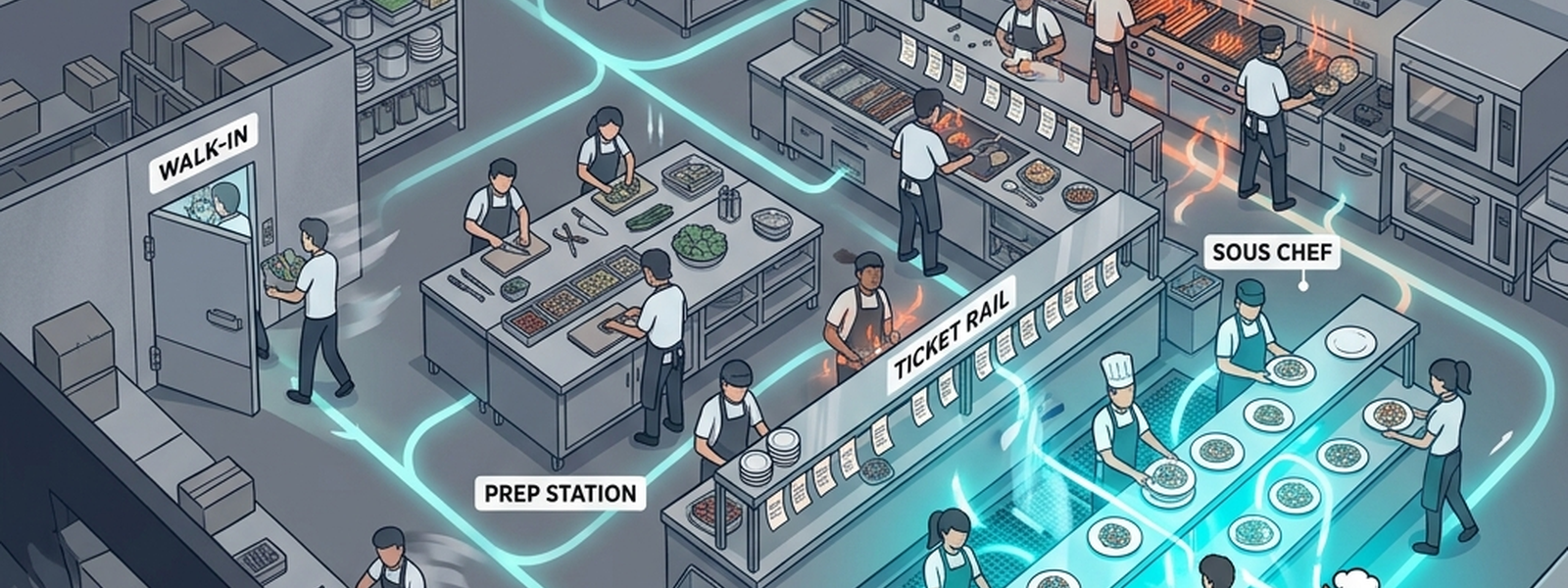
Stand at the pass on a Saturday night, at the peak of service. Trucks are still arriving at the back door. The walk-in is stocked. The prep station is a blur of motion. The ticket rail is full, orchestrated perfectly, nothing firing out of order. A reject bin sits quietly to one side, mostly empty. Someone’s tasting a sauce mid-service, not waiting for a complaint. Plates go out to the right tables, on time, and a few of them are headed somewhere new entirely — blended smooth for a guest with different needs than anyone else at the table. Nothing about this kitchen is static. It’s running, continuously, and it barely needs anyone to stop and think about it working.
That’s the kitchen this series has been building, one station at a time, since Article 1.
In Plain English
This final article doesn’t introduce a new concept — it’s a deliberate walk back through everything the series has covered, reassembled as one connected system. The point is simple: every piece of good pipeline design, from extraction to monitoring, exists to get data from where it’s created to where it’s needed, correctly, reliably, and increasingly, fast enough for both people and AI systems waiting on it.
The Old Way
The “old way,” across this entire series, was consistent: pipelines built and run by hand, one hard-won rule at a time, tested rarely, monitored only for whether they finished, and rebuilt from scratch whenever something changed that nobody had anticipated. None of that discipline has become obsolete — every “new way” this series covered was built on top of it, not instead of it. The receiving clerk in Article 2 still needs to know what a delivery is supposed to look like; the AI proposing a schema mapping still needs a person to check its work. The throughline across all twenty articles has been augmentation, not replacement.
What’s Changing (and Why AI Is the Reason): The Series, Recapped
- Understanding got faster, everywhere. From reading an unfamiliar delivery (Article 2) to proposing transformation rules (Article 3) to drafting a whole pipeline from a plain-language description (Article 16), AI has consistently compressed the slowest, most repetitive parts of pipeline work, leaving more time for the judgment calls that still need a person.
- Reliability got more proactive. Idempotency, incremental logic, dependency management, dead-letter queues, backfilling, testing, and monitoring — Articles 6 through 14 and 19 — all got measurably easier with AI assistance, turning pipeline hygiene from a discipline that depended on individual diligence into something increasingly built in and continuously checked.
- The kitchen gained new kinds of diners. Across nearly every article, one thread kept resurfacing: pipelines increasingly serve AI agents and AI systems directly — querying data, consuming embeddings, expecting freshness — not just a person checking a dashboard the next morning. A pipeline that’s merely “good enough for a person who’ll notice if something looks off” is no longer good enough on its own.
The Metaphor, Fully Extended: The Whole Kitchen
| Kitchen Station | Series Article & Core Lesson |
|---|---|
| The back door, trucks arriving | Article 1 — The whole ETL/ELT journey, ingredients to finished plate |
| The receiving clerk reading delivery slips | Article 2 — Extraction, and making sense of unfamiliar sources |
| The prep station | Article 3 — Transformation: cleaning, standardizing, enriching |
| The walk from kitchen to table | Article 4 — Loading data into its destination |
| Two kitchens, two philosophies | Article 5 — ETL versus ELT |
| Checking the order number before firing a ticket | Article 6 — Idempotency, safe to rerun |
| Restocking, not rebuilding, the pantry | Article 7 — Incremental versus full loads |
| The ticket rail | Article 8 — Orchestration and dependencies |
| The reject bin | Article 9 — Dead-letter queues and error handling |
| The delivery log | Article 10 — Data lineage |
| Tasting before service | Article 11 — Pipeline testing |
| A supplier swapping ingredients quietly | Article 12 — Surviving schema drift |
| Watching the walk-in door | Article 13 — Change data capture |
| Catching up after a closure | Article 14 — Backfilling |
| The full kitchen equipment list | Article 15 — The pipeline tooling landscape |
| Describing a dish instead of writing the recipe | Article 16 — Natural-language pipeline generation |
| The gas bill | Article 17 — Pipeline cost efficiency |
| Blending it smooth enough to drink | Article 18 — Pipelines feeding RAG and AI systems |
| Tasting constantly, not just at the end | Article 19 — Monitoring and observability |
| The whole kitchen, running itself | Article 20 — Every piece, reassembled as one connected whole |
For Beginners: What to Actually Do
- If you’re new to this space, treat this series as a rough order of skill-building: understand extraction, transformation, and loading solidly (Articles 1 through 5) before leaning heavily on AI-assisted generation tools — you need to be able to evaluate a draft, not just receive one.
- Revisit any article in this series that covered a concept you use regularly at work, and try re-explaining its metaphor to a colleague without technical jargon — that’s a genuine test of whether you’ve actually internalized it.
- Get comfortable being the person who asks “what happens if this runs twice, or fails halfway through, or the source changes shape?” — those questions, more than any specific tool skill, are what separate a pipeline that survives contact with reality from one that doesn’t.
- Don’t treat “AI can build this now” as a reason to skip understanding what’s actually happening underneath. Every article in this series showed AI accelerating a process that still fundamentally depends on someone able to judge whether the result is right.
For Practitioners and Leaders: The Deeper Layer
- Step back and audit your own pipeline estate against this series’ throughline: where has generation and automation sped up, while review discipline and monitoring maturity haven’t kept pace? That gap is where avoidable failures are most likely to surface.
- The recurring theme of “the kitchen has new kinds of diners” — AI agents and AI systems consuming pipeline output directly — deserves a deliberate response across your whole data platform, not just a one-off fix in whichever pipeline happens to feed an AI project first.
- Consider where your organization still treats pipeline reliability disciplines (Articles 6 through 14) as optional extras rather than a baseline. AI-assisted tooling makes all of them cheaper to implement well; there’s less excuse than there used to be to skip them under deadline pressure.
- The most durable skill for a data professional going forward isn’t memorizing any single tool’s current capabilities — it’s the judgment to know what a generated pipeline, or an AI-suggested fix, doesn’t yet know about your specific data and your specific business. That judgment is what every article in this series, in different language, has ultimately been about.
Quick Recap
- This series treated a data pipeline as a professional kitchen — the unglamorous system that turns raw, messy ingredients into something a person or an AI system can actually use.
- Across twenty articles, AI consistently accelerated understanding, drafting, and monitoring, but never replaced the human judgment needed to evaluate context, correctness, and consequence.
- A clear throughline: pipelines increasingly serve AI systems directly, not just human dashboards, raising the stakes on freshness, correctness, and reliability rather than lowering them.
- The disciplines covered — extraction, transformation, loading, idempotency, incremental processing, orchestration, error handling, lineage, testing, resilience to drift, change capture, backfilling, tooling, generation, cost, RAG readiness, and monitoring — combine into one connected practice, not twenty separate ones.
- The most durable skill going forward is judgment: knowing what an AI-generated or AI-assisted pipeline doesn’t yet know about your business.
Where This Fits in the Series
This article closes the loop opened in Article 1, reassembling every station covered since as one running kitchen. There’s no next article to point toward within this topic — but every concept covered here remains a living discipline, not a finished one, as AI-assisted tooling continues to evolve.
Key References
- dbt Core Documentation — Official documentation for data transformation workflows, DAG creation, and testing.
- Apache Airflow Architecture Guide — Open-source platform standards for orchestrating complex data pipelines.
- Apache Kafka Documentation — Industry standard specification for real-time event streaming pipelines.
Subscribe to the Newsletter
Get the latest DataParables articles delivered straight to your inbox.