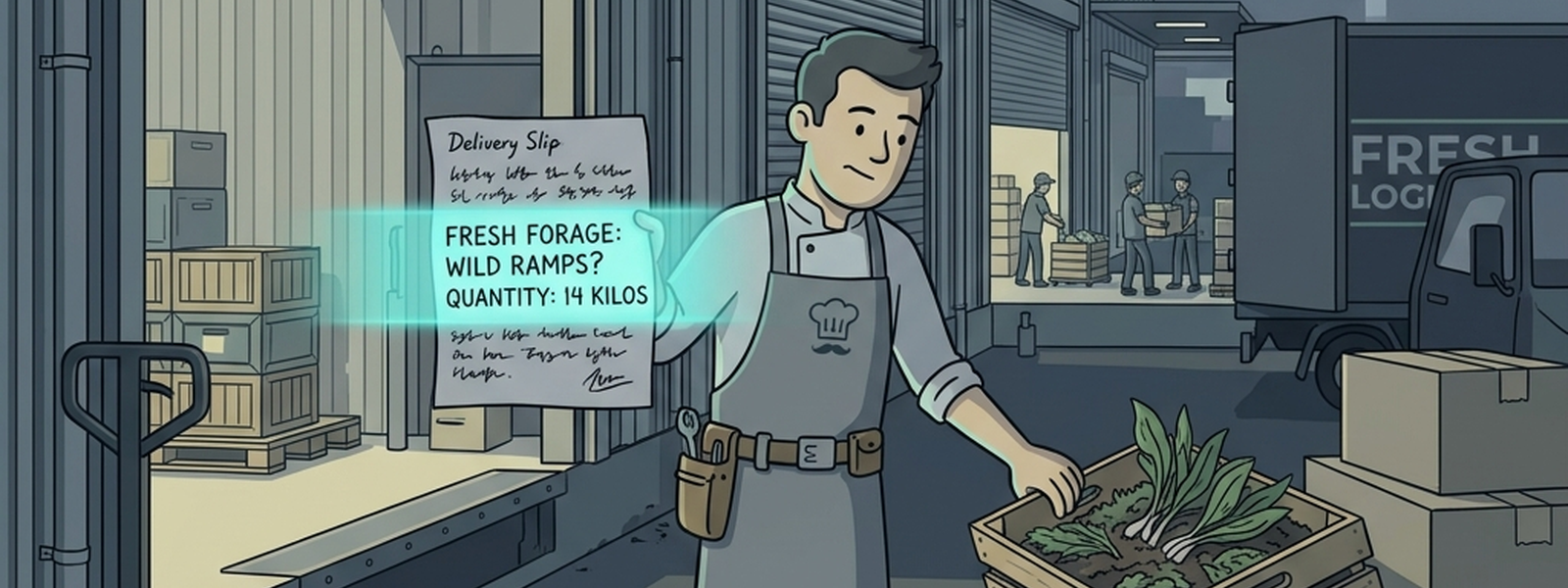
Opening Scene
A new supplier’s truck pulls up at the back door for the first time. No one on staff recognizes the crates. The delivery slip lists items in the supplier’s own shorthand — “med toms, 2x,” “leafy grn, bunch” — nothing matching the kitchen’s usual inventory sheet. The receiving clerk can’t just refuse the delivery; they have to figure out, right there at the door, what actually arrived and how it maps to what the kitchen calls things.
That moment — figuring out what a new or unfamiliar source is actually handing you — is the entire job of the extract step, and it’s a lot harder than it sounds.
In Plain English
Extraction is the process of pulling data out of a source system — a database, an API, a spreadsheet, a stream of events — and getting it into a form the rest of the pipeline can work with. It sounds like the easy part, a formality before the “real” work of transformation begins. In practice, extraction is where most of the surprises live: sources change shape without warning, arrive in inconsistent formats, or simply don’t document what a field actually means.
The Old Way
Traditionally, extraction meant an engineer writing a custom connector for each source: a script that knew exactly which API endpoint to call, which columns a particular file format contained, and which quirks to work around — the equivalent of a receiving clerk who’d worked with the same three suppliers for a decade and had every delivery’s format memorized. That familiarity was valuable, but it didn’t transfer. A new supplier meant starting from zero: reading unfamiliar documentation (if it existed at all), guessing at field meanings, and writing brittle code that broke the moment the source changed something as small as a column order.
Undocumented or legacy sources were the worst case — the data equivalent of a truck showing up with no delivery slip at all, just crates the clerk has to open and inspect one at a time.
What’s Changing (and Why AI Is the Reason)
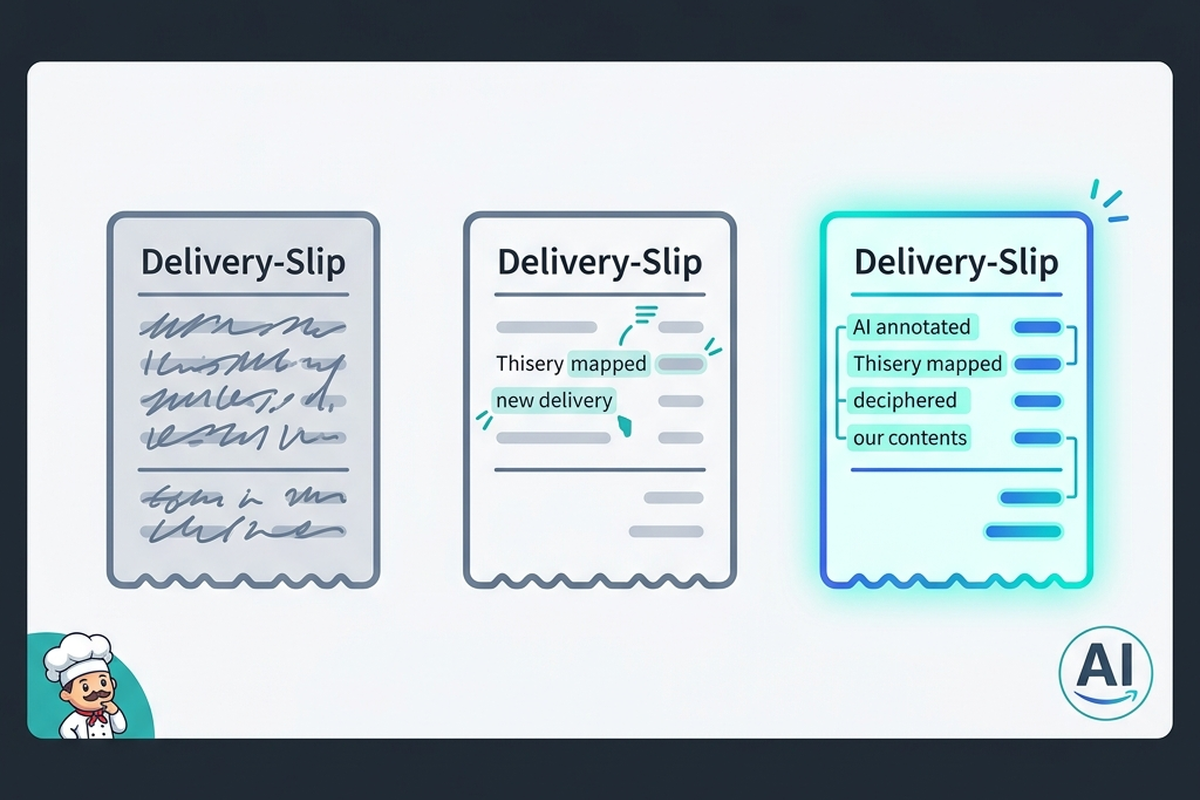
- AI can read a delivery slip it’s never seen before. Given a new file, API response, or database table, AI tools can now infer likely field meanings, guess at data types, and propose a mapping to known concepts — “leafy grn, bunch” probably means “lettuce, per bunch” — dramatically shortening the time between “a new source shows up” and “we understand what’s in it.”
- Schema drift gets caught earlier. Sources change their shape more often than anyone expects — a supplier renames a field, adds a new one, or quietly changes units. AI-assisted monitoring can now flag “this delivery doesn’t look like the others from this supplier” automatically, rather than waiting for a downstream report to look wrong weeks later.
- Undocumented sources are becoming approachable again. Legacy systems with no real documentation — a truck with no delivery slip — are increasingly tractable with AI assistance, which can propose a plausible structure from the data itself, giving a starting point where there used to be only manual inspection or institutional memory.
The Metaphor, Fully Extended
| Kitchen Element | Data Extraction Concept |
|---|---|
| A new supplier’s truck | An unfamiliar data source |
| The delivery slip | The source’s schema or API documentation |
| Shorthand item names (“med toms, 2x”) | Cryptic or inconsistent field names |
| The receiving clerk inspecting crates | The extraction process reading raw source data |
| A supplier who changes their labeling without notice | Schema drift — a source changing shape unexpectedly |
| A truck with no delivery slip at all | An undocumented legacy source |
| The clerk’s years of memorized supplier quirks | Hand-written, source-specific connector logic |
| A new hire who can identify produce on sight | An AI tool inferring field meaning from raw data |
| Refusing a delivery that looks wrong | Validation rejecting malformed extracted records |
For Beginners: What to Actually Do
- Treat every new source like an unfamiliar delivery: inspect a sample before you trust the whole shipment. Look at actual records, not just documentation, since the two don’t always agree.
- Learn to spot the three classic extraction failure modes early: a field that’s silently empty more often than expected, a type that quietly changed (a number arriving as text), and a value range that’s shifted.
- When an AI tool proposes a field mapping for a new source, verify it against a handful of real records you understand — an inference that’s 90% right can still be dangerously wrong on the 10% that matters.
- Keep a running note of every source’s known quirks. It’s the junior version of the clerk’s memorized supplier knowledge, and it pays off the second time that source misbehaves.
For Practitioners and Leaders: The Deeper Layer
- AI-assisted schema inference is a strong way to bootstrap understanding of a new or undocumented source, but it reflects what the sample data happened to look like, not necessarily the source’s full range of behavior — validate against a wider or more recent sample before treating an inferred schema as reliable.
- Schema drift detection changes the incident-response shape of a data team: instead of finding out a source changed weeks later via a broken report, you find out within a run cycle. That’s a real win, but only if someone owns triaging those alerts — an automated warning nobody reads is no better than no warning.
- Undocumented legacy sources are often undocumented for a reason — sometimes nobody left remembers what a field means, and sometimes the field genuinely means three different things depending on who entered it. AI-inferred structure is a starting hypothesis for these systems, not ground truth; budget real verification time before anything downstream depends on it.
- Consider extraction reliability as a shared cost across every pipeline that touches a given source. A flaky connector fixed once, well, saves every downstream pipeline from repeating the same brittle workaround.
Quick Recap
- Extraction is the process of pulling data from a source system into a form the rest of the pipeline can use — and it’s where most pipeline surprises actually originate.
- Traditionally, extraction meant hand-written, source-specific connectors that broke whenever a source changed shape.
- AI can now infer likely field meanings and structure from unfamiliar or undocumented sources, shortening the time to understand a new delivery.
- Schema drift — a source quietly changing shape — can now be flagged automatically instead of discovered downstream, weeks later.
- AI-inferred structure is a strong starting point, not a substitute for verifying against real records, especially for sources with real consequences if they’re wrong.
Where This Fits in the Series
Article 1 walked through the whole kitchen, end to end. This article zoomed into the back door — how a pipeline actually reads and makes sense of what arrives. Article 3 moves inside, to the prep station, where raw ingredients get washed, chopped, and standardized: the transformation step.
Key References
- dbt Core Documentation — Official documentation for data transformation workflows, DAG creation, and testing.
- Apache Airflow Architecture Guide — Open-source platform standards for orchestrating complex data pipelines.
- Apache Kafka Documentation — Industry standard specification for real-time event streaming pipelines.
Subscribe to the Newsletter
Get the latest DataParables articles delivered straight to your inbox.