Opening Scene
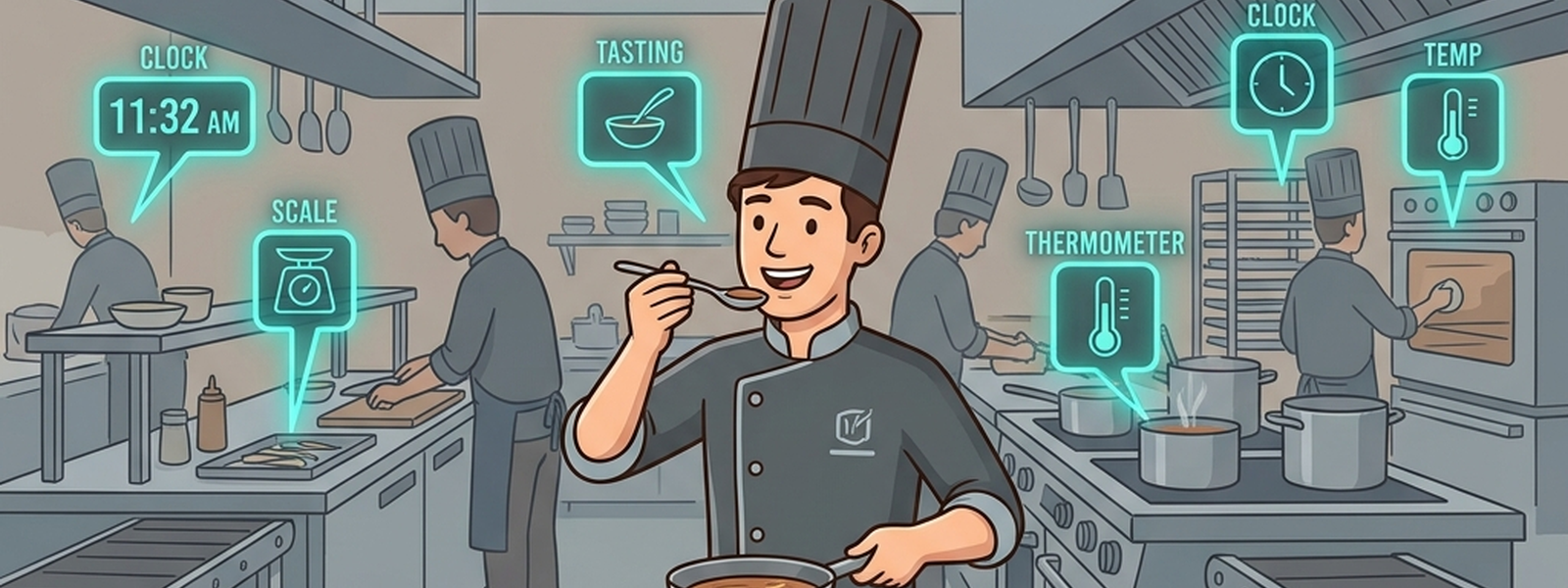
A good chef doesn’t taste a sauce once, at the very beginning, and assume it stays right for the rest of service. They taste constantly — as it reduces, as new ingredients go in, as the pan heats unevenly — catching small drifts before they become a plate anyone sends back. A kitchen that only checks quality once, at the start, finds out something’s wrong the same way every under-monitored system does: from a complaint, much later, after a lot of bad plates already went out.
Pipeline monitoring is the discipline of tasting constantly, and this series has actually touched it in almost every article without naming it directly until now.
In Plain English
Pipeline monitoring (or observability) means continuously checking whether a pipeline is behaving correctly — not just whether it completed without crashing, but whether its output actually looks right: normal row counts, normal value ranges, normal timing, normal reject rates (Article 9). It’s the ongoing counterpart to testing (Article 11): testing checks correctness before deployment; monitoring checks it continuously, in production, against real, ever-changing data.
The Old Way
Traditionally, pipeline monitoring meant checking one thing: did the job finish, yes or no. A green checkmark meant success, regardless of whether the output actually made sense. This is the kitchen equivalent of only checking whether the stove is still on, with no attention to whether what’s cooking on it is actually any good — technically operational, and completely blind to the kind of failure that matters most: a pipeline that runs successfully and produces confidently wrong results.
Real monitoring, when it existed at all, was often built reactively — a specific check added only after a specific bad number had already reached a dashboard and someone had to explain what happened. Coverage grew one incident at a time, the same reactive pattern Article 11 described for testing.
What’s Changing (and Why AI Is the Reason)
- Normal is being learned automatically, not just hard-coded. Instead of someone manually defining fixed thresholds (“alert if row count drops below X”), AI-assisted monitoring can learn what a pipeline’s typical behavior actually looks like — including patterns that shift by day of week or season — and flag genuine deviations rather than triggering false alarms on entirely normal variation.
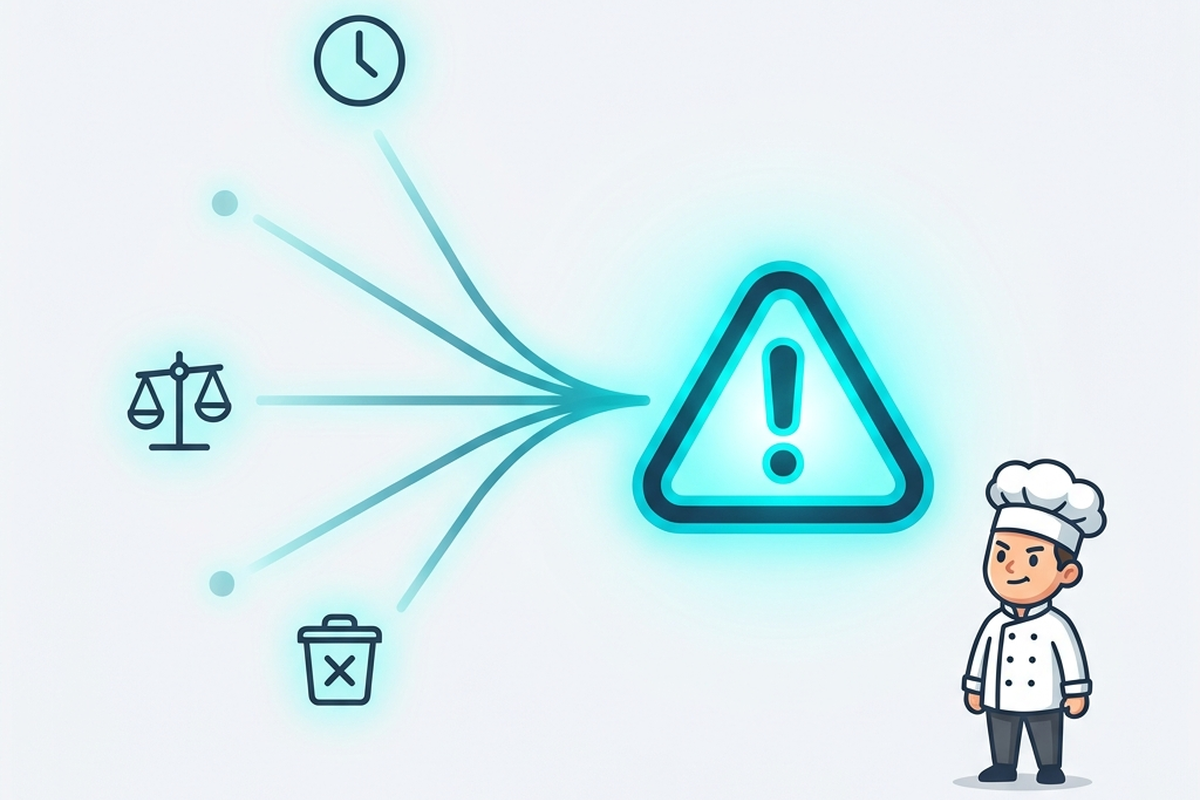
- Multiple weak signals are being combined into one meaningful alert. A slightly unusual row count alone might mean nothing. A slightly unusual row count, combined with a slightly higher reject rate and a slightly longer run time, is a much stronger signal something’s actually wrong — AI-assisted monitoring can connect signals like this across a pipeline that a person checking each dashboard individually would likely miss.
- Root cause suggestions arrive alongside the alert, not after separate investigation. Rather than just saying “something’s off,” AI-assisted tooling can increasingly point toward a likely cause — tracing back through lineage (Article 10) and recent changes — turning “something’s wrong, go find out why” into a genuine head start on the actual investigation.
The Metaphor, Fully Extended
| Kitchen Element | Pipeline Monitoring Concept |
|---|---|
| Tasting constantly throughout service | Continuous monitoring of pipeline output |
| Checking only whether the stove is still on | Monitoring that only checks job completion, not correctness |
| A chef who’s learned exactly how a sauce should taste at each stage | AI-learned baselines for normal pipeline behavior |
| Noticing a sauce is slightly off, combined with the pan running a bit hot | Correlating multiple weak signals into one meaningful alert |
| A head chef who can immediately guess what went wrong from the taste alone | AI-assisted root cause suggestions delivered alongside an alert |
| Waiting for a customer complaint to learn something was wrong | Reactive, incident-driven monitoring coverage |
For Beginners: What to Actually Do
- Get in the habit of checking more than “did it finish” for any pipeline you own — look at row counts, value ranges, and timing as a matter of routine, not just when something already seems wrong.
- Learn what your pipeline’s genuinely normal behavior looks like before you try to define alerts for abnormal behavior — you can’t recognize a deviation you haven’t first understood the baseline for.
- When an AI-assisted monitoring tool flags something, resist immediately dismissing it as a false alarm — treat the first few alerts as a chance to calibrate whether the tool’s sense of “normal” actually matches reality.
- Build the reflex to check monitoring signals together, not in isolation. A cluster of small anomalies is often more meaningful than any single one alone.
For Practitioners and Leaders: The Deeper Layer
- “The job finished successfully” and “the output is correct” are different claims, and conflating them is one of the most common reasons a bad pipeline output reaches a business decision before anyone catches it. Make sure your monitoring actually checks the second claim, not just the first.
- AI-learned baselines are a real improvement over static, manually-set thresholds, but they need periodic review — a baseline learned during an unusual period (a promotion, an outage, a one-off event) can quietly bake in the wrong definition of “normal.”
- Correlated, multi-signal alerting reduces alert fatigue, which matters more than it might seem — a team that’s learned to ignore noisy alerts will also miss the real ones buried among them.
- Monitoring maturity is a strong proxy for overall pipeline maturity across an organization. Teams that only ever check for job completion are, almost by definition, discovering their most serious problems the same way this series started: from a complaint, after the fact, rather than catching it in the kitchen.
Quick Recap
- Pipeline monitoring continuously checks whether output is actually correct, not just whether a job finished — the ongoing counterpart to testing before deployment.
- Traditionally, monitoring meant checking only job completion, which is blind to a pipeline that runs successfully and produces confidently wrong results.
- AI-assisted monitoring can learn genuine baselines of normal behavior, correlate multiple weak signals, and suggest likely root causes alongside an alert.
- The gap between “it finished” and “it’s correct” is where the most damaging pipeline failures hide.
- Monitoring maturity is a good overall signal of how mature a team’s pipeline discipline really is.
Where This Fits in the Series
Article 18 covered a newer kind of destination pipelines now serve. This article named a discipline that’s actually been present throughout the whole series. Article 20 closes the series, walking back through everything covered and tying it together as one connected kitchen.
Key References
- dbt Core Documentation — Official documentation for data transformation workflows, DAG creation, and testing.
- Apache Airflow Architecture Guide — Open-source platform standards for orchestrating complex data pipelines.
- Apache Kafka Documentation — Industry standard specification for real-time event streaming pipelines.
Subscribe to the Newsletter
Get the latest DataParables articles delivered straight to your inbox.