
Opening Scene
Every dish this series has discussed so far assumes a diner sitting at a table, with a plate, a knife and fork, and time to appreciate a full presentation. Now imagine a different guest: someone who can only take nutrition through a straw. Handing them a beautifully plated steak does nothing for them — not because the food is bad, but because it’s in completely the wrong form for how this particular guest actually consumes anything. The kitchen has to rethink the dish from the ingredients up: blended, strained, sized for what will actually pass through a straw.
Feeding an AI system — particularly a retrieval-augmented generation (RAG) system — is that same rethink, applied to a data pipeline.
In Plain English
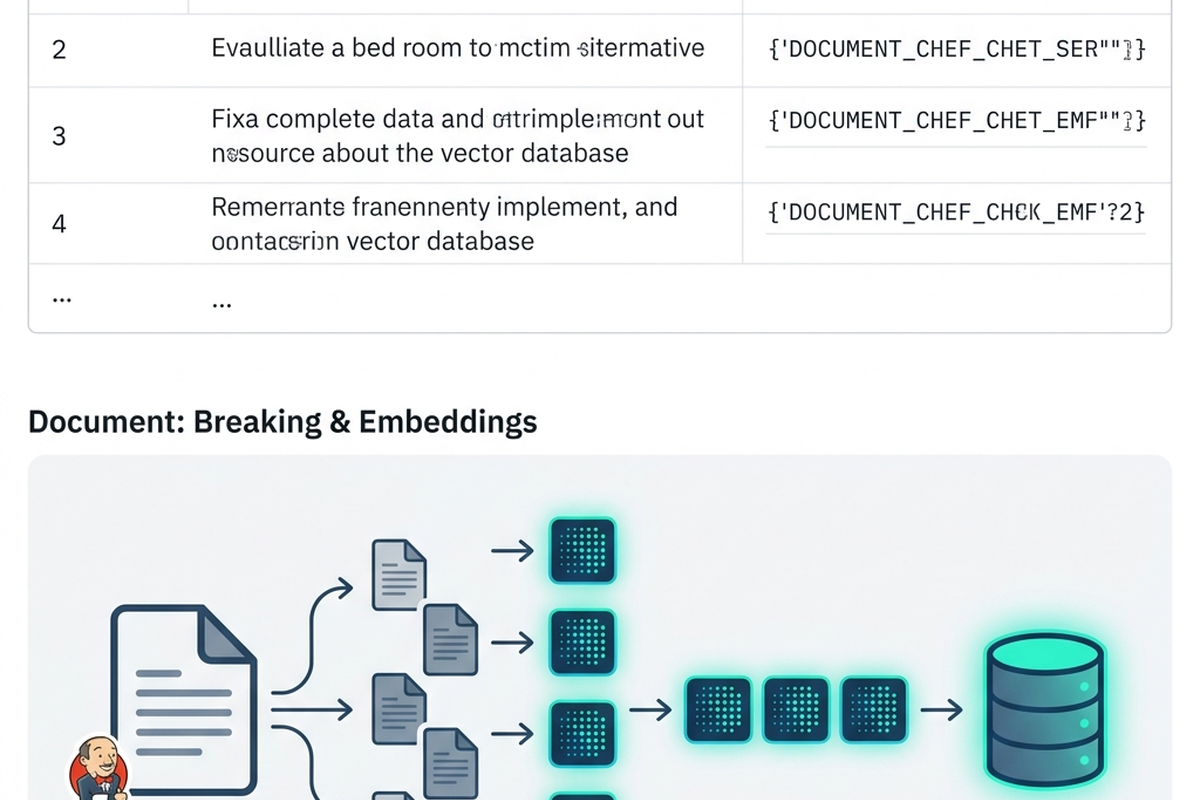
A pipeline built to feed an AI system, especially one using retrieval-augmented generation, doesn’t just move and clean data the way earlier articles in this series described — it has to break content into small, well-sized pieces (chunks), convert those pieces into a mathematical representation (embeddings) that captures their meaning, and load the result into a specialized store built for fast similarity search. It’s not a smaller version of a normal pipeline. It’s a different kind of preparation, built for a fundamentally different kind of “eating.”
The Old Way
Traditionally, pipelines were built to serve two kinds of destinations: a warehouse a person would query with structured questions, or a dashboard someone would look at directly. Both assumed a human consumer working with rows, columns, and charts. There was no established discipline for preparing unstructured content — documents, support tickets, product manuals — for a system that needed to search it by meaning rather than by exact keyword match.
Early attempts to make unstructured content searchable relied on keyword indexing: fast, but blind to meaning — a search for “cancel my order” wouldn’t reliably find a document phrased as “how do I stop a purchase,” even though a human would immediately recognize they meant the same thing. It’s the equivalent of trying to feed the straw-only guest a regular plated meal, just cut into smaller pieces — smaller, but still fundamentally the wrong preparation.
What’s Changing (and Why AI Is the Reason)
- Chunking strategy has become a real design discipline. How content gets broken into pieces — by paragraph, by section, with or without overlap between chunks — meaningfully affects how well an AI system can later find and use the right piece. This series’ earlier transformation concepts (Article 3) apply here in a new form: get the “cut size” wrong, and even perfectly clean content becomes hard to retrieve well.
- Embedding generation is itself a new pipeline step. Converting each chunk into a vector — a list of numbers capturing its meaning — is now a standard stage a RAG pipeline runs everything through before loading, similar in spirit to a transformation step, but producing a fundamentally different kind of output than any traditional pipeline stage did before.
- Freshness requirements are often stricter. An AI agent answering questions from a knowledge base that’s a week out of date can confidently give wrong or outdated answers with no visible warning sign — raising the bar on how current a RAG pipeline’s content needs to stay, closer to Article 13’s change-data-capture urgency than a traditional nightly warehouse refresh.
The Metaphor, Fully Extended
| Kitchen Element | RAG Pipeline Concept |
|---|---|
| A guest who can only eat through a straw | An AI system that consumes content in a fundamentally different form |
| Blending and straining a dish to the right consistency | Chunking and embedding content for retrieval |
| Deciding how finely to blend | Choosing a chunking strategy (size, overlap, boundaries) |
| A nutrition label describing a blended meal’s composition | An embedding representing a chunk’s underlying meaning |
| A pantry organized for quick keyword search only | A traditional search index that misses meaning-based matches |
| A guest whose meal must always be freshly blended, never left sitting out | A RAG pipeline needing to stay current, not just periodically refreshed |
For Beginners: What to Actually Do
- Don’t assume a pipeline you’d build for a dashboard is a reasonable starting point for a RAG system — start from the actual retrieval use case and work backward to what preparation it needs.
- Experiment directly with chunk size and overlap on real content from your own use case. The right answer varies a lot by content type, and intuition here is built by testing, not by following a fixed rule.
- Learn to distinguish a retrieval failure (the right chunk exists but wasn’t found) from a generation failure (the right chunk was found but used poorly) — they need completely different fixes, and conflating them wastes debugging time.
- Treat freshness for a RAG pipeline as seriously as you would for any system a person is directly relying on for an accurate answer, because that’s exactly what it is.
For Practitioners and Leaders: The Deeper Layer
- Chunking strategy is a real architectural decision with downstream consequences, not an implementation detail — treat it with the same design rigor you’d apply to a warehouse’s schema, because it similarly shapes everything built on top of it later.
- The reliability disciplines earlier in this series — idempotency, incremental processing, testing, lineage — all still apply to RAG pipelines and are just as easy to skip under the pressure of shipping something that “looks like it’s working” in an early demo.
- Stale content in a RAG pipeline is a particularly quiet failure mode: the system doesn’t error, it just confidently answers from outdated material. Build explicit freshness monitoring rather than assuming it’ll be noticed.
- As RAG pipelines multiply across an organization, watch for the same tool-sprawl and duplicated-effort problems that motivated dedicated ingestion and transformation tooling in the first place (Article 15) — this is a new pipeline category, and it benefits from the same maturing discipline the rest of this series has covered.
Quick Recap
- Pipelines feeding AI systems, especially RAG systems, need a fundamentally different kind of preparation: chunking content and generating embeddings, not just cleaning and loading rows.
- Traditional pipelines were built for human consumers working with structured data or keyword search — neither approach handles meaning-based retrieval well.
- Chunking strategy and embedding generation are real design disciplines with significant downstream impact on retrieval quality.
- Freshness matters more here than in many traditional pipelines, because a stale RAG system fails silently and confidently.
- Every reliability discipline covered earlier in this series still applies — RAG pipelines aren’t exempt from needing to be tested, idempotent, and traceable.
Where This Fits in the Series
Article 17 covered what a pipeline costs to run. This article covered a newer kind of destination pipelines increasingly serve. Article 19 returns to a theme threaded through this whole series — how a pipeline is watched and monitored — and pulls it together as its own dedicated discipline.
Key References
- dbt Core Documentation — Official documentation for data transformation workflows, DAG creation, and testing.
- Apache Airflow Architecture Guide — Open-source platform standards for orchestrating complex data pipelines.
- Apache Kafka Documentation — Industry standard specification for real-time event streaming pipelines.
Subscribe to the Newsletter
Get the latest DataParables articles delivered straight to your inbox.