
Opening Scene
An experienced chef doesn’t need a full recipe to cook something good. Tell them “something bright and citrusy to cut the richness of this dish” and they can work out the actual steps themselves — which citrus, how much, when to add it — arriving at something close to what you had in mind, often on the first try. You described the outcome. They handled the technique.
That’s roughly what’s happening when someone describes a pipeline in plain language and an AI tool drafts the actual extraction, transformation, and loading logic to match.
In Plain English
Natural-language pipeline generation lets someone describe what they want a pipeline to do — “pull customer orders from this system daily, join them with product data, and load the result into the warehouse” — and have an AI tool draft the actual implementation: the extraction logic, the transformation steps, the loading configuration. It doesn’t replace understanding what a pipeline does; it changes where the effort goes, from writing every line by hand to describing intent clearly and reviewing what comes back.
The Old Way
Traditionally, every pipeline started with someone who knew the relevant tool’s syntax sitting down and writing the actual code or configuration, line by line, translating a business requirement into implementation details themselves. This meant pipeline-building was gated by who had that specific technical skill, even when the underlying request was conceptually simple — the kitchen equivalent of only being able to get a citrus note into a dish if you personally knew which exact citrus, ratio, and timing to use, with no way to just describe what you wanted and have someone skilled work it out.
This gate wasn’t really about the difficulty of the underlying idea. Plenty of pipeline requests are conceptually straightforward — “get this data from there to here, cleaned up” — but still required someone fluent in a specific tool’s implementation details to actually build.
What’s Changing (and Why AI Is the Reason)
- The distance between intent and implementation is shrinking. A plain-language description can now produce a working first draft of extraction, transformation, and loading logic directly — not a full solution, but often a genuinely useful starting point that used to require someone with deep tool-specific expertise to produce from scratch.
- Iteration happens in the same language as the original request. Instead of a business stakeholder describing a change and waiting for an engineer to translate and implement it, the loop is getting shorter — describe what’s wrong or what’s missing, get an updated draft, review again — closer to sending a dish back with “a bit more acid” and getting a refined version quickly.
- The review skill matters more than the writing skill now. As generating a first draft gets easier, the valuable human skill shifts toward being able to read generated pipeline logic and judge whether it’s actually correct — a different, and in some ways harder, skill than writing it from scratch, the same way judging a finished dish well requires real palate, even if you didn’t cook it yourself.
The Metaphor, Fully Extended
| Kitchen Element | Natural-Language Pipeline Generation Concept |
|---|---|
| “Something bright and citrusy to cut the richness” | A plain-language description of desired pipeline behavior |
| A skilled chef translating that into an actual technique | AI generating draft extraction/transformation/load logic |
| Only being able to cook if you know the exact technique yourself | Pipeline-building gated by specific tool syntax knowledge |
| Sending a dish back with “a bit more acid” | Iterating on a generated pipeline in plain language |
| A trained palate judging whether the dish actually works | The skill of reviewing generated pipeline logic for correctness |
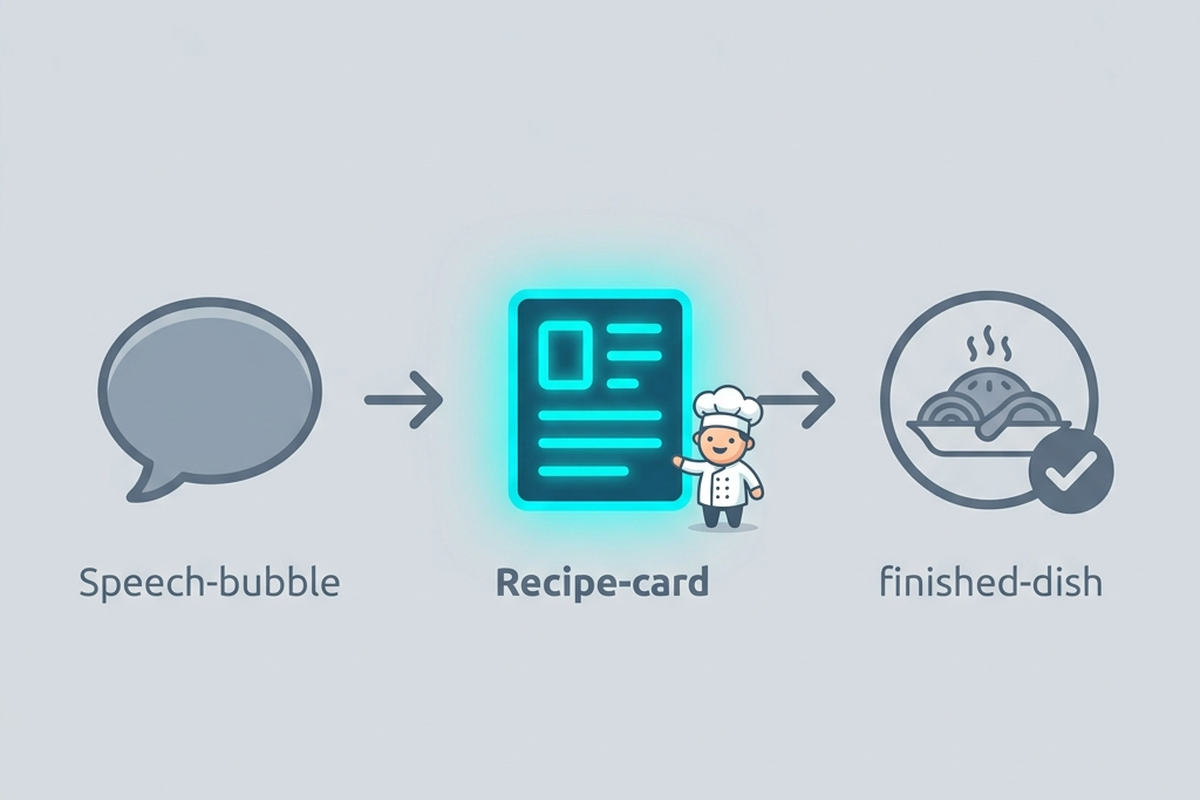
| A recipe card versus a finished, tasted dish | Generated code versus a pipeline that’s actually been verified |
For Beginners: What to Actually Do
- Use natural-language generation to produce a first draft, then treat reading and understanding that draft as the real learning exercise — don’t just accept it and move on without knowing what it actually does.
- Practice describing pipeline requirements precisely. “Get customer data” is vague; “extract active customers updated in the last 24 hours, keyed by customer ID” is something a tool (or a person) can actually act on well.
- Build the review habit early: for every generated pipeline, ask specifically how it handles duplicates, missing fields, and reruns (Article 6) — the same edge cases you’d check in hand-written code.
- Don’t let ease of generation replace understanding of what “correct” actually means for your specific data. A fluent-looking draft can still be wrong in ways that only someone who knows the domain would catch.
For Practitioners and Leaders: The Deeper Layer
- As pipeline generation gets easier, the bottleneck shifts to review capacity — make sure your team’s ability to critically evaluate generated logic is growing alongside its ability to produce more of it, or you’ll trade a slow-but-careful process for a fast-but-unreliable one.
- This capability meaningfully lowers the gate on who can initiate a pipeline change, which is a genuine democratization — but it raises the importance of a real review step before anything generated reaches production, especially for pipelines with financial or compliance weight.
- Treat generated pipeline logic with the same scrutiny you’d apply to code from a new, unproven contributor: useful, often good, but not yet trusted by default.
- The skill mix your team needs is shifting, not shrinking — investing in strong review and judgment skills is now at least as important as investing in tool-specific implementation skills, and worth reflecting in how you train and hire.
Quick Recap
- Natural-language pipeline generation lets someone describe intent and get a working first draft of extraction, transformation, and loading logic.
- Traditionally, building a pipeline required someone fluent in specific tool syntax, regardless of how simple the underlying request actually was.
- This is lowering the gate on who can initiate pipeline work, while shifting the valuable skill toward reviewing and judging generated logic.
- Iteration increasingly happens in plain language, shortening the loop between “this isn’t quite right” and a corrected version.
- Treat generated logic like code from an unproven contributor — often good, but always worth review before it reaches anything that matters.
Where This Fits in the Series
Article 15 covered the tools this all runs on. This article covered a fast-changing way of directing those tools. Article 17 looks at a less exciting but equally important question: what all of this actually costs to run, and how to keep that cost under control.
Key References
- dbt Core Documentation — Official documentation for data transformation workflows, DAG creation, and testing.
- Apache Airflow Architecture Guide — Open-source platform standards for orchestrating complex data pipelines.
- Apache Kafka Documentation — Industry standard specification for real-time event streaming pipelines.
Subscribe to the Newsletter
Get the latest DataParables articles delivered straight to your inbox.