Opening Scene
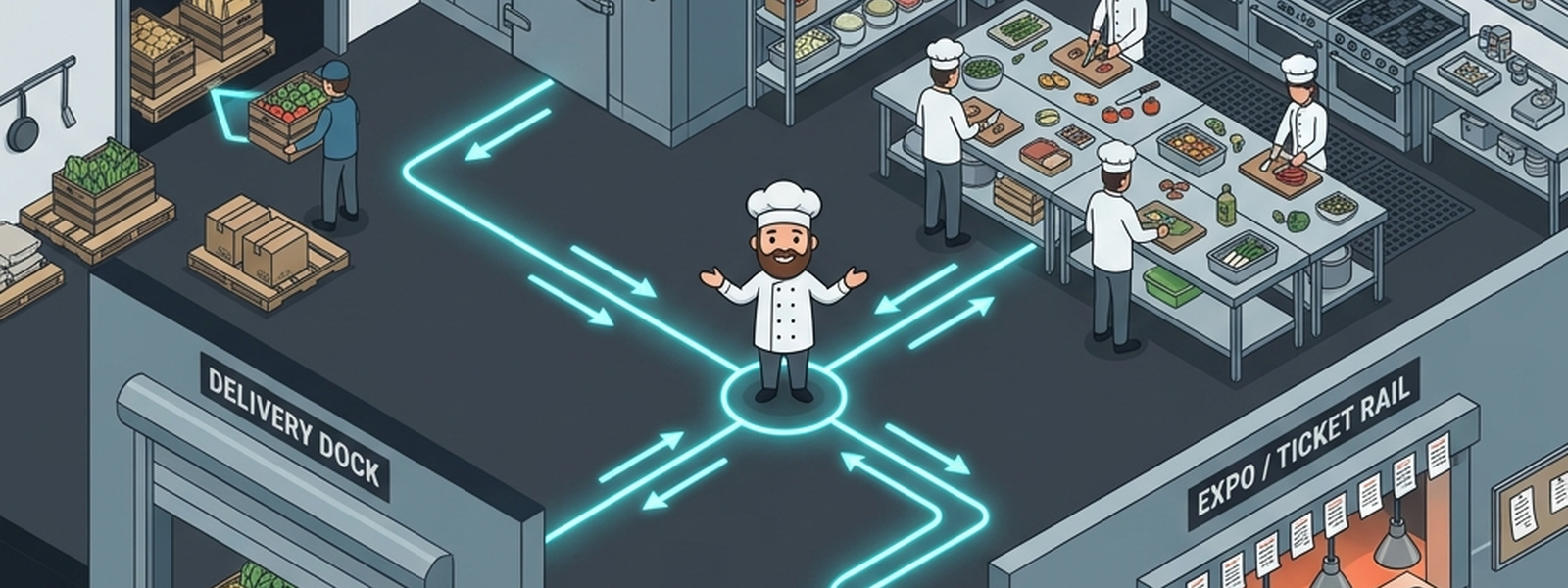
Walk into any serious professional kitchen and you won’t find one machine that does everything. There’s a delivery intake area, a walk-in cooler, prep stations with their own tools, a range, an expo station running the tickets. Each piece of equipment does one job well, and the kitchen’s actual capability comes from how well they work together, not from any single machine being impressive on its own.
The modern data pipeline toolkit looks the same way, and a lot of confusion about “which tool should we use” comes from not first knowing which kitchen station a given tool is actually meant to be.
In Plain English
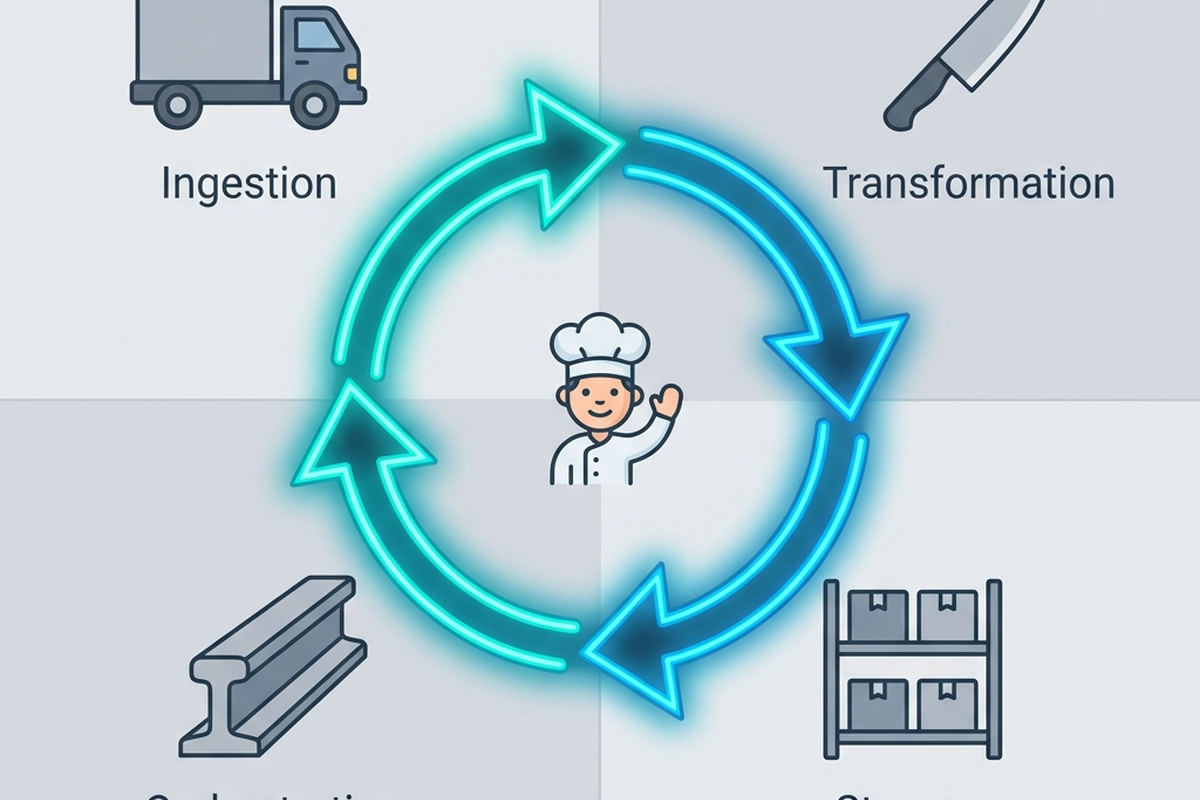
Pipeline tooling generally falls into a few distinct categories: ingestion tools that handle extraction from source systems, transformation tools that handle cleaning and reshaping, orchestrators that manage scheduling and dependencies (Article 8), and storage/warehouse platforms that hold the result. Most real pipelines combine tools from several of these categories rather than using one tool for everything — the same way a kitchen combines a delivery dock, a walk-in, a prep station, and a range, instead of expecting one machine to do all four jobs.
The Old Way
Traditionally, teams often built custom code for most of this — hand-written extraction scripts, hand-written transformation logic, a custom-built scheduler — because purpose-built tools for each category either didn’t exist yet or didn’t fit a team’s specific needs. This gave total control but meant every team was maintaining its own version of the same basic kitchen equipment, reinventing solutions to problems — retry logic, dependency management, connection handling — that had already been solved elsewhere many times over.
As the ecosystem matured, dedicated tools emerged for each category, and the harder problem shifted from “how do we build this” to “which combination of tools actually fits what we need, and how do we get them working together well.”
What’s Changing (and Why AI Is the Reason)
- AI is showing up inside every category, not as a separate category of its own. Ingestion tools increasingly use AI to infer schemas (Article 2); transformation tools increasingly use it to suggest cleaning logic (Article 3); orchestrators increasingly use it to draft dependency graphs (Article 8). The tooling landscape isn’t gaining a new “AI station” — every existing station is getting an AI-assisted upgrade.
- Choosing between tools is becoming less of a one-time, high-stakes decision. Because AI-assisted tools can help translate pipeline logic between platforms, migrating from one tool to another is becoming less catastrophically expensive than it used to be — lowering the cost of an imperfect initial choice, though not eliminating it.
- Natural-language interfaces are lowering the barrier to entry across categories. Increasingly, someone can describe what they want a pipeline to do in plain language and get a reasonable starting configuration across ingestion, transformation, and orchestration tools alike — a theme this series returns to directly in a later article.
The Metaphor, Fully Extended
| Kitchen Element | Pipeline Tooling Concept |
|---|---|
| The delivery dock | Ingestion / extraction tools |
| The prep station | Transformation tools |
| The expo running the ticket rail | Orchestration tools |
| The walk-in and pantry | Storage and warehouse platforms |
| A kitchen building all its own equipment from scratch | Custom, hand-written pipeline code for every stage |
| Buying purpose-built equipment for each station | Adopting dedicated tools for ingestion, transformation, and orchestration |
| Swapping in a new piece of equipment without rebuilding the whole kitchen | Migrating between tools with AI-assisted translation of pipeline logic |
For Beginners: What to Actually Do
- Before evaluating any specific tool, first identify which category (ingestion, transformation, orchestration, storage) the problem you’re solving actually belongs to. A lot of tool confusion comes from skipping this step.
- Resist the instinct to look for one tool that does everything. The strongest pipeline setups are usually a well-chosen combination, not a single all-in-one platform stretched past what it’s good at.
- When comparing tools within a category, look past feature lists to how well each one handles the failure modes covered earlier in this series — retries, idempotency, schema drift. That’s where real differences show up in practice.
- Treat your first tool choice as a real decision, but not an irreversible one — especially now that migrating between tools is meaningfully less painful than it used to be.
For Practitioners and Leaders: The Deeper Layer
- A common architectural mistake is choosing tools category by category in isolation, without checking how well they actually integrate with each other — the strength of a kitchen is in the workflow between stations, not just the quality of any one station alone.
- As AI capability spreads across every category rather than concentrating in one new tool, evaluate vendors on how well they’ve integrated it into their existing strengths, not just on whether they have an “AI feature” to point to.
- Lower migration costs are a genuine strategic asset — they reduce the organizational fear of choosing wrong, which historically has led teams to over-invest in analysis paralysis before a first tool decision. Weigh that explicitly when a team is stuck debating options.
- Periodically revisit your tooling stack against how your actual pipeline needs have changed, rather than treating an initial tool choice as permanent. The lowered cost of migration makes this a genuinely reasonable thing to do every couple of years, not just when something breaks.
Quick Recap
- Pipeline tools generally fall into a few categories: ingestion, transformation, orchestration, and storage — most real setups combine tools from each rather than using one tool for everything.
- Historically, teams built most of this by hand before dedicated tools matured for each category.
- AI capability is spreading across every category rather than forming a separate “AI tool” category of its own.
- Migrating between tools is becoming less costly, thanks to AI-assisted translation of pipeline logic, which lowers the stakes of an initial choice.
- Evaluate tools on how well they handle the real failure modes covered throughout this series, not just on feature lists.
Where This Fits in the Series
Article 14 covered recovering from a missed window. This article zoomed out to the tools used to build all of this in the first place. Article 16 goes deeper into one specific, fast-moving capability inside that toolkit: describing a pipeline in plain language and having AI draft the first version.
Key References
- dbt Core Documentation — Official documentation for data transformation workflows, DAG creation, and testing.
- Apache Airflow Architecture Guide — Open-source platform standards for orchestrating complex data pipelines.
- Apache Kafka Documentation — Industry standard specification for real-time event streaming pipelines.
Subscribe to the Newsletter
Get the latest DataParables articles delivered straight to your inbox.