
Opening Scene
A kitchen closes for a week for repairs. When it reopens, the inventory system, the ordering history, the supplier deliveries — none of it just picks up cleanly where it left off. Someone has to go back and reconstruct what should have happened during the closure: orders that would have come in, deliveries that were rescheduled, records that need to reflect reality even though the normal process wasn’t running. Skip that step, and the books have a permanent, unexplained gap.
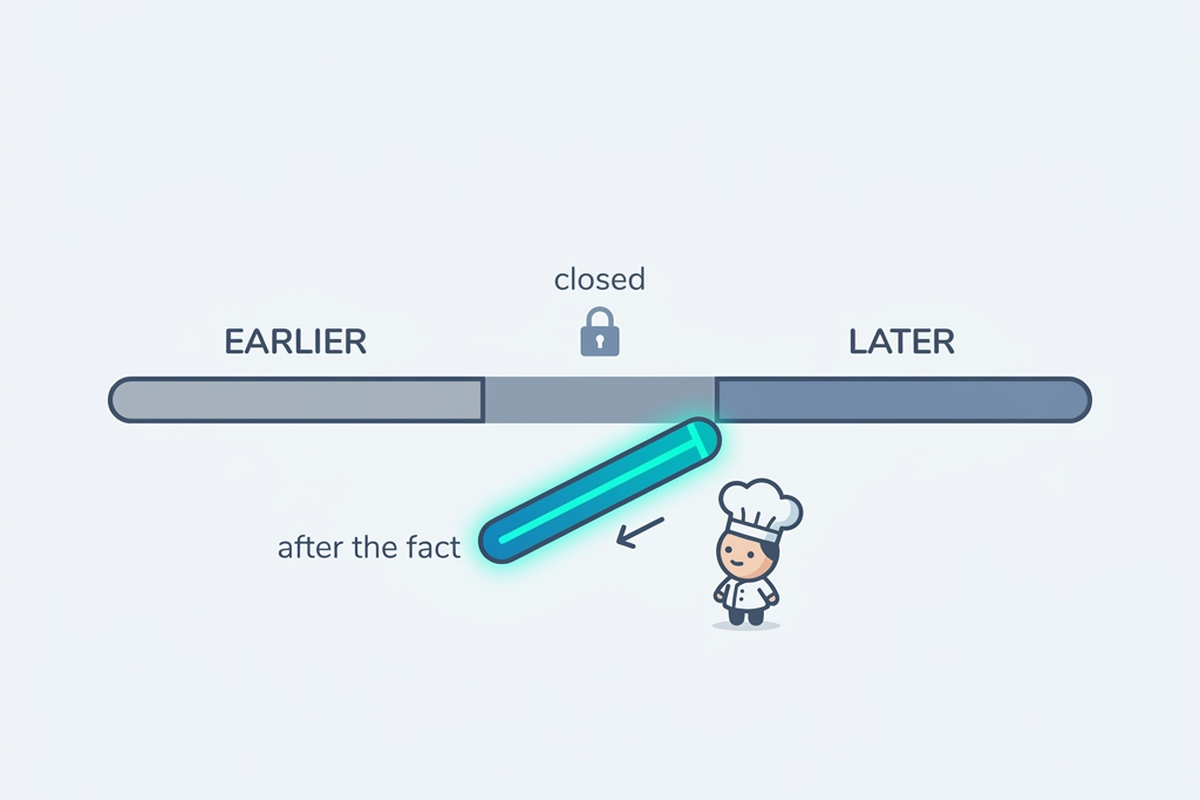
Backfilling is a pipeline’s version of that reconstruction — deliberately going back and processing data for a period that was missed, instead of just resuming forward and leaving a hole.
In Plain English
Backfilling means running a pipeline against historical data it didn’t process at the time — because it was down, because a bug caused bad output that needs replacing, or because a new pipeline needs history it never originally captured. It’s different from a normal run, which processes new data going forward; a backfill deliberately reaches backward to fill a gap that already exists.
The Old Way
Traditionally, backfilling was one of the riskiest, most manual operations in a pipeline’s life. An engineer had to figure out exactly what window needed reprocessing, temporarily adjust the pipeline to accept an unusual historical date range, run it carefully — often outside normal hours to avoid resource contention with live processing — and verify the result matched what should have happened, all while making sure the backfill itself didn’t create duplicates if the pipeline wasn’t properly idempotent (Article 6’s concern, resurfacing here in a higher-stakes form).
Because it was risky and infrequent, backfilling often wasn’t well-rehearsed. Teams found out how well their pipeline handled a backfill during an actual incident, under pressure, which is the worst possible time to discover a gap in the process.
What’s Changing (and Why AI Is the Reason)
- Identifying exactly what needs backfilling is faster. AI-assisted tooling can now compare what should have run against what actually ran and precisely identify the gap — down to the exact records or time windows affected — rather than an engineer manually reconstructing the timeline from logs and memory.
- Backfill logic can be templated and safer by default. Because AI tools can help draft pipeline logic generally, backfill-safe patterns — respecting idempotency, avoiding resource contention with live runs — can be built in as a standard capability from the start, rather than being a fragile, one-off manual procedure improvised under pressure each time.
- Verification is more thorough. After a backfill runs, AI-assisted comparison can check the reconstructed data against expected patterns or related sources more comprehensively than a person spot-checking a sample, catching subtle backfill errors — like a partial reprocessing that missed an edge case — before they’re mistaken for a clean recovery.
The Metaphor, Fully Extended
| Kitchen Element | Backfilling Concept |
|---|---|
| A week-long closure for repairs | A period a pipeline failed to process |
| Reconstructing what should have happened during the closure | Backfilling historical data for the missed window |
| Figuring out exactly which records and dates were affected | Identifying the precise scope of a backfill |
| Doing the reconstruction carefully, outside normal business hours | Running a backfill in a way that avoids contention with live pipelines |
| Double-counting an order because the reconstruction wasn’t careful | A non-idempotent backfill creating duplicate data |
| A manager reviewing the reconstructed books against outside records | Verifying backfilled data against expected patterns or related sources |
For Beginners: What to Actually Do
- Before you ever need to backfill under pressure, know in advance how your pipeline is meant to handle a historical date range — don’t discover the answer during an actual incident.
- Treat every backfill as a chance to accidentally duplicate data if the underlying pipeline isn’t idempotent (Article 6) — verify that property specifically before running one.
- After a backfill completes, don’t just check that it ran without error — actively compare the results against what you’d expect, or against a related source, before considering the gap closed.
- Keep a written record of when and why a backfill happened. Future you, or someone else on the team, will eventually need to know that a given period’s data was reconstructed rather than captured live.
For Practitioners and Leaders: The Deeper Layer
- Backfilling well depends on properties (idempotency, clear incremental keys, reliable lineage) that this series has already covered individually — it’s a good practical test of whether those disciplines are actually in place, or just assumed to be.
- Because backfills are infrequent, they’re exactly the kind of operation that decays in institutional knowledge fastest — consider actually rehearsing a backfill occasionally, in a safe environment, rather than only ever doing it for real during an incident.
- AI-assisted gap detection and verification meaningfully reduce backfill risk, but the decision of what counts as an acceptable reconstruction — versus data that’s genuinely, permanently lost — is still a judgment call that belongs to a person, especially for anything with compliance or financial weight.
- Track backfill frequency as a signal in its own right. A team that’s frequently backfilling is often telling you something about the underlying reliability of its pipelines that’s worth addressing at the source, not just repeatedly working around.
Quick Recap
- Backfilling deliberately reprocesses historical data for a period a pipeline missed, instead of just resuming forward and leaving a permanent gap.
- Traditionally, backfilling was risky and manual, and teams often learned how well it worked during a real incident rather than in advance.
- AI tools can now precisely identify what needs backfilling, help build backfill-safe pipeline logic by default, and verify results more thoroughly.
- A good backfill depends on properties covered earlier in this series — idempotency and reliable incremental logic especially.
- Frequent backfilling is a signal worth investigating on its own, not just a routine operation to keep repeating.
Where This Fits in the Series
Article 13 covered catching every change as it happens. This article covered recovering when that didn’t happen for a while. Article 15 zooms out from any single pipeline’s mechanics to the broader landscape of tools teams actually reach for to build all of this.
Key References
- dbt Core Documentation — Official documentation for data transformation workflows, DAG creation, and testing.
- Apache Airflow Architecture Guide — Open-source platform standards for orchestrating complex data pipelines.
- Apache Kafka Documentation — Industry standard specification for real-time event streaming pipelines.
Subscribe to the Newsletter
Get the latest DataParables articles delivered straight to your inbox.