
Opening Scene
Before the first ticket of the night goes out, someone tastes the sauce. Not because it’s required by law, but because a kitchen that skips this step finds out a dish is wrong from a customer sending it back, in front of everyone, instead of from a quiet spoonful in the back. Tasting before service is cheap. Fixing a mistake after it’s already on someone’s table is not.
Testing a pipeline before it runs against real, live data is the exact same trade: a small, deliberate check now, instead of a business user discovering the mistake in a report later.
In Plain English
Pipeline testing means verifying a pipeline’s logic works correctly before it processes real data — checking that a transformation produces the expected result on known sample data, that a join doesn’t unexpectedly multiply rows, that an edge case (an empty field, a duplicate key) is handled the way it’s supposed to be. It’s the same discipline as testing any other software, applied to the part of the system most people never think to test until something’s already gone wrong.
The Old Way
Traditionally, pipelines were often the least-tested part of a company’s technology, even at organizations with strong testing discipline everywhere else. A pipeline “worked” if it ran without crashing and the numbers looked roughly right to whoever glanced at them — a kitchen tasting-before-service standard that, in practice, meant nobody was actually tasting anything, just hoping the dish looked fine from across the room.
When pipelines were tested, it was often only after something had already broken: a bug surfaced in production, someone wrote a test to catch that specific case, and testing coverage grew reactively, one incident at a time, rather than being designed in from the start.
What’s Changing (and Why AI Is the Reason)
- AI can generate test cases, including the ones you wouldn’t think of. Given a transformation’s logic, AI tools can now propose edge cases worth testing — a null in an unexpected field, a duplicate key, a date at a year boundary — catching the kind of scenario a rushed engineer skips not from carelessness, but because it genuinely didn’t occur to them.
- Anomaly detection is becoming a form of continuous tasting. Instead of testing only before deployment, AI-assisted monitoring can now continuously check whether a pipeline’s output still looks statistically normal — catching a transformation that’s silently drifted wrong over time, not just one that was wrong from the start.
- Writing tests is faster, so more of them actually get written. AI-assisted test generation lowers the effort of writing a reasonable first pass at test coverage, which matters because the single biggest reason pipelines go untested has always been time pressure, not disagreement that testing is worthwhile.
The Metaphor, Fully Extended
| Kitchen Element | Pipeline Testing Concept |
|---|---|
| Tasting the sauce before service | Testing a transformation before it runs on real data |
| A dish sent back by a customer | A bug discovered in production, by an end user |
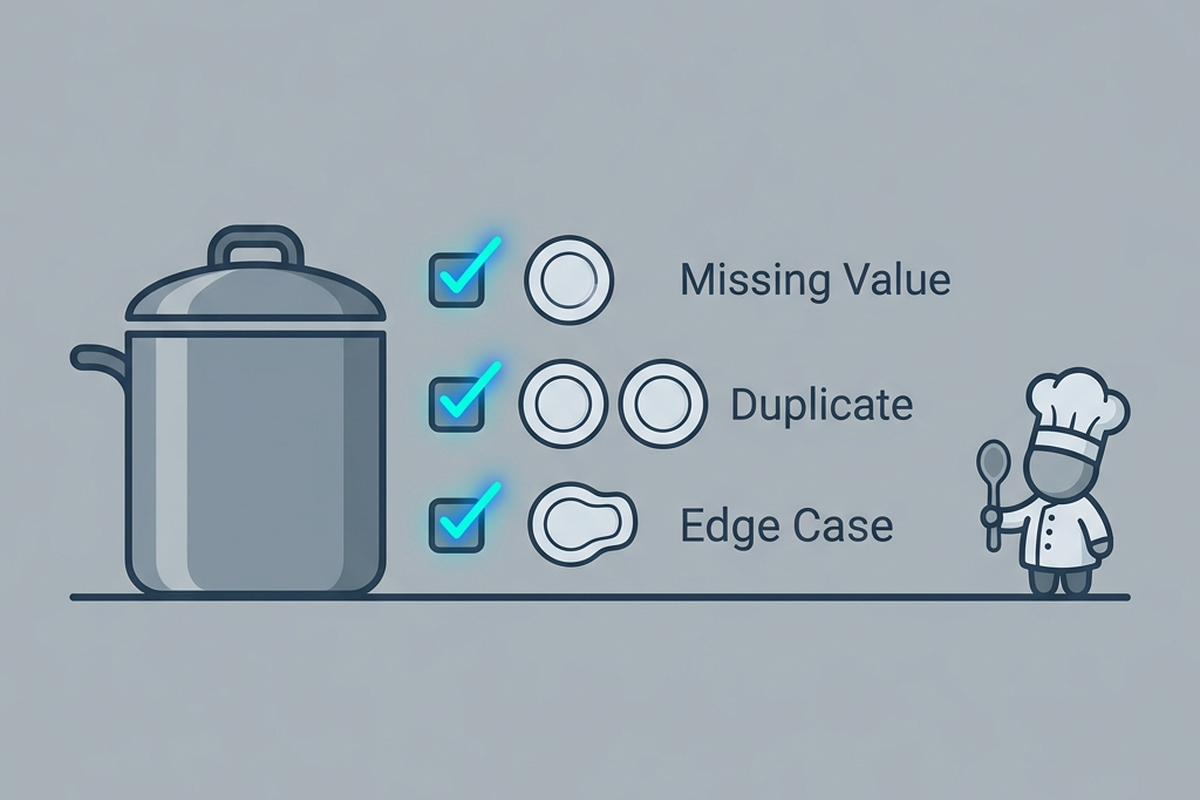
| A tasting checklist covering common mistakes | A test suite covering known edge cases |
| A dish that only ever gets checked by eye, from across the room | A pipeline “tested” only by whether it runs without crashing |
| An experienced cook who knows to check for an unlikely allergy substitution | AI-suggested test cases covering scenarios a person might not think of |
| Sampling dishes continuously through service, not just once before opening | Continuous anomaly detection on live pipeline output |
For Beginners: What to Actually Do
- Before you consider a transformation finished, run it against a small set of known inputs where you already know the correct output — that’s the pipeline equivalent of tasting the sauce.
- Deliberately test the ugly cases: empty values, duplicate keys, a record that shouldn’t exist but somehow does. Those are where real pipelines actually break.
- Don’t treat “it ran without an error” as proof that a pipeline is correct — a transformation can complete successfully and still produce a wrong answer.
- When an AI tool suggests test cases for your pipeline, actually use a few of the ones that surprise you. Those are usually the most valuable, precisely because you wouldn’t have thought of them yourself.
For Practitioners and Leaders: The Deeper Layer
- Untested pipelines are common not because teams don’t value testing, but because time pressure consistently wins against an invisible, hard-to-prioritize task — treat lowering the effort of writing tests (via AI-assisted generation or otherwise) as a genuine reliability investment, not a nice-to-have.
- Reactive, incident-driven test coverage leaves systemic gaps — it only ever tests for the specific failure that already happened once. Deliberately generated edge-case coverage closes gaps nobody has hit yet, which is exactly the coverage that prevents the next incident instead of just the last one.
- Continuous anomaly detection is a meaningful complement to pre-deployment testing, not a replacement for it — it catches drift and unexpected real-world behavior that a fixed test suite, run once before deployment, never will.
- Make pipeline test coverage visible the same way you’d make application test coverage visible. What isn’t measured tends to quietly stay untested, no matter how much everyone agrees it matters in principle.
Quick Recap
- Pipeline testing verifies transformation logic works correctly before it touches real data — the discipline of tasting before service, not after a complaint.
- Historically, pipelines were often the least-tested part of a system, checked mainly by whether they ran without crashing.
- AI tools can now generate meaningful edge-case tests and continuously monitor live output for drift, extending testing beyond a one-time, pre-deployment check.
- The main reason pipelines go untested is time pressure, not disagreement about value — lowering the effort of testing is itself a reliability win.
- “It ran successfully” is not the same as “it’s correct” — real testing checks the actual output against a known-correct expectation.
Where This Fits in the Series
Article 10 covered tracing data back to where it came from. This article covered catching mistakes before they ever reach that trail. Article 12 looks at what happens when a source changes its shape without warning — and what a pipeline needs in place to survive that gracefully.
Key References
- dbt Core Documentation — Official documentation for data transformation workflows, DAG creation, and testing.
- Apache Airflow Architecture Guide — Open-source platform standards for orchestrating complex data pipelines.
- Apache Kafka Documentation — Industry standard specification for real-time event streaming pipelines.
Subscribe to the Newsletter
Get the latest DataParables articles delivered straight to your inbox.