
Opening Scene
At 6am, before any customer has walked in, a restaurant’s back door is already busy. Farm trucks pull up one after another — crates of vegetables still caked in dirt, fish packed in ice, boxes of unlabeled spices, a delivery of flour in bags that don’t match yesterday’s. None of it looks like food yet. By 7pm that same night, a plate goes out to table twelve: clean, composed, exactly what the customer ordered, with no trace of the mess it came from.
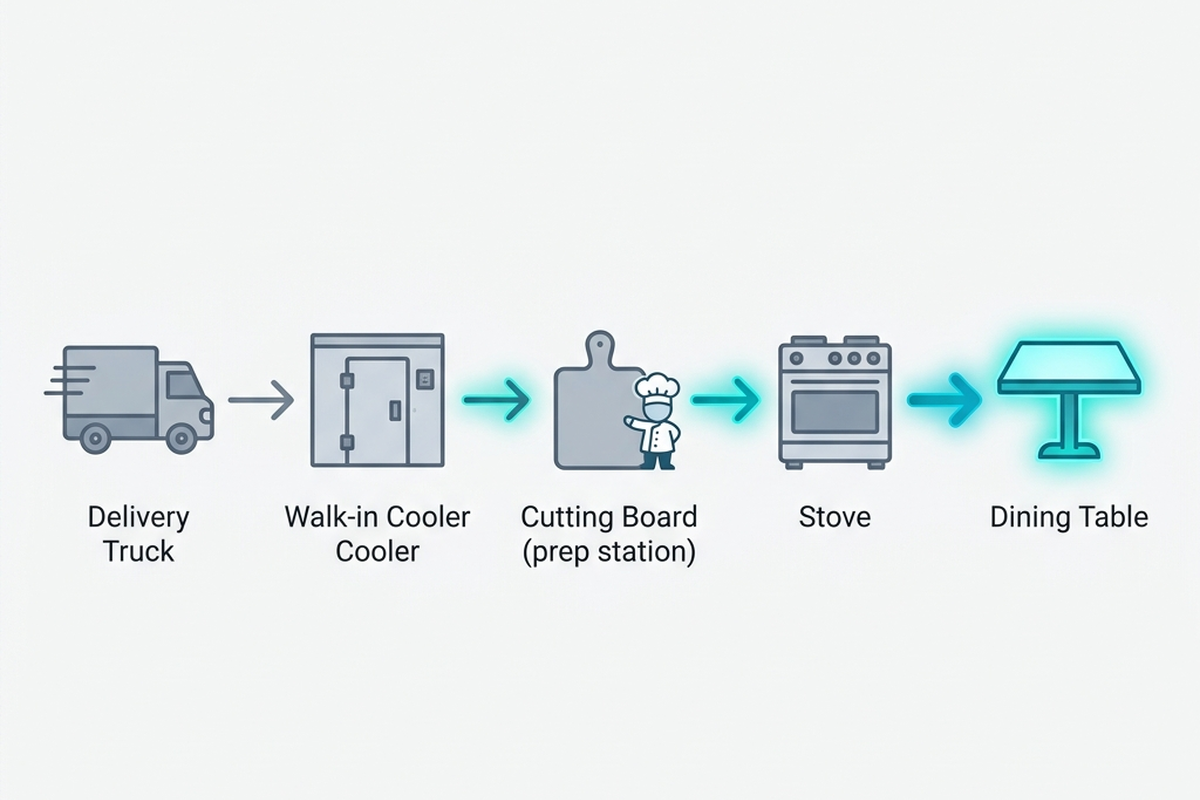
Everything that happened in between — checking deliveries, washing, chopping, cooking, plating — is the kitchen’s real work, and almost nobody eating dinner ever thinks about it. A data pipeline runs the exact same journey, just with data instead of vegetables.
In Plain English
A data pipeline is the system that moves data from where it’s created (source systems: apps, sensors, spreadsheets, other databases) to somewhere it can actually be used (a warehouse, a dashboard, an AI assistant), cleaning and reshaping it along the way. ETL (Extract, Transform, Load) and ELT (Extract, Load, Transform) are the two classic patterns for that journey — they differ mainly in when the “cooking” happens, which later articles in this series will get into. For now, think of the whole pipeline as the kitchen itself: the thing that turns raw ingredients into something worth serving.
The Old Way
Traditionally, a data pipeline was a set of scripts an engineer wrote by hand, scheduled to run overnight while nobody was watching — much like a kitchen that preps everything the night before and closes its doors until the next service. A job would extract yesterday’s data, run it through a series of transformation steps coded line by line, and load the result into a warehouse by morning. If a delivery showed up in an unexpected format — a new column, a renamed field, a file that didn’t quite match the usual shape — the pipeline broke, and someone got paged to go fix it by hand, the data equivalent of a chef improvising when the fish delivery shows up looking nothing like what was ordered.
This worked, but it was brittle and slow to adapt. Every new data source meant a new engineer sitting down and hand-writing new parsing logic, the same way a kitchen has to train someone new every time it starts sourcing from a different farm.
What’s Changing (and Why AI Is the Reason)
- The kitchen can read an unfamiliar delivery slip. AI tools can now look at a new, messy, or previously unseen data source and propose how to parse and map it — inferring column meanings, guessing at formats, flagging what looks off — the way an experienced chef can glance at unlabeled produce and know what it is and how it needs to be handled, without a supplier spec sheet.
- The kitchen doesn’t fully close anymore. Pipelines are increasingly expected to clean, enrich, and route data continuously rather than only in an overnight batch window — service that never quite stops, with prep happening in smaller, constant motions instead of one long push before opening. Later articles in this series look at what that shift actually requires.
- There’s a new kind of diner in the dining room. Pipelines used to feed one audience: a dashboard a person would check the next morning. Increasingly, they also feed AI agents that query and act on the data directly, with no patience for “the numbers usually update by 9am” — a diner who expects the kitchen to already be serving when they walk in, at any hour.
The Metaphor, Fully Extended
| Kitchen Element | Data Pipeline Concept |
|---|---|
| Farm trucks arriving at the back door | Source systems delivering raw data |
| The delivery slip | Schema or metadata describing the incoming data |
| The receiving clerk checking crates | Validation at ingestion |
| The walk-in cooler | A staging area or raw data lake |
| The prep station (washing, chopping) | The transformation step |
| The head chef’s recipe card | Transformation logic and business rules |
| Plating | Loading data into its destination |
| The dining room | The destination system — a warehouse, dashboard, or AI agent |
| A regular with a standing weekly order | A recurring, scheduled pipeline job |
| A walk-in customer arriving anytime | Real-time data arriving unpredictably |
| A sous chef learning the head chef’s style | AI tools learning to automate common transformation patterns |
For Beginners: What to Actually Do
- Before writing a single transformation, ask the kitchen question first: where is this data coming from, and what condition does it actually arrive in? Most pipeline bugs are surprises at the back door, not mistakes at the stove.
- Get comfortable reading a schema the way a receiving clerk reads a delivery slip — know what you’re supposed to be getting before you check what actually showed up.
- Don’t trust a new data source’s format on day one. Log what you observe for a while before you build permanent logic around it, the way a kitchen learns a new supplier’s habits before fully trusting their deliveries.
- When you use an AI tool to infer a schema or mapping from messy source data, spot-check its guesses against a few real records before wiring it into anything that runs unattended.
For Practitioners and Leaders: The Deeper Layer
- The brittleness of hand-written parsing logic was always a scaling problem, not just an annoyance — every new source added linearly to engineering load. AI-assisted schema inference changes that curve, but only if someone keeps reviewing what it infers; unsupervised inference on a source with regulatory or financial weight is a real risk, not a convenience.
- “The kitchen doesn’t close” is a genuine operating-model shift, not just a technical one — continuous pipelines change who’s on call, how incidents get triaged, and what “the data is wrong” means when there’s no longer a clean overnight boundary between “yesterday’s numbers” and “today’s.”
- Treat the arrival of AI agents as pipeline consumers as a freshness and reliability requirement, not a footnote. An agent acting on stale or malformed data doesn’t pause to double-check the way a human glancing at a weird dashboard number might.
- Audit which of your pipelines still assume a human will notice when something’s wrong. That assumption gets more dangerous, not less, as more of a pipeline’s output goes directly to systems that act without asking.
Quick Recap
- A data pipeline moves data from source systems to somewhere useful, cleaning and reshaping it along the way — the same journey a kitchen takes raw ingredients through to a finished plate.
- ETL and ELT are two patterns for that journey, differing in when the “cooking” (transformation) happens.
- Traditionally, pipelines were hand-written, scheduled batch jobs — brittle whenever a new source showed up looking different than expected.
- AI is changing two things at once: pipelines can now interpret unfamiliar data faster, and they increasingly need to run continuously for AI agents that expect data to always be current.
- None of this removes the need for a human checking the kitchen’s work — it just changes where that judgment gets applied.
Where This Fits in the Series
This is the opening article — the whole kitchen, end to end, before we walk into any single station. Article 2 steps up to the back door itself: how a pipeline actually reads an unfamiliar delivery, and what “extract” really involves when the source doesn’t cooperate.
Key References
- dbt Core Documentation — Official documentation for data transformation workflows, DAG creation, and testing.
- Apache Airflow Architecture Guide — Open-source platform standards for orchestrating complex data pipelines.
- Apache Kafka Documentation — Industry standard specification for real-time event streaming pipelines.
Subscribe to the Newsletter
Get the latest DataParables articles delivered straight to your inbox.