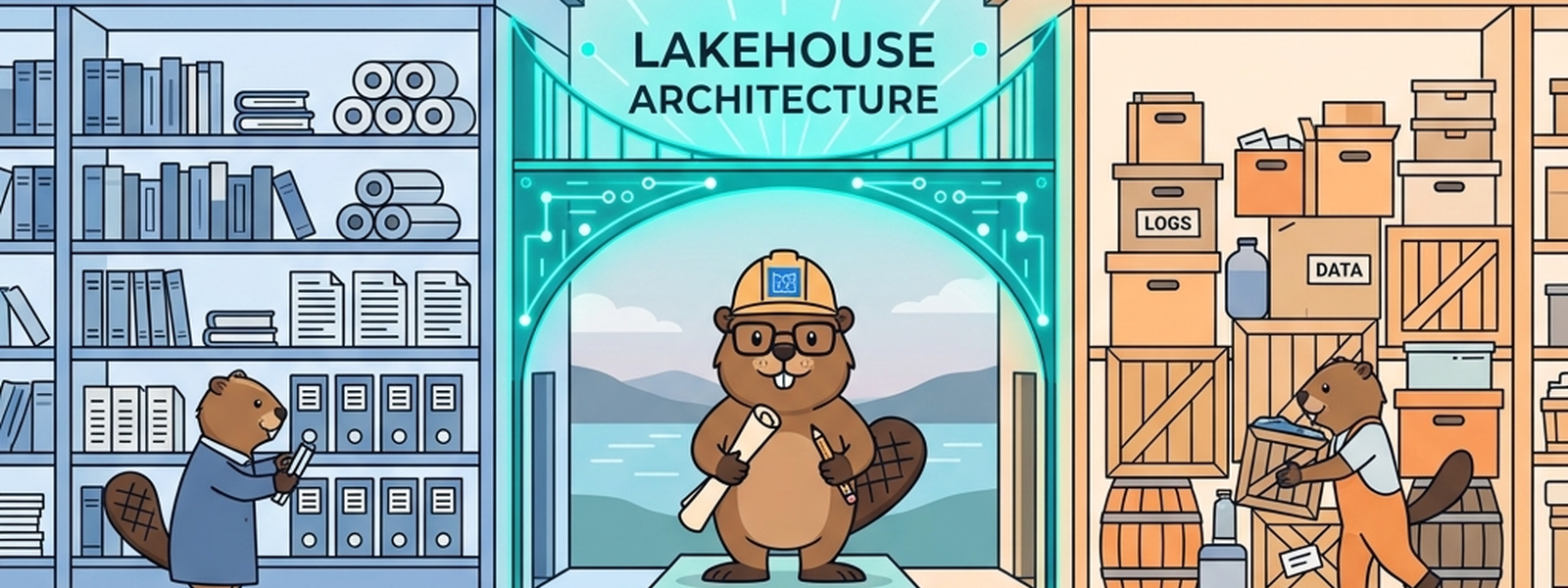
Opening Scene
A meticulously catalogued library has every book in its place before it’s ever shelved: classified, labeled, cross-referenced. Find a book, and you’ll find exactly what the catalogue promised. A self-storage unit works the opposite way: you put boxes in as fast as you need to, however they fit, and figure out exactly what’s in which box only when you actually go looking for something.
Both are legitimate ways to store things. The right choice depends on what you’re storing and how you’ll need to find it later.
In Plain English
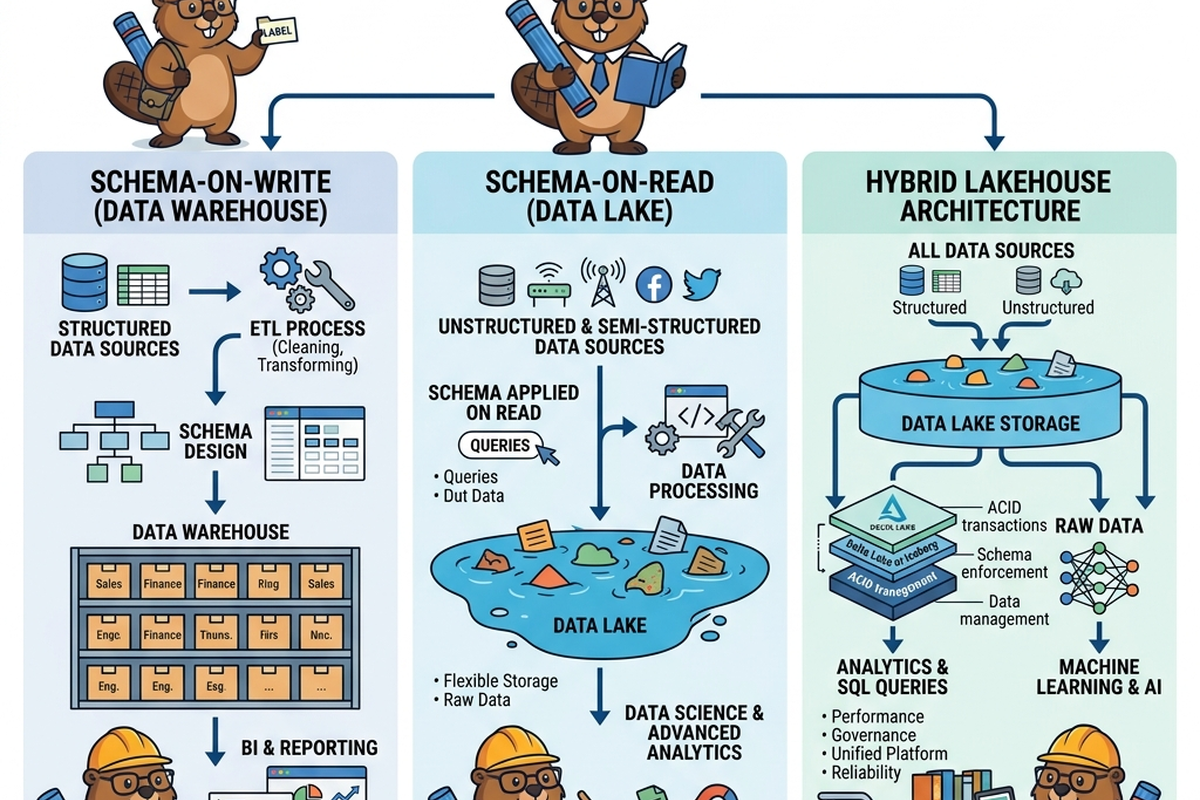
A data warehouse stores data in a carefully structured way decided in advance — this is sometimes called “schema-on-write,” because the structure (the schema) is defined before the data is written in. A data lake stores data more flexibly, often in its raw or near-raw form, with structure applied only when someone actually goes to read and use it — “schema-on-read.” A lakehouse is a more recent approach that tries to combine the flexibility of a lake with some of the reliable structure of a warehouse.
The Old Way
Traditionally, warehouse modelling meant deciding the cataloguing system before a single book arrived — defining tables, columns, and types up front, then transforming incoming data to match that structure before it was ever stored. This produced trustworthy, well-organized, fast-to-query data, but it was slow to adapt: adding a genuinely new kind of “book” to the library often meant redesigning part of the catalogue first.
Data lakes emerged partly as a reaction to this rigidity — load raw data in as-is, worry about structure later. This was fast and flexible, but came with a real cost: without discipline, a storage unit full of unlabeled boxes can quietly become a place where nobody, months later, remembers what’s actually inside any given box, or whether two boxes contain the same thing labeled differently.
What’s Changing (and Why AI Is the Reason)
- AI is acting as an on-demand librarian for the storage unit. Tools can now scan raw, unstructured or semi-structured data sitting in a lake and infer likely structure at the moment someone wants to query it — effectively cataloguing the box only once someone actually needs what’s inside, rather than requiring that work to happen up front.
- The line between warehouse and lake is blurring on purpose. Lakehouse architectures, increasingly supported by AI-assisted schema inference and validation, let teams keep the lake’s flexible ingestion while still getting much of the warehouse’s structure and reliability — narrowing the old trade-off rather than forcing a choice between them.
- Auditing the storage unit is now realistic at scale. AI tools can scan large volumes of loosely structured lake data and flag likely duplicate, inconsistent, or mislabeled “boxes” automatically, addressing the lake’s classic weakness — undiscoverable, undocumented content — without requiring a slow, comprehensive manual audit.
The Metaphor, Fully Extended
| Library / Storage Element | Data Modelling Concept |
|---|---|
| The meticulously catalogued library | The data warehouse |
| The flexible self-storage unit | The data lake |
| A hybrid library with both catalogued shelves and a flexible drop-off area | The lakehouse architecture |
| Cataloguing a book before it’s shelved | Schema-on-write |
| Figuring out what’s in a box only when you open it | Schema-on-read |
| The library’s classification system, decided in advance | A predefined warehouse schema |
| A box labeled vaguely as “miscellaneous” | Raw or loosely structured data in a lake |
| A librarian cataloguing a book the moment someone requests it | AI-assisted schema inference at query time |
| A storage unit audit to find duplicate or mislabeled boxes | AI-assisted data quality scanning across lake data |
| Renovating the library’s catalogue system | Redesigning a warehouse schema to support new data |
For Beginners: What to Actually Do
- Get comfortable with the core trade-off: warehouses are structured and fast to query but slower to change; lakes are flexible and fast to load into but require more care to keep usable.
- When you encounter a new dataset, ask whether it was “catalogued before shelving” (likely a warehouse table, already structured) or “dropped into storage as-is” (likely raw lake data, structure applied only when read).
- Practice the instinct of checking documentation or metadata before trusting a lake-stored dataset’s apparent structure — what looks like a clear “box label” may not match what’s actually inside.
- If you’re using an AI tool to query lake data directly, sanity-check at least a few of its structural assumptions (inferred column names or types) against the raw data before trusting the results fully.
For Practitioners and Leaders: The Deeper Layer
- AI-assisted schema-on-read inference reduces, but doesn’t eliminate, the governance risk of an under-documented lake — invest in metadata and cataloguing discipline even when AI tools can technically infer structure on demand, since inference quality still depends heavily on data quality and consistency.
- Lakehouse architectures are increasingly the practical default for new builds precisely because AI-assisted schema validation makes it realistic to enforce some structure without sacrificing ingestion flexibility — worth revisiting for any team still treating warehouse and lake as a strict either/or choice.
- AI-driven duplicate and inconsistency scanning across lake data is valuable, but tends to surface volume that exceeds what a small data team can triage manually — pair this tooling with a clear prioritization process (e.g., focusing first on data feeding regulatory reporting or customer-facing AI tools) rather than treating every flagged issue as equally urgent.
- The choice between warehouse, lake, and lakehouse is still fundamentally a modelling decision tied to how data will be used, not just a technology choice — AI tooling makes execution easier in all three approaches, but doesn’t replace the upfront thinking about access patterns and governance needs.
Quick Recap
- Data warehouses use “schema-on-write” — structure decided up front, like a catalogued library.
- Data lakes use “schema-on-read” — structure applied at query time, like a flexible storage unit.
- Lakehouses combine flexible ingestion with more warehouse-like structure and reliability.
- AI can now infer likely structure from raw lake data on demand, acting as an on-demand librarian.
- AI-assisted scanning makes it realistic to audit large volumes of loosely structured lake data for duplication and inconsistency at scale.
Where This Fits in the Series
Article 5 looked at modelling data specifically for analytics questions; this article zoomed out to compare the broader storage philosophies — warehouse, lake, and lakehouse — that shape how modelling happens in the first place. Article 7, “Renovating a House With People Still Inside,” turns to what happens after a model exists: how to change it safely without breaking everything that depends on it.
Subscribe to the Newsletter
Get the latest DataParables articles delivered straight to your inbox.