Opening Scene
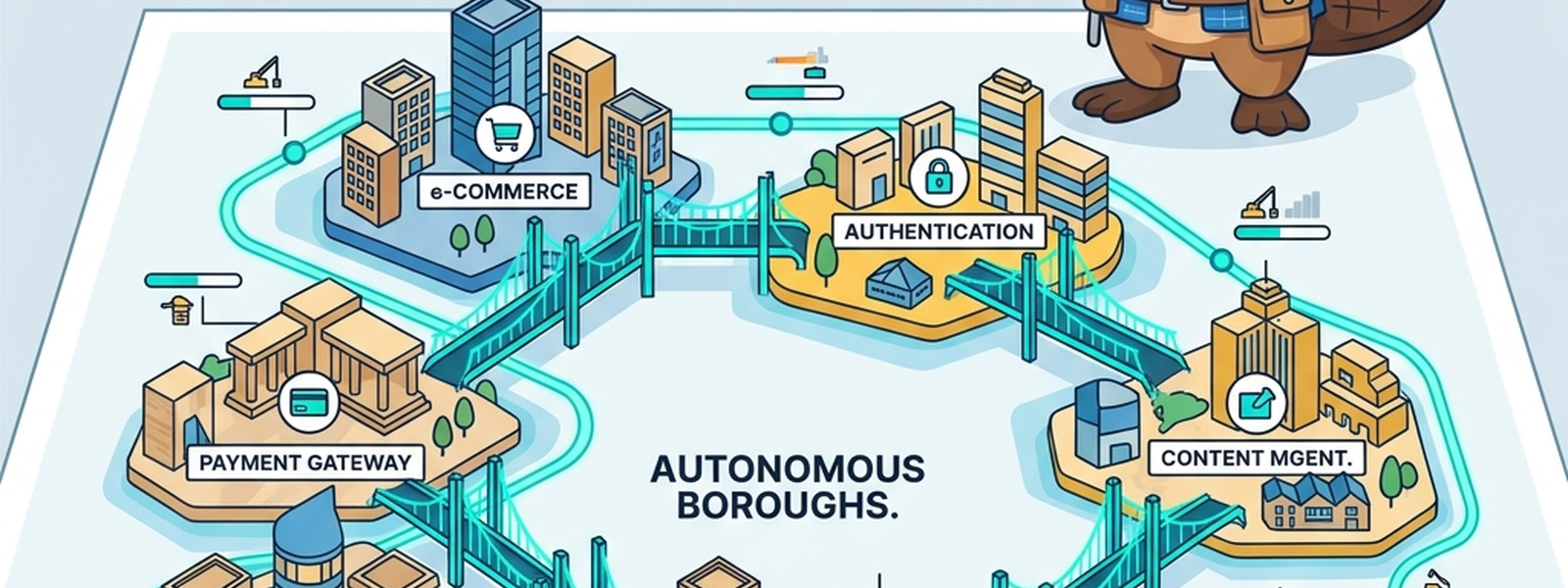
A city made up of several genuinely independent boroughs, each with its own council, its own permit office, its own renovation timeline, can’t coordinate a citywide renovation the way a single building’s owner can. Borough A might be ready to move to a new blueprint standard while Borough B is still three renovations behind. Any citywide change has to work across boroughs that are never all on the same version at the same time.
Schema evolution across a distributed, microservices-based system faces this exact same decentralized reality.
In Plain English
In a system built from many independently deployed services, each often owning its own schema, schema evolution can’t rely on a single, centrally coordinated migration the way a monolithic system can. Every principle covered throughout this arc — additive changes, breaking-change identification, versioning, compatibility, expand-contract, deprecation — still applies, but now has to work across service boundaries where different teams, on different timelines, are never guaranteed to be running the same schema version simultaneously.
The Old Way
Before distributed schema evolution was treated as a genuinely distinct discipline, teams sometimes applied monolithic assumptions to a fundamentally decentralized reality:
- Some organizations attempted centrally coordinated “everyone migrates on this date” rollouts across independent services, similar to trying to force every borough onto exactly the same renovation timeline, an approach that rarely survived contact with real organizational independence.
- A schema change in one service sometimes broke a consumer in another service without warning, similar to one borough’s renovation unexpectedly disrupting a neighboring borough’s infrastructure nobody had checked for a dependency on.
- Without a shared, decentralized contract mechanism, different services drifted toward incompatible assumptions about a shared schema, discovered only when an integration actually broke.
This mismatch between monolithic assumptions and a genuinely decentralized reality is precisely what dedicated distributed schema evolution practices were built to address.
What’s Changing (and Why AI Is the Reason)
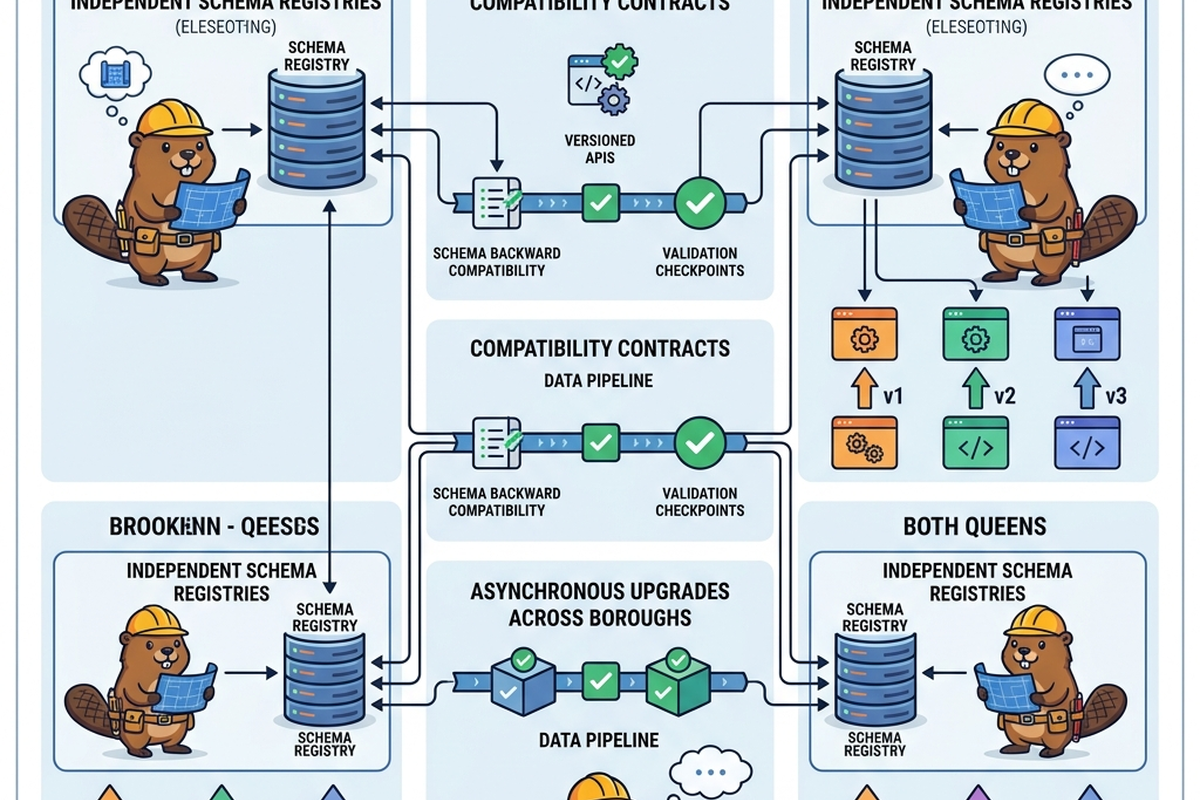
- Schema registries with cross-service compatibility checking, connecting directly to the data contracts covered elsewhere on this site, can now enforce that any individual service’s schema change remains compatible with every other service’s actual current expectations, without requiring centralized, lockstep coordination. This extends the compatibility discipline from Article 14 specifically to a multi-team, multi-timeline environment.
- AI-assisted cross-service impact analysis can trace a proposed schema change’s actual downstream effects across service boundaries that a single team might not have full visibility into, surfacing a genuine dependency in another team’s service before the change ships. This directly extends the dependency tracing from Article 12, scaled to a genuinely decentralized organization.
- AI-assisted consumer-driven contract testing can automatically verify that a service’s schema still satisfies every consuming service’s actual expectations, catching drift between independently evolving schemas before it causes a real integration failure. This gives each borough’s council a genuine, automated way to check their renovations against their neighbors’ actual needs, without requiring a single central authority to manually track everything.
The Metaphor, Fully Extended
| Building Element | Distributed Schema Evolution Concept |
|---|---|
| Several independently governed boroughs, each with its own timeline | Several independently deployed services, each owning its own schema |
| Forcing every borough onto exactly the same renovation date | Attempting centrally coordinated, lockstep migration across independent services |
| One borough’s renovation disrupting a neighboring borough’s infrastructure | A schema change in one service breaking an unnoticed consumer in another service |
| A citywide compatibility office checking every borough’s plans against its neighbors’ actual needs | A schema registry with cross-service compatibility checking |
| Each borough council automatically testing its renovation plans against neighboring boroughs’ real requirements | AI-assisted consumer-driven contract testing verifying cross-service schema expectations |
For Beginners: What to Actually Do
- Recognize that schema evolution in a distributed system can’t assume every consumer updates in lockstep, even more so than the single-system compatibility challenges covered in Article 14.
- Get comfortable with the idea that a schema change’s true impact might extend into services your own team doesn’t own or fully see.
- Use AI-assisted cross-service impact analysis before assuming a schema change is locally safe.
- Notice that every principle from earlier in this arc still applies here — this article extends them, it doesn’t replace them.
For Practitioners and Leaders: The Deeper Layer
- Invest in schema registries with genuine cross-service compatibility enforcement, rather than assuming centrally coordinated, lockstep migration is realistic across independent teams.
- Use AI-assisted cross-service impact analysis to surface dependencies a single team’s local visibility would miss.
- Adopt consumer-driven contract testing to let services independently verify their schema evolution against real downstream expectations.
- Recognize that decentralized schema evolution requires more automated tooling, not less discipline, precisely because no single team has full visibility into the whole system.
Quick Recap
- Schema evolution in a distributed, microservices-based system has to work across service boundaries where teams are never guaranteed to be on the same schema version simultaneously.
- This directly parallels a city of independently governed boroughs, each on its own renovation timeline.
- Schema registries with cross-service compatibility checking and AI-assisted impact analysis extend this arc’s earlier disciplines to a genuinely decentralized environment.
- AI-assisted consumer-driven contract testing lets independent services verify compatibility without requiring centralized, manual coordination.
Where This Fits in the Series
Article 17 covered deprecating and removing old schema elements. This article covered a city of many boroughs, each with its own blueprint. Article 19 looks at the contractor who reads every blueprint at once.
Subscribe to the Newsletter
Get the latest DataParables articles delivered straight to your inbox.