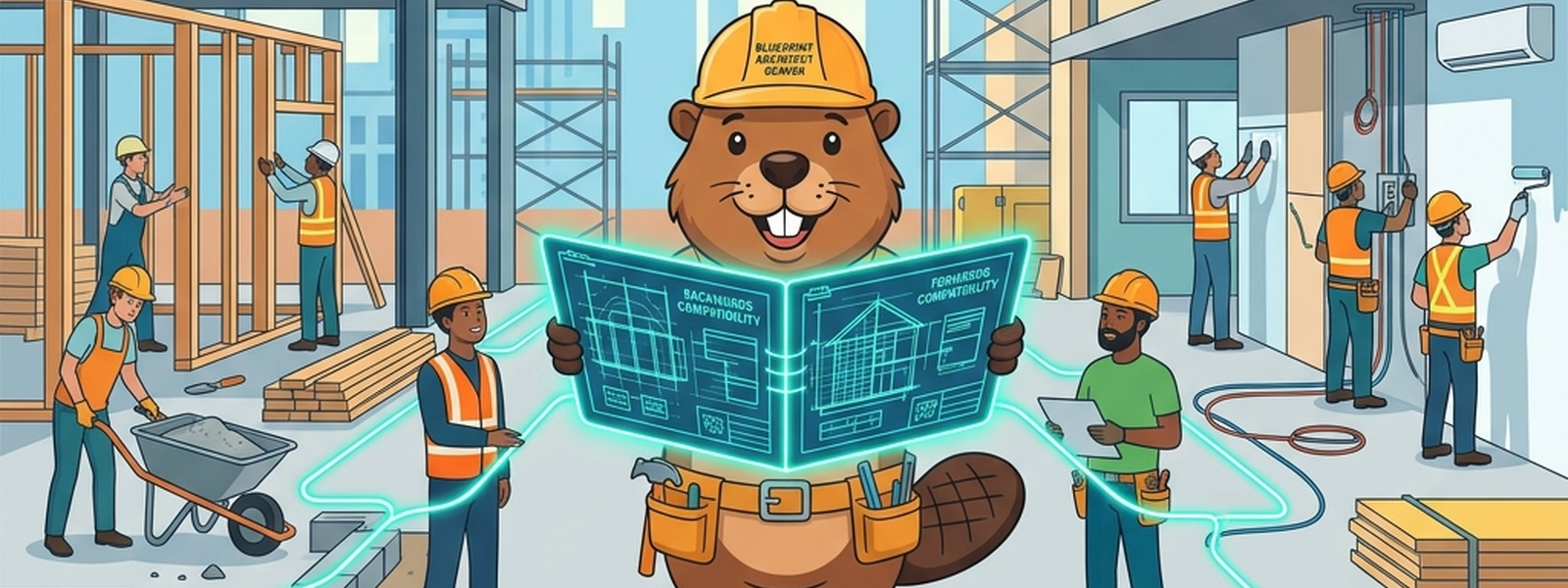
Opening Scene
During a genuinely careful renovation, there’s often a stretch of time when the old crew’s original drawings and the new crew’s updated drawings both have to describe the same building correctly at once — because tenants haven’t fully moved out, old systems haven’t been fully decommissioned, and both the old and new floor plans need to make sense simultaneously for the building to keep functioning through the transition.
Backward and forward compatibility describe this exact same overlapping requirement for a schema.
In Plain English
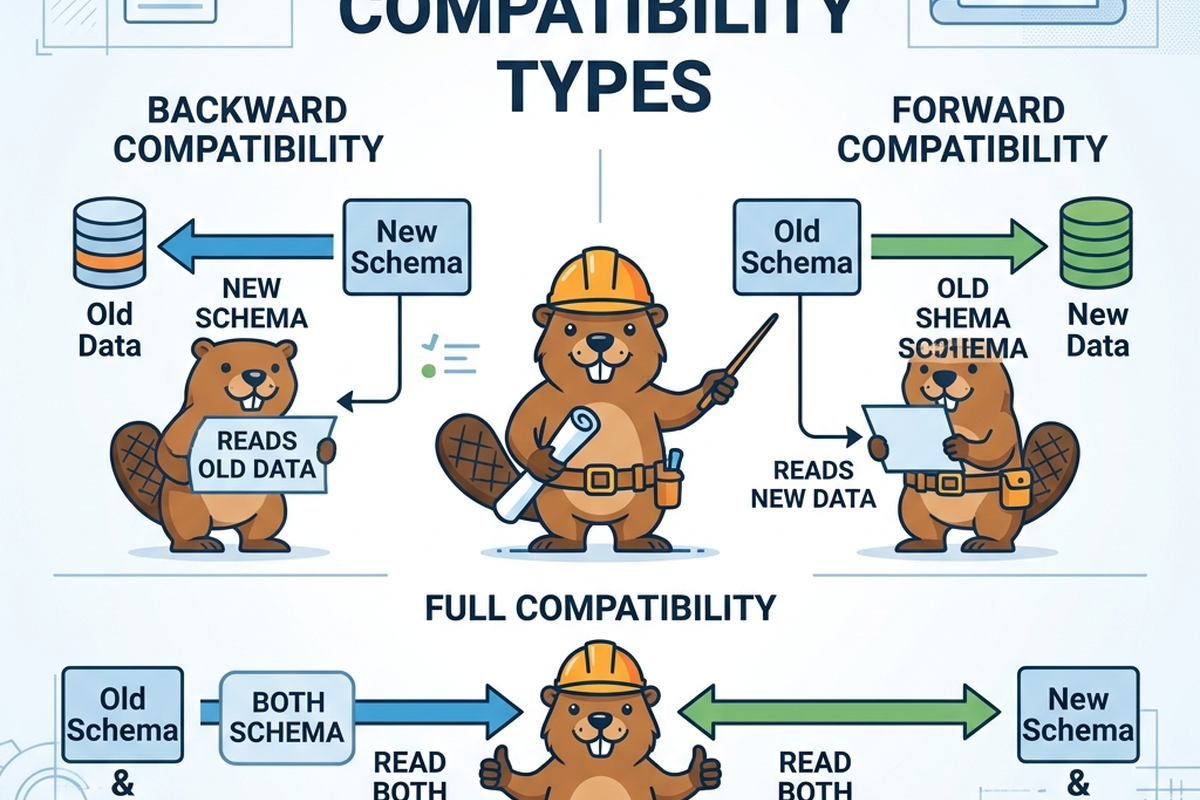
Backward compatibility means a new schema version can still be correctly read by consumers built against an older version. Forward compatibility means an older schema version can still be correctly read by consumers built against a newer version. Both properties matter during any real migration, because a rollout is rarely instantaneous — old and new consumers, and old and new schema versions, coexist for a real stretch of time.
The Old Way
Before compatibility was treated as a property to deliberately design for, migrations often assumed a cleaner, instantaneous cutover that didn’t actually reflect reality:
- Teams sometimes assumed every consumer would update in lockstep with a schema change, similar to assuming every tenant in a building moves out on the exact same day a renovation crew arrives, an assumption reality rarely honored.
- Without explicit backward or forward compatibility, a schema change could break old consumers immediately upon deployment, even if a “grace period” was informally intended, because nothing actually enforced that grace period’s compatibility.
- Coordinating a truly simultaneous cutover across many independent consumers was often impractical, leading teams to either delay changes indefinitely or accept real breakage during the transition.
This assumption of a clean, instantaneous cutover is precisely what deliberate compatibility design was built to replace.
What’s Changing (and Why AI Is the Reason)
- AI-assisted compatibility testing can now simulate old consumers reading new schema versions, and new consumers reading old schema versions, automatically verifying both backward and forward compatibility before a change ships, rather than discovering incompatibility only after real consumers break in production. This directly builds on the version tracking established in Article 13, using it as the basis for concrete, automated compatibility verification.
- Schema evolution rules — like “always provide a default for new fields” and “never remove a field without a deprecation period” — can now be automatically enforced by AI-assisted schema registries, making backward and forward compatibility a systematically checked property rather than a matter of individual developer discipline. This turns compatibility from a hoped-for outcome into a genuinely enforced guarantee.
- AI-assisted rollout coordination can help identify which consumers are still running an older schema version during a phased migration, letting a team track real-world compatibility risk as it decreases over the course of a rollout, rather than migrating blind. This closes a genuine visibility gap in coordinating a real, multi-consumer transition.
The Metaphor, Fully Extended
| Building Element | Compatibility Concept |
|---|---|
| Old drawings still correctly describing the building for tenants who haven’t moved yet | Backward compatibility, old consumers correctly reading a new schema |
| New drawings still correctly describing the building for the incoming renovation crew | Forward compatibility, new consumers correctly reading an old schema |
| Assuming every tenant moves out on the exact same day | Assuming every consumer updates in perfect lockstep with a schema change |
| A dry run confirming both old and new drawings genuinely describe the same building correctly | AI-assisted compatibility testing simulating old and new consumers against both schema versions |
| A building manager tracking which tenants have moved to the new wing and which haven’t yet | AI-assisted rollout coordination tracking which consumers are still on an older schema version |
For Beginners: What to Actually Do
- Never assume a schema change deploys and takes effect for every consumer simultaneously — real rollouts happen gradually.
- Learn to distinguish backward compatibility (new schema, old consumer) from forward compatibility (old schema, new consumer) — they’re genuinely different properties.
- Use AI-assisted compatibility testing to verify both directions before shipping a schema change, not just the direction you happen to be thinking about.
- Notice that this article directly depends on the versioning foundation established in Article 13.
For Practitioners and Leaders: The Deeper Layer
- Design schema changes for genuine backward and forward compatibility as a default expectation, not an afterthought considered only when a migration goes wrong.
- Use AI-assisted schema registries to automatically enforce compatibility rules, rather than relying on individual developer discipline.
- Use AI-assisted rollout coordination to track real compatibility risk as a phased migration progresses, rather than migrating blind.
- Recognize that a truly instantaneous, lockstep cutover across many independent consumers is rarely realistic — plan for genuine coexistence instead.
Quick Recap
- Backward compatibility lets old consumers correctly read a new schema; forward compatibility lets new consumers correctly read an old schema — both matter during a real migration.
- This directly parallels old and new renovation drawings both needing to correctly describe the same building during a phased transition.
- AI-assisted compatibility testing and schema registry enforcement can now verify and guarantee both directions automatically.
- AI-assisted rollout coordination gives teams real visibility into compatibility risk as a phased migration actually progresses.
Where This Fits in the Series
Article 13 covered schema versioning itself. This article covered two crews reading the same blueprint during a phased transition. Article 15 looks at the permit office — schema change review and governance.
Subscribe to the Newsletter
Get the latest DataParables articles delivered straight to your inbox.